
Case Overview
On January 14th, 2015, at 2:20 a.m., Marcus Ryan Cullars-Golden was shot and killed by St. Paul police officers Jeremy Doverspike and Dan Peck. Doverspike and Peck self-responded to a service call for harassment from an unnamed 911 caller who reported Marcus was texting death threats to him. SPPD has failed to provide any evidence of these alleged text messages.
This original 911 call for service turned into a deadly incident due to the failure of the responding officers, Officers Peck and Doverspike, to respond appropriately and not de-escalate the situation.
When a 911 call comes in, dispatch’s job is to accurately compile all the information, relay it to the police and send squad cars. The police officer’s job in a harassment call is to assess and investigate both sides of the situation. That is the reason that dispatch sent two training squad cars, Squad 221T and Squad 223T, to the call about Marcus. One squad car would talk to the 911 caller and the other squad car would talk to Marcus. Doverspike and Peck chose to escalate the situation by arriving without first notifying dispatch. By rushing in and not waiting on the dispatched squad cars, 221T and 223T, Doverspike and Peck placed themselves and Marcus in a dangerous but avoidable situation. Doverspike and Peck only had the narrative that was told to dispatch by the 911 caller and announced on the radio. The threats had not been investigated and no one had actually viewed the phone for any alleged threats at the time of contact with Marcus. Notably, the 911 caller was safely locked in the apartment building throughout the 911 phone call and the officer’s arrival. Therefore, Marcus Golden did not pose an immediate threat to the 911 caller, Ofc. Jeremy Doverspike, or Ofc. Dan Peck.
Doverspike and Peck could have prevented the death of Marcus Golden by following SPPD policies and basic training and firearm rules. Instead, they chose to violate them. First, they did not follow SPPD policies on notifying dispatch that they were going to the call. Secondly, they did not signal their arrival with lights or sirens. Third, the officers did not wait for backup and the assigned squads to arrive. Fourth, they did not follow basic investigation procedures for determining if a crime was even committed or preserving evidence of a crime. Fifth, they could’ve let Marcus simply drive away. Instead, they pursued him on foot. Lastly, the officers also fired at a moving vehicle from approximately 80 feet away. In doing so, they fired toward an apartment building and towards their fellow officers who were entering the parking lot from the east.
Marcus was parked in the far west corner of a narrow and steep apartment parking lot. The driveway to the lot has only one way in and out and is very long and curved. Jeremy Doverspike and Dan Peck arrived in a squad car without lights or a siren on, knowing that in-car cameras would not be activated unless their overhead lights were switched on. According to the surveillance camera from the apartment building lobby, the officers pulled into the lot at 2:19:24am. Forty-six seconds later, the surveillance camera captures Marcus’s car, a green GMC Jimmy, driving in the opposite direction, towards the parking lot exit. It is this Reinvestigation Team’s belief that it is at approximately this moment that Officers Doverspike and Peck shot Marcus from approximately 80 feet away. We are unable to confirm this statement because SPPD failed to conduct ballistics testing. Another twelve seconds later, the officers aired over the radio that shots were fired.
The crime scene photos will show how the snow helped preserve the facts of this case. You will see how the officer’s narrative describes how Marcus drove straight at them but this was not the reality. You will see how the officers’ own footprints tell the truth about their actions in Marcus’s death. You will hear in the SPPD press conference that the male 911 caller is suddenly portrayed as a female. This is to paint the situation as a domestic call and twist the facts to make the case more reasonable that the officers killed Marcus as he was driving away. Shooting him once in the left arm as he tried to steer and once in the back of the head. From these tracks it is obvious Marcus tried to avoid the officers, placing his own life in danger by driving near a steep ditch. Marcus even hit a fire hydrant trying to get as far away as possible from Officer Doverspike. Officer Doverspike’s footprints show he was in the way of the only escape route Marcus had to leave safely . The Officers had no proof of the alleged threats. The 911 caller had not shown anyone his text messages this was all hearsay at this point. Officer Doverspike and Officer Peck were also aware that there was one way into the apartment parking lot and there were other officers on the way. Officer Doverspike had already called in the license plate. We have to ask, what threat, at that moment, did Marcus pose? What was the reason to fire any shots at a leaving Marcus toward an apartment building full of people?
No charges were brought against the officers in the aftermath of this incident. Marcus Golden’s family, loved ones, and community deserve a complete explanation of this incident and the mistakes made by authorities throughout.
The events that unfolded after Doverspike and Peck arrived at the scene will be described thoroughly in this report. Our investigation shows that Marcus Golden died due to:
- The failure of SPPD Officers Doverspike and Peck to follow SPPD policy on: notifying dispatch of call response; activation of squad lights, sirens, and camera when making a stop; determining whether a crime has been committed.
- The failure of Officers Doverspike and Peck to follow SPPD policy and proper law enforcement training at shooting at a moving vehicle.
- The violation of the rules of justifiable use of deadly force by Officers Doverspike and Peck for shooting at a subject who was not an immediate threat to themselves or others at the time of the shooting.
- A failure of SPPD and all investigators for releasing inaccurate information to the media, therefore compromising the integrity of the investigation and Marcus’ fourth amendment rights.
Additionally, we assert that several actors, including the Washington County Attorney, the Ramsey County Attorney, and the SPPD failed to demonstrate appropriate accountability and investigate the incident thoroughly to get the truth of what happened.
This report provides a thorough review of this incident, showing that this police killing should not have occurred and demonstrating the need for an official independent review of the case. The report includes conclusions and recommendations to prevent further needless deaths at the hands of SPPD officers.
Definitions
CAD (Computer-aided dispatch) – Computer-aided dispatch is a dispatch system used to coordinate emergency services.
ICC (In-car camera) – The cameras installed in police squad cars.
FTO (Field Training Officer) – A training officer assigned to supervise new recruit officers during the months-long probationary period.
Tango Car – Squad cars whose number ends in “T”, such as 221T, are called tango cars or training cars. Officers in these cars typically include a field training officer and field officer trainee.
Incident Chronology
Beginning of the Incident
Marcus Golden was talking to his close friend X when he left his home on Tuesday night, January 13th around 10:30pm. Marcus was going to return some of his ex-girlfriend’s belongings. Marcus and X discussed that Marcus could come up and stay with him later that night. Marcus told X that he would talk to him again when he got home and then ended the call. Hours later, when X didn’t hear from Marcus, he tried calling him again. X got no answer. That earlier phone call was the last time X would speak with his best friend.
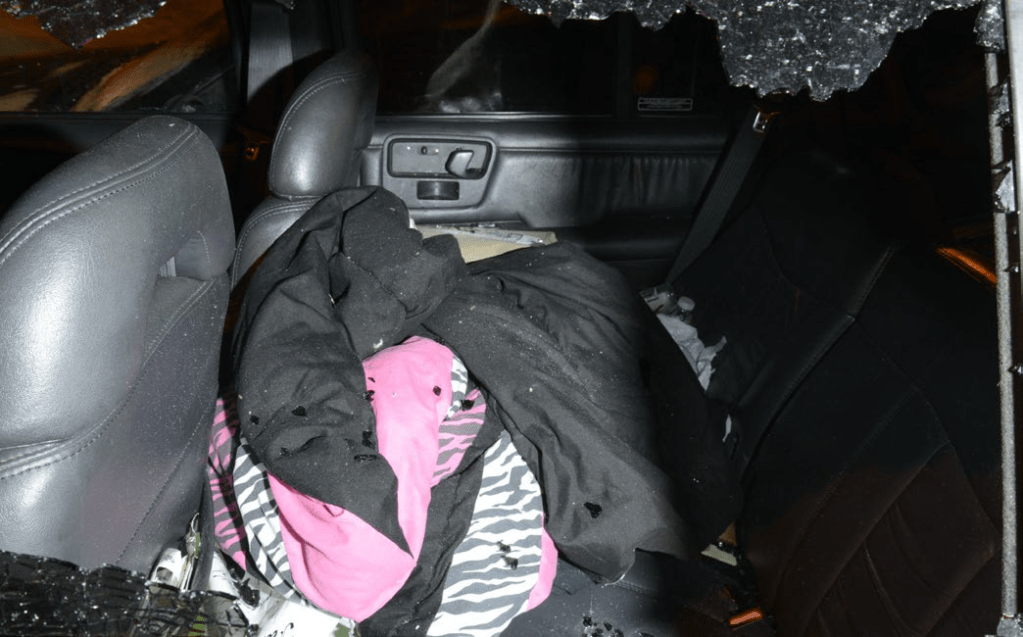
Later that night, Marcus ended up at an apartment complex at 261 University Avenue in St. Paul, MN. The apartment complex was the home of Marcus’ ex-girlfriend’s ex-boyfriend, J. The ex-girlfriend, E.E., told investigators that she stayed at J’s apartment part-time during the week as well (p. 144, part 1). Marcus had a very contentious relationship with E.E. for the past four months. During the last few months of his life, Marcus was in some questionable situations with E.E. and her family. Only Marcus and E.E. knew the entirety of those situations. At the time of Marcus’ death, they were together six days before and Marcus had been attempting to return some of E.E.’s things to her. See the photo below of what looks to be E.E.’s things in Marcus’ car.
Marcus Golden was talking to his close friend X when he left his home on Tuesday night, January 13th around 10:30pm. Marcus was going to return some of his ex-girlfriend’s belongings. Marcus and X discussed that Marcus could come up and stay with him later that night. Marcus told X that he would talk to him again when he got home and then ended the call. Hours later, when X didn’t hear from Marcus, he tried calling him again. X got no answer. That earlier phone call was the last time X would speak with his best friend.
Later that night, Marcus ended up at an apartment complex at 261 University Avenue in St. Paul, MN. The apartment complex was the home of Marcus’ ex-girlfriend’s ex-boyfriend, J. The ex-girlfriend, E.E., told investigators that she stayed at J’s apartment part-time during the week as well (p. 144, part 1). Marcus had a very contentious relationship with E.E. for the past four months. During the last few months of his life, Marcus was in some questionable situations with E.E. and her family. Only Marcus and E.E. knew the entirety of those situations. At the time of Marcus’ death, they were together six days before and Marcus had been attempting to return some of E.E.’s things to her. See the photo below of what looks to be E.E.’s things in Marcus’ car.
Marcus, E.E., and J. were allegedly texting questionable messages to each other through an app called Glide. The alleged messages have since been deleted. Glide is a live messaging application where you can send short video clips to a person or group. Glide offers its users the ability to block unwanted messages or groups. Marcus, E.E., and J. did not make the choice to do that. All three continued to engage in messaging each other. Based on that fact, it seems there was a lot more going on between them than the narrative the police presented, which will be described below.
The 911 complainant, J, called 911 on January 14th, 2015, at 2:14 am claiming Marcus was driving in and out of his parking lot. J. told dispatch he just wanted Marcus to leave. He told them that Marcus somehow found out where he lived and was threatening him through a texting application. As you will read in the 911 call, J. claims he did not know Marcus. Yet, J. informed dispatch he knew Marcus carried a gun on him and him “always has a gun.” J. guessed where the gun was kept after dispatch prodded him with questions about it. J. claimed Marcus sent messages to him for hours and told Marcus he would call the police on him over 50 times, but J. never tried to disengage and block him. As will be discussed later, the family disputes the contents of the 911 call that was included in the data we received from SPPD. These concerns raise questions about the quality and truthfulness of the SPPD investigation. However, to complete this report with the information we do have, we will use the 911 call given by SPPD which is attached below as Appendix K. Next, we will describe the officers’ dispatch and arrival to the scene that followed J’s 911 call.
Officer Dispatched to the Scene
Timeline
| Time* | Description |
| 2:14am | Two squads were dispatched to the harassment complaint call, 223T (Officers Rutschow and Htoo) and 221T (Officers Banick and Lee)(p. 38). Both squads were Tango cars, meaning one officer in each squad was in training. Both squads acknowledge the call. As this was aired over their radio, squad 215 (Officers Peck and Doverspike) chose to go to the call without telling dispatch. |
| 2:18am | Squad 223T requests the last name of the suspect from the dispatcher. The dispatcher advises that there was a previous call from this phone number and the suspect is believed to be Marcus Golden (p. 38, part 1). The previous call they are referring to was a call that J. had made anonymously on November 9th, 2014, on Marcus Golden after an altercation with E.E.. Officer Doverspike was one of the responding officers to this call (p. 200, part 2). While en route to the call, Officer Htoo aired over the computer-Aided Dispatch system (CAD) that Marcus had threatened to kill officers in the past. He said, “GOLDEN has been known to be a violent person and has made threats against St. Paul Police Officers that he would kill them.” |
| 2:19am | Squad 211T (Sandell and Karst-Adams) requests that dispatch also send them to the call. |
| 2:19:24am (Apt. Video) | Squad 215 (Doverspike and Peck) rolls into the frame on the apartment video. |
| 2:20:10am (Apt. Video) | We know at 2:20:10 the GMC Jimmy drives down the driveway and crashes according to the apartment security video. (12 seconds later the officers’ air shots fired.) |
| 2:20:14??? | The officers broadcast their arrival on the scene and aired the GMC Jimmy’s license plate over the radio. Based on the radio traffic audio, this was 8 seconds before shots fired came over the radio. |
| 2:20:22am | The officers Doverspike and Peck squad 215 would broadcast “shots fired” over the radio 8 seconds after Ofc. Doverspike radios in the license plate, according to the radio traffic audio. (58 seconds from the officers’ arrival to the broadcasting of shots fired.) *The times from the apartment video and the radio traffic may be different due to different operating systems. |
| Time Sent to the Call | Squad Number | Officer Names |
| 2:14am | 223T | Officers Rutschow and Htoo |
| 2:14am | 221T | Officers Banick and Lee |
| 2:19am* * Officers request to be sent | 223T | Officers Sandell and Karst-Adams |
| 2:19am** ** Officers arrive without advising dispatch | 215 | Officers Doverspike and Peck |
Officer Arrival to the Scene
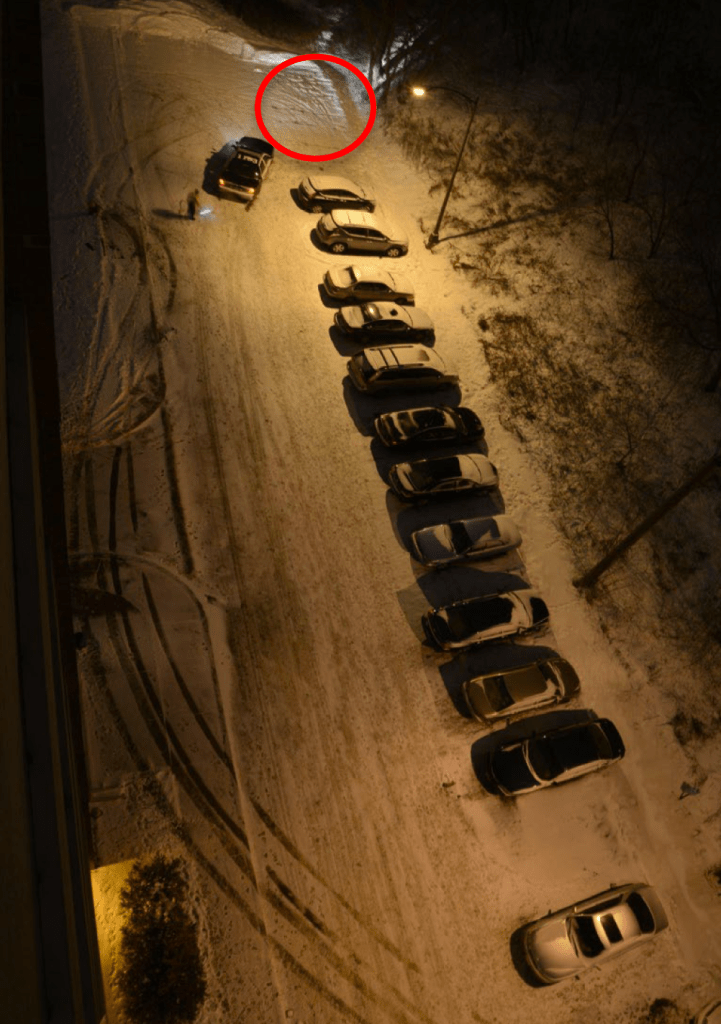
The radio transmissions show that when Officers Peck and Doverspike arrived on scene, they knew they were looking for Marcus Golden. They drove and proceeded towards Marcus’ car at the end of the lot. At this point, they knew Marcus’ name, physical description, and a description of the car he was driving. The officers were also aware because of this transmission that Marcus had allegedly threatened SPPD officers’ lives previously.
Marcus was parked in the far, dark corner of the parking lot and there were no red and blue flashing lights to indicate there was an approaching squad car. It is possible that because there were no emergency lights activated, Marcus may not have even known that the approaching car was a police squad car. Because the officers failed to turn on their squad overhead lights as they approached, the squad’s in-car camera system was not activated and there is no SPPD footage of the incident. This is a violation of Minnesota state law, statute 169.17, as well as SPPD policy SPPD policy 625.00 as shown in the table below.
| MN Statute 169.17 | SPPD policy 625.00 |
| Law enforcement vehicles should sound a siren and display at least one red light in the front of the vehicle when in use. In addition, law enforcement vehicles may use flashing blue lights in the back of the vehicle and/or mounted on the passenger side as ordered by Minnesota statute 169.64 subd. 4(b). The flashing police lights must be seen by other drivers from no less than 500 feet away under normal night conditions according to 169.59. | The officer should signal the violator to stop. This signal should be with the red emergency lights, hand signals, sounding the horn, and if necessary, the siren. These signals also alert other drivers of the intent of the officer and will usually facilitate securing the right of way for the stopping maneuver. |
Officer Doverspike drove while Officer Peck was in the passenger seat. They drove towards the green GMC Jimmy in the lot and parked their squad car at a 45-degree angle adjacent to Marcus’ car.
The concerns this investigation team has are the following:
- The officers never announced to dispatch that they were responding to the call.
- The officers, instead of waiting for the other three dispatched squad cars to arrive, proceeded towards Marcus’ car.
- Prior to approaching Marcus’ vehicle, the officers did not speak or attempt to speak with the 911 caller, who was still inside the apartment building.
After exiting the car, Officer Peck claims that while he was issuing commands, Marcus shifted his vehicle into gear and drove forward. As Marcus pulled out of the parking space, Doverspike, despite knowing the license plate number, description of the vehicle, name, and description of the driver, pursued Marcus on foot. According to the crime scene photos taken in the early morning of the shooting Marcus drove in a wide arc around Officer Doverspike and his vehicle, and even drove up onto the sidewalk to avoid Officer Doverspike. The sidewalk Marcus drove onto is on the edge of a very steep drop. Marcus would’ve easily rolled his GMC Jimmy if he drove too close to the edge. Marcus drove up and around Officer Doverspike while he also crouched down behind his dashboard, driving to avoid being shot at by the officers. These actions put Marcus at a much greater risk of crashing. According to this evidence, Marcus was just trying to safely escape from the officers.
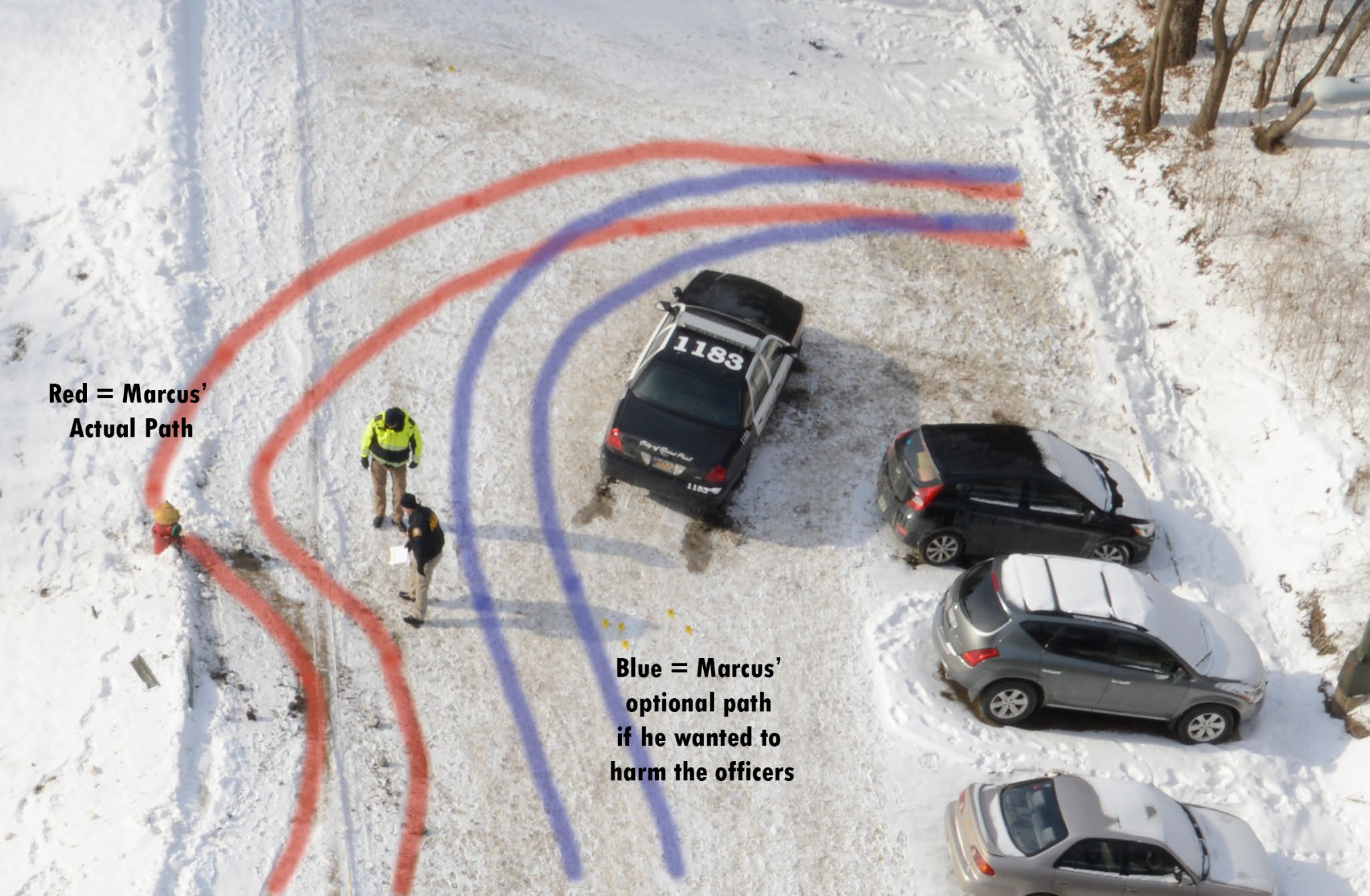
Photo C. An aerial view of the parking lot shows in red the path that Marcus drove while exiting the lot versus the path, in blue, he could have taken if he had tried to hit the officers with his vehicle.
Officer Peck clearly had different instincts in his training than Officer Doverspike and instead ran back to the squad car after Marcus began to drive away. The Reinvestigation Team wants to point out the lack of plausibility Officer Peck’s statements would have had in those moments.
- As he ran to his squad car, Officer Peck would have been unable to see where his partner, Officer Doverspike, or Marcus were. This would have, therefore, rendered any of his statements about this moment irrelevant. Officer Peck then realized his partner was not getting in the squad car to give chase to Marcus’s car.
According to the footprints in the snow, Officer Doverspike appeared to be running alongside Marcus’ car.
- Officer Peck acknowledges in his statement that he saw his partner, who had been running after Marcus’ car, slip and fall.
- Officer Peck also describes that he saw broken glass a ways down from the fire hydrant, breaking in front of Officer Doverspike.
The problem with these two statements from Officer Peck is that the area where Officer Doverspike slipped and fell is not next to or close to the broken glass. Directly in front of where this investigation believes Officer Peck was shooting, there are impressions in the snow of what appears to be Officer Doverspike falling. Officer Doverspike claims to have no memory of this fall, but he does admit he had snow on his pants.
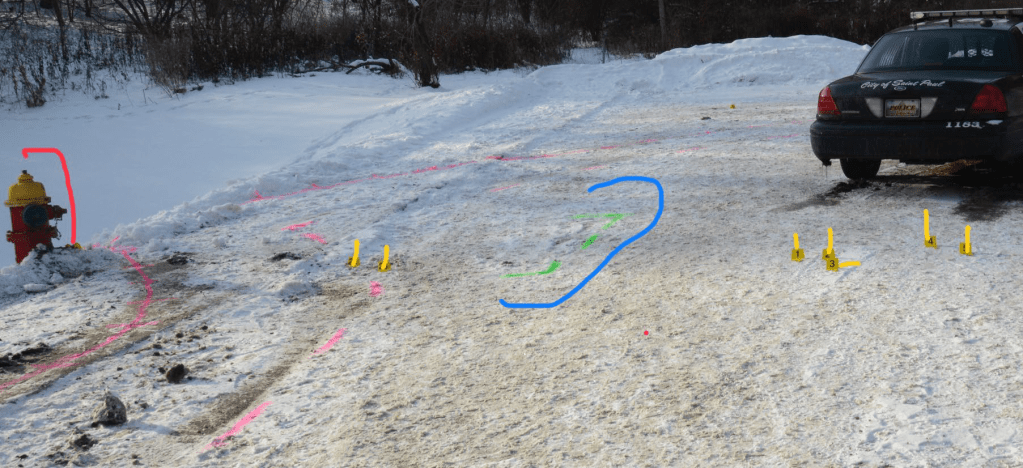
Photo D. The above photo shows the distance between the fire hydrant (in red), the groupings of cartridge casings fired by Officers Doverspike and Peck (yellow), the location where Officer Doverspike slipped and fell (in blue) and squad car 1183. The broken glass Officer Peck claims to see BREAK in front of his partner is further down the lot.
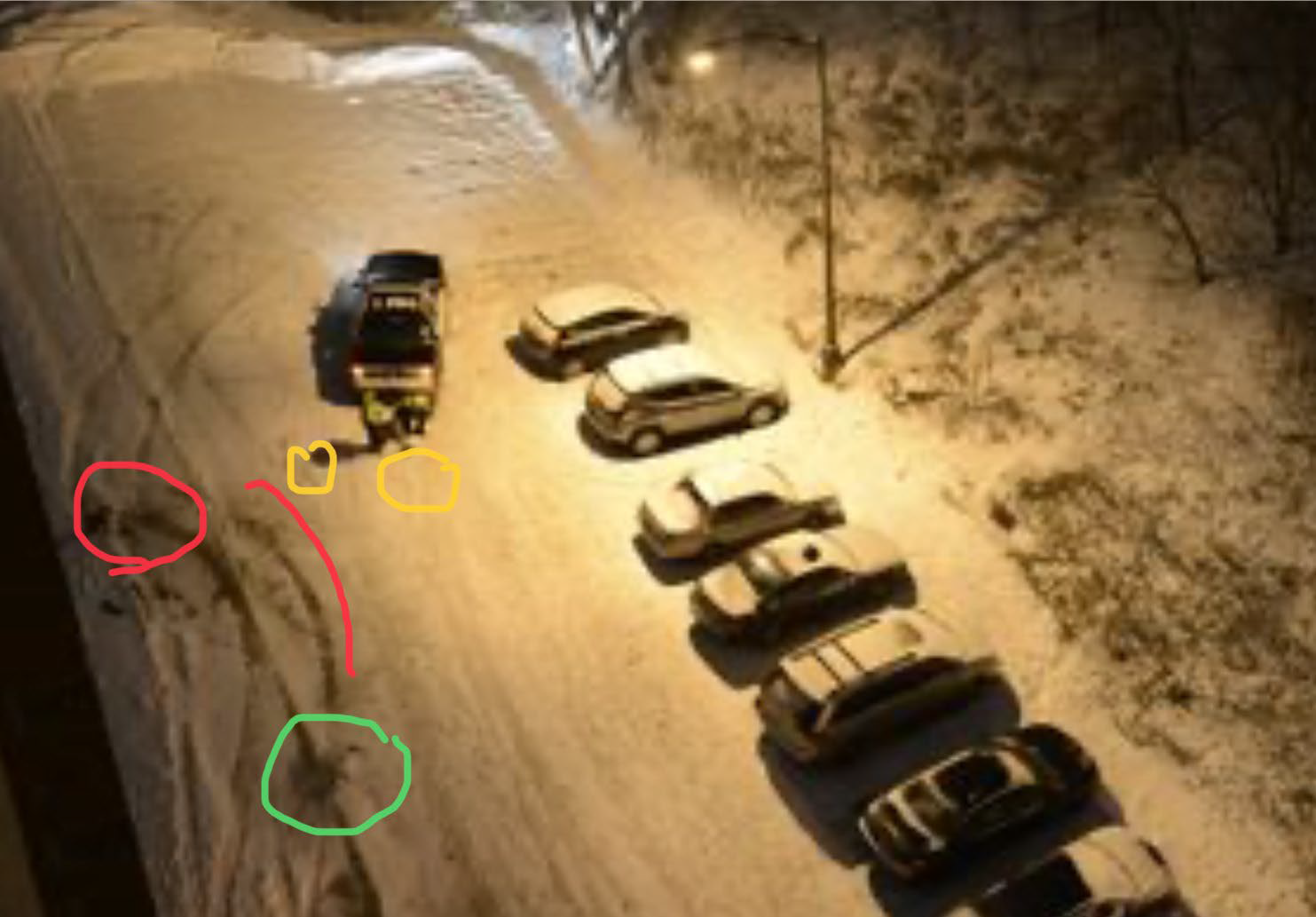
Photo E. An aerial photo shows the distance between the fire hydrant, in red, and the broken glass, in green. The yellow circles highlight the collections of cartridge casings from both officers. Officer Peck’s five casings landed behind squad 1183. As you can see from the above photo, Officer Doverspike fell beside the yellow circles.
We know at 2:20:10 the GMC Jimmy drives down the driveway and crashes according to the security video.
At 2:20:22, the officers broadcast over the radio that shots were fired.
Officer Peck shoots at Marcus’ car claiming that he began shooting because he heard a shot coming from Marcus Golden’s Jimmy. An analysis of Marcus’ hands showed he never shot a gun. Officer Peck and Officer Doverspike continued firing at a departing Marcus. At that point, both officers were well behind Marcus. There was no immediate danger to these officers’ lives, despite their claims.
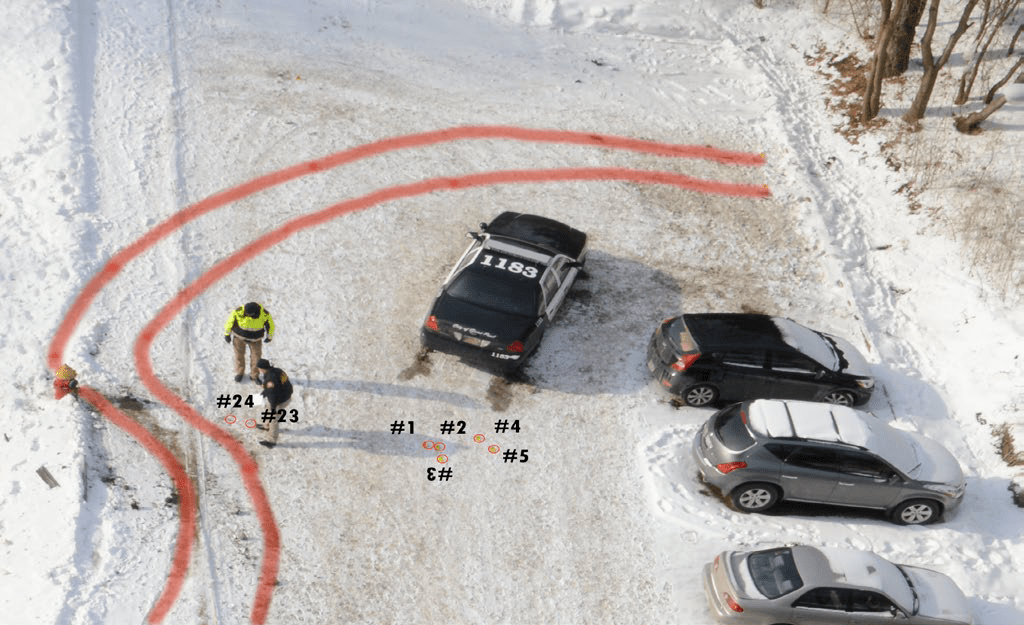
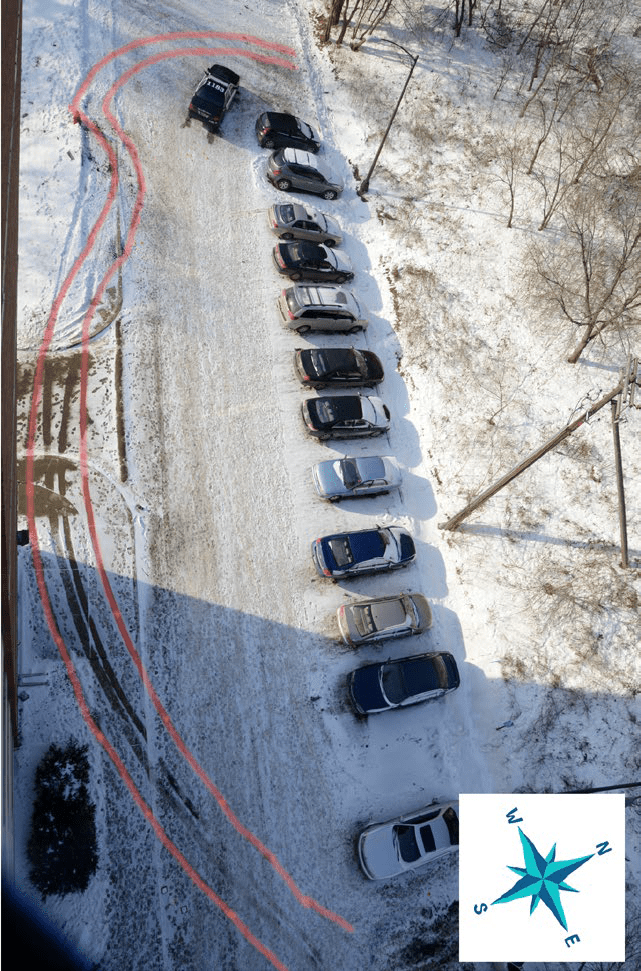
Photo G shows the tire tracks of the approaching squad 211T, driven by Officer Karst Adams and Officer Sandell, who were slamming on their brakes. The tire tracks in the bottom of the photo show where they came to a quick stop.

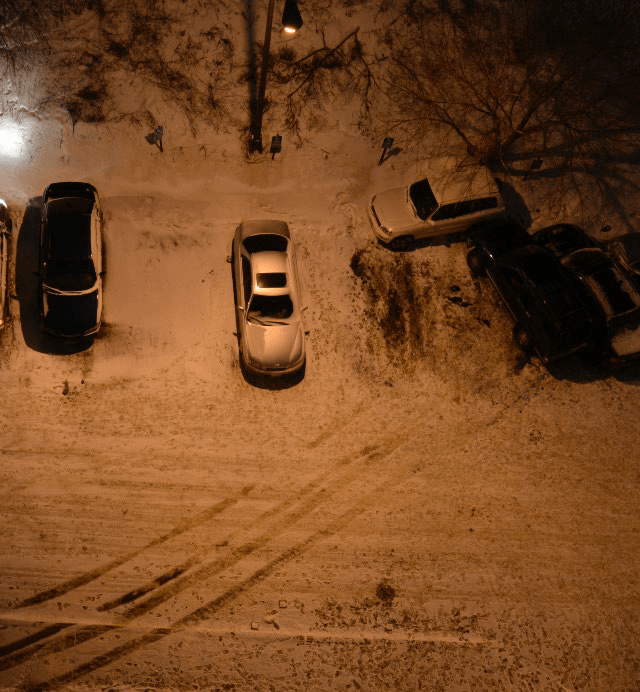
Photo H is an aerial photo of the parking lot and shows Marcus’ tire tracks after he made his last correction of the car. As the car drove off of the sidewalk and left into the lot, the tire tracks went from dark to light impressions in the snow, indicating that Marcus was no longer pressing on the accelerator. It also tells us that Marcus never tried to brake before he crashed into the line of cars on the east side of the parking lot.
From the analysis of the tire tracks, footsteps, casings, autopsy, and bullet holes, this investigation approximates that for the time that the officers were firing at Marcus, he was at least 80ft away from them, a range where the officers were safe from being hit by the Jimmy. We can see that Marcus completed this last correction of his car and looked at squad 211T that was coming towards him. According to the camera footage from the apartment building, we know that at 2:20:10, the GMC Jimmy drives down the driveway and crashes. At this point, Marcus was driving away from the officers, and their shell casings were pooled around the fire hydrant and their squad car. According to the CAD notes, shots were fired at 2:20:22.
From the tire tracks of the Jimmy, we know that Marcus stopped accelerating or braking after making the last turn. According to the autopsy, Marcus was shot in the left back of his head with it exiting his right eye, and the blood and matter indicate he was looking out the right-hand passenger window. This is the exact location where we believe Marcus was shot by Dan Peck or Jeremy Doverspike. Looking at where the blood splatter is located in Marcus’s car, we know Marcus’s head was turned towards the passenger seat and door looking down the hill, in the direction of the advancing secondary squad. The secondary squad slammed on its brakes and slid on the fresh snow to avoid crashing into the turning Jimmy. It is this investigation team’s belief that Officer Peck or Doverspike actually put their approaching officers in fear and in danger by shooting in their direction.
Again, as Marcus made the last turn, other officers arrived on scene, including but not limited to Officers Sandell and Karst-Adams. The officers secured the vehicle and rendered aid. Marcus was dragged out of the Jimmy by his feet and placed on the snow. They handcuffed him and assessed his injuries. He had been shot in the back of his left arm and on the back left side of his head. Marcus was struggling to breathe and was turned on his side to relieve his airway. They waited for medical aid to arrive. Marcus was moved to the ambulance and died shortly after. Marcus died across the street from Regions hospital.
Saint Paul Police Narrative
Immediately after Marcus Golden was shot and killed by SPPD, the police department began to investigate themselves and put out information in the media about the circumstances of his death. Marcus Golden’s death was front-page news the next day. Wrapped up in the headlines and articles about Marcus were the beginnings of the police narrative. This isn’t uncommon in police-involved shootings. Deaths at the hands of the police are often played out in the media before the case has been fully and competently investigated. As you will read in appendix C, SPPD spokesperson Paul Paulos held a press conference and began relaying inaccurate information that was printed in local newspapers:
- Paul Paulos incorrectly stated that it was a female 911 caller in the incident.
- Paul Paulos incorrectly stated that Marcus drove at the officers and shots were fired.
Officers had a description of the suspect’s vehicle and found it in the back of the apartment’s parking lot, which Paulos described as a dark and secluded area. They pulled up their squad at an angle, facing the man’s SUV.
The two officers — Jeremy Doverspike, a seven-year St. Paul veteran, and Dan Peck, with just under two years on the force — exited their squad and ordered Golden to get out. He refused and accelerated at Doverspike, almost striking the officer, Paulos said.
“Fearing for their lives,” both officers opened fire, Paulos said, and the SUV crashed into three cars parked in the lot before coming to a stop. Golden, of St. Paul, was declared dead at the scene.
“By the time they pulled up, located the suspect vehicle … to the point of getting out and being confronted, shots fired, it took seconds,” Paulos said.
A loaded handgun was found “within immediate reach” of Golden, Paulos said, adding that whether the gun had been fired remained under investigation.
This paints an inaccurate narrative about the events that lead to Marcus’ death, the facts are as follows:
- It was a male 911 caller.
- The GMC Jimmy tire tracks show Marcus drove up on the sidewalk to go around the officers.
- The only shots fired were from Officer Doverspike and Officer Peck.
- It also depicts Marcus’s involvement in a domestic confrontation with his ex-girlfriend at the time of his death.
- The handgun was found in the car two hours and 54 minutes after a search warrant was issued for Marcus’s grandparents’ home and Marcus’ car.
The police narrative offers false justification for shooting Marcus. It is the false justification Doverspike, and Peck hides behind in claiming Marcus’ vehicle came dangerously close to hitting Doverspike and his gun. It is also the false narrative Peck uses to justify shooting at Marcus. After falsely stating Marcus drove at his partner while also attempting to suck him under the rear of his car, it is this false justification that Peck uses when claiming he was sure Marcus shot at his partner. As stated earlier, Officer Peck’s statement of those events is implausible because he was not looking at his partner or Marcus. Officer Peck ran to the passenger side door and only then realized his partner was not getting into the car.
These false justifications and narratives impact the public’s perception of Marcus as well as the officers before the investigation is finished and the case goes to court, otherwise known as trial by the media. For example, read the following excerpt from an article written by the Star Tribune on February 8th, 2015. See below:
“Many details surrounding last month’s killing of Marcus Golden have yet to be released. What St. Paul police have said, however, is this: In the early morning darkness of Jan. 14, two officers drove to a high-rise apartment building on the 200 block of University Avenue on a call about a man who was known to carry a gun, and who was texting death threats to a former girlfriend. They found Golden, 24, sitting in his SUV behind the building. The officers began talking with him, then ordered him to step out of the vehicle and shut off the engine. He refused, then hit the gas. As he sped toward one of the officers, they opened fire, killing him. Police later said they found a loaded handgun within Golden’s reach.”
Despite this narrative, the facts of this case are as follows:
- Marcus’ full name went out on air before the officers arrived.
- Officers had been involved previously with Marcus
- Officers knew Marcus recently had interactions with the SPPD.
- A gun was never involved in any of his recent incidents.
- It was a male 911 caller.
- Marcus, still driving, leaned, and crouched over the passenger seat to avoid gunfire from the police. He drove around Officer Doverspike.
- Marcus went up on the sidewalk. This put Marcus in more danger as the sidewalk had a very steep drop off and he could have easily rolled his SUV.
One of the other players in this narrative is the St. Paul Police Department 911 operators and dispatch center.
911 Call
The situation between Marcus and the two SPPD officers began with a 911 call. The caller, J. stated that Marcus had been sending him death threats for hours and that he just wanted him (Marcus) to leave. For the full 911 call, read the transcript provided in Appendix K below.
The Role of Dispatch
The importance of Dispatch in any 911 call cannot be overstated. Dispatchers are responsible for collecting all relevant information from the caller in a concise and compassionate way and then transmitting it in its entirety to the responding officers.
The 911 dispatcher who spoke to J. did not ask many questions that elicited detail about the nature of the call. They asked for descriptive information about Marcus, his vehicle, and where J. would meet the officers. Yet, the 911 dispatcher did not ask J. further questions about his relationship with Marcus. The dispatcher also did not ask J. about the specifics of the texts he was receiving or ask him to read the texts verbatim. Rather, the dispatcher pushed J. to answer questions he did not actually know to be factual about whether or not Marcus owned a gun. J. repeatedly said that he didn’t know where Marcus would keep his gun, just that he somehow knew he carried one. The dispatcher, however, asked J. three times where Marcus would have the gun ignoring this is not factual information. In addition, the dispatcher failed to confirm the fact that not only was the gun not seen that night, but it was not used in a threatening manner. The dispatcher then relayed the information about the gun to the police officers in a confusing way, saying Marcus was “known to carry a gun.” This is a vital piece of information because whether or not Marcus showed a gun to J. would dictate Officer Doverspike and Peck’s response and level of alertness which, in turn, would have played an important part in Marcus’s death.
If at this point, we are speculating that Marcus had access to a gun, then it is fair to say anyone can have access to a gun at any time. Minnesota is a carry state. Furthermore, we have to also look at this situation with Dispatch and ask if they had relayed the information accurately, would it have made a difference for Marcus that day? Maybe the concentration would have been on a harassment investigation and the situation would not have escalated. The role of the officers was to investigate and find out more information about the alleged threatening texts when they arrived on scene. Dispatch’s inability to provide accurate information about the gun and the texts escalated the situation and helped contribute to the death of Marcus Golden that day.
Officer Interviews
Nothing can be more important than the officers’ statements to any investigation. The SPPD’s entire investigation seems to be set around the officers’ statement of facts, rather than presenting the facts and letting that present the truthful narrative. CUAPB’s Reinvestigation Team carefully reviewed every officer statement and listened to any audio of the interviews. We then compared the statements between the officers to try to put together a timeline of events. Unlike SPPD, our Reinvestigation Team pulled out the inconsistencies to try to figure out the actual events rather than just the officers’ perspective of the events.
What Officers Knew When They Exited the Squad Car
- Suspect was named Marcus Golden.
- Marcus was driving a green GMC Jimmy.
- Description of Marcus as a light-skinned black male with a hat and full beard
- Marcus was at the apartment at least 5 minutes prior to the 911 call according to caller [Doverspike transcript 88]
- The 911 caller’s phone number but did not give his name.
- The 911 caller was safely in a locked apartment complex.
- Marcus allegedly sent threatening messages to the 911 caller [Doverspike transcript 88]
- Marcus’ alleged reputation to carry firearms according to the 911 caller. [Doverspike transcript 88, Peck 66]
- Marcus had allegedly threatened to kill officers in the past.
- Officer Doverspike had been to a call 2 months prior (November 2014) with Marcus Golden.
- Two Tango cars were en route and dispatched.
- The officers had not notified dispatch of their arrival.
Statement of Officer Jeremy Doverspike
Officer Jeremy Doverspike gave a voluntary interview to the SPPD on January 15th, 2015 (p. 157, part 1) Officer Peck had been with SPPD 7 years at that time. Officer Doverspike’s statement is congruent with his partner’s, except for these areas:
- Doverspike says threats were directed to the complainant’s girlfriend.
- Unclear as to whether they had put themselves on the call by the time they arrived on scene.
- Doverspike assumed Marcus would have left before they arrived.
- Doverspike pulled in at an angle relative to the GMC Jimmy, set his spotlight on Marcus, and said he exited the car. The emergency lights were not on, only the spotlight and headlights of the squad car.
- Doverspike airs the plate and their presence on the scene.
- Doverspike raised his pistol as he saw Marcus looking at him, then Marcus dropped down to the passenger side. Then his head popped up just over the dashboard and the car started moving.
- Doverspike described Golden’s head disappearing.
- Officer Doverspike said that Marcus put the car into gear while Peck is telling Marcus to put his hands up and Doverspike finished airing the plates, standing in front of the cop car door (Interview, 15:00); “he reaches his right hand up and puts the car in drive I’m assuming, ’cause I can hear it” (Interview, 8:02). At this point, Doverspike said “I raise my gun up from the low ready to pointing at him” (Interview, 8:02). In contrast to his own statement, Doverspike, later in the interview, said “I don’t know if I repositioned the gun first or if I just shot right away” (Interview, 16:00).
- Doverspike’s statement, he claims that the GMC Jimmy hits his gun, and he fires two rounds.
- Doverspike is not certain what happens next to the vehicle but says, “I don’t know if he slid or was just sliding on the snow or something, but I think it came close to, the rear of his car either hitting the fire hydrant or came really close to hitting it.”
- Doverspike does not remember losing balance and “almost falling backwards” at some point as the GMC Jimmy struck something
- This all happened in 46 seconds.
Statement of Officer Dan Peck
Officer Dan Peck also gave a voluntary interview to the SPPD on January 15th, 2015 (p. 157, part 1) Officer Peck had been with SPPD 2 years at that time. Officer Peck’s statement is congruent with his partner’s, except for these areas:
Inconsistencies with Partner’s Statement
- Peck says threats were directed to the complainant, not the complainant’s girlfriend.
- Unclear as to whether they had put themselves on the call by the time they arrived on scene.
- Peck was looking for a running vehicle on scene, whereas Doverspike assumed it would have left before they arrived.
- Peck agrees when asked if they had “lights on patrolling.”
- Peck details a short argument before Golden placed both hands on the steering wheel, during which Peck drew his sidearm.
- Peck can see Golden’s face as he puts the car in gear, whereas Doverspike described Golden’s head disappearing. Peck corroborates that Golden is hunched down as he starts moving.
- Peck detailed Doverspike losing balance and “almost falling backwards” at some point as the GMC Jimmy struck something.
- Peck describes hearing gunshots and seeing one of the GMC Jimmy’s windows break almost directly in front of Doverspike. He interpreted this as gunfire coming from the GMC Jimmy which caused him to return fire.
- Peck states seeing Doverspike pointing the gun directly at the driver saying, “I was on the passenger side still and I kind of backed up even further to kind of see where Jeremy was and where this vehicle was. And I saw that, that, him in the headlights like so. And with his gun pointed at the, at the, basically the driver.”
Statement of Officers Scott Sandel and Tyrone Karst-Adams
| Basic Info | |
| Officers Scott Sandell and Tyrone Karst-Adams were interviewed by Sergeant Donahue on the day of the incident, January 14th, 2015, at 6:45am and 6:12am, respectively. | |
| Officer Sandell – pg. 199, SPPD Report Part 1 | Officer Karst Adams – pg. 201, SPPD Report 1 |
| These are the statements from the witness officers, Officers Scott Sandell and Tyrone Karst-Adams. In their interviews, they describe their first-hand accounts of Officer Doverspike and Peck’s actions and Marcus Golden’s actions. Officer Scott Sandell was a Field Training Officer operating squad 211T with his trainee, Officer Tyrone Karst-Adams. The Field Training program is the last part of training for recruit police officers. Officer Sandell was sitting in the passenger seat of the squad when they heard a call of a harassment complaint. Dispatch advised them of the following prior to arrival: ● The suspect is the ex-boyfriend of the complainant’s ex-girlfriend. ● Description of his clothing and driving a green GMC Jimmy. ● Complainant also advised the suspect is known to carry guns but did not know if he had one tonight. They arrived, pulled into the front lot, and heard squad 215 (Doverspike and Peck) radio they were in the back with the suspect. As they made the corner into the parking lot, Officer Sandell immediately observed Squad 215 in the far back west end of the lot. ● Officer Sandell observed both officers (Doverspike and Peck) standing outside the squad. ● One officer (Doverspike) was standing near the driver’s side rear wheel well. ● (Peck) was standing back behind the squad car on the passenger’s side. He then observed a green SUV come around the front of the squad eastbound towards them. He could not tell if the SUV was going forward or reverse. It was going really fast for a parking lot. Officer Sandell next observed the suspect vehicle come around the squad car and observed one of the officers moving back to avoid being hit by the vehicle. The following statement from Officer Sandell contradicts the earlier statements provided by Officer Doverspike and Peck: As this was happening, Officer Sandell heard 6 to 10 shots and actually observed the muzzle flashes. The suspect vehicle then struck the fire hydrant. This does not align with Officer Peck’s earlier statement that Marcus’ car hit the fire hydrant and then he began shooting. Officer Sandell said he observed the suspect vehicle was now for sure facing him and began driving towards them. He described the vehicle as “hauling ass” as it was driving towards them. He remembered yelling at his recruit to stop driving forward and to stop. When they finally stopped, it appeared the suspect vehicle was only 50 yards away. The suspect vehicle then veered straight north crashing into a parked vehicle. Officer Tyrone Karst Adams: He is on FTO and was driving the squad car 211T. Dispatched described the following: ● The suspect was sending out threatening text messages. ● The suspect was known to carry a gun. ● The suspect was driving a green GMC Jimmy ● The suspect was last seen 5 minutes prior to the complainant calling. Officer Karst-Adams radioed dispatch to send the call to them and that they would be responding. They drove to the back of the lot, and he observed an officer in front of the squad. The squad was facing the northwest direction. A concern in Officer Karst-Adams statement that contradicts Officers Doverspike and Peck’s narrative is below: | |
Statements contradicting Doverspike and Peck
- As Karst-Adams was driving towards them, he observed a car pass in front of the officer then heard several shots. Karst-Adams stopped and placed his car in park. He said he observed the vehicle that drove towards the officers almost come to a stop. Officers Sandell, Peck, and Doverspike do not mention the car coming to a stop or slowing.
- He heard a loud noise crashing and then the vehicle accelerated in their direction. The vehicle veered to the right crashing into several cars. Karst-Adams thought the vehicle was going to hit him until it veered to the right and crashed. Once the vehicle crashed, both he and Officer Sandell exited the squad and approached the vehicle.
- Officer Karst-Adams said he “had been in Afghanistan and expected things like this to happen over there but not here.”
Earlier Arrival
According to Officer Sandell, he and his trainee Officer Karst-Adams arrived on scene before Marcus had been shot. According to his statement, Officer Sandell said,
“The suspect vehicle was going really fast for being in a parking lot. He next observed the suspect vehicle come around the squad car and observed one of the officers moving back to avoid being hit by the vehicle. As this was happening, he heard 6 to 10 shots and actually observed the muzzle flashes. He said the suspect vehicle then struck the fire hydrant. He said he observed the suspect vehicle was now for sure facing him and began driving towards them. He described the vehicle as “Hauling Ass” as it was driving towards them. He said he remembers yelling at his recruit to stop driving forward and to stop. When they finally stopped it appeared the suspect vehicle was only about 50 yards apart. The suspect vehicle then veered straight north crashing into a parked vehicle. He observed several vehicles fly up in the air and move because of the force of the impact.” -p. 200-201, part 1
Physical Evidence: Footprints
An Analysis of Doverspike’s Footprints
Because there is no body-worn camera footage, we must rely on the tire tracks and footprints to determine each officers’ steps and actions on January 14th, 2015. The following photographs are arranged to show the path of Officer Doverspike after he first exited his squad car.
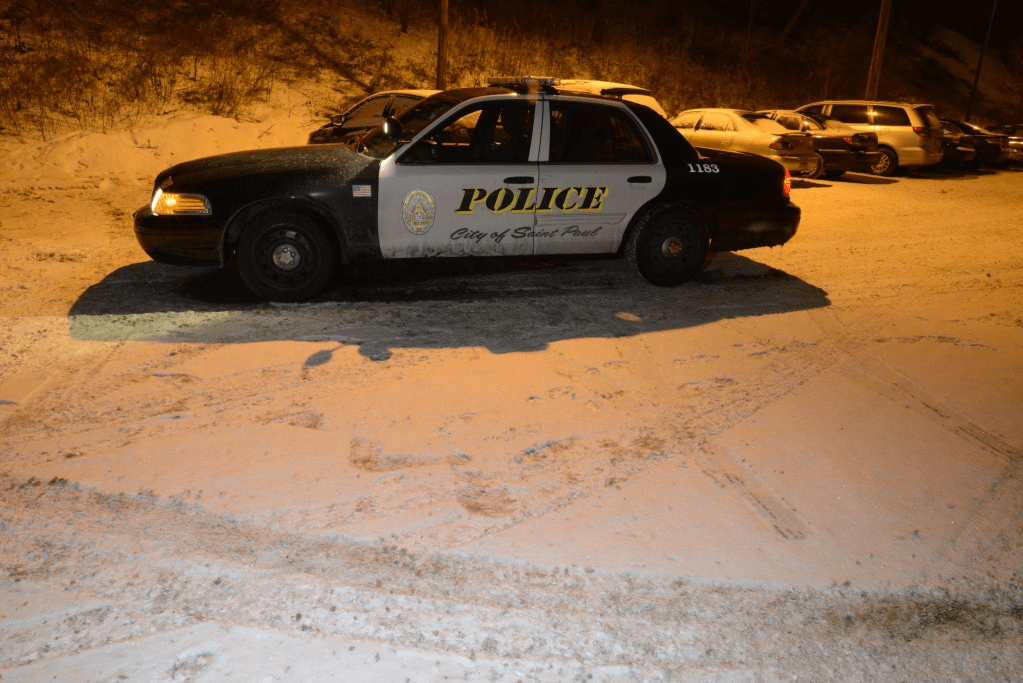
Doverspike exited the driver’s side of the vehicle and left his car door open. He says in his interview, “The front of my car is facing the front of his car at an angle, my rear end is out. My driver’s door is still open, ’cause I didn’t close it during the incident.” Doverspike also said earlier in his statement, “The driver puts his hands on the steering wheel. At this time, I stepped out from behind my car to air the license plate.”
Thus, we know that as Doverspike exited his vehicle:
- He walked around his open door, and
- Stepped out from behind his car to take down Marcus’s license plate.
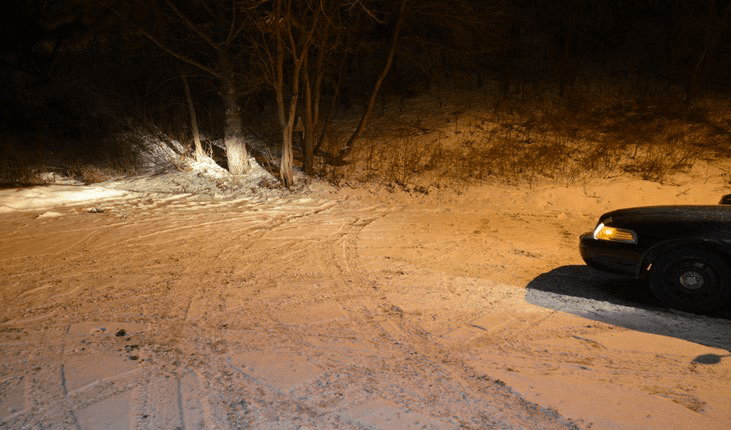
Marcus was parked in the far, dark corner of the parking lot and there were no red and blue flashing lights to indicate he was being stopped. Marcus had no knowledge that there was an approaching squad, and he may not have even known that the approaching car was the police. At the moment Marcus was stopped in the parking lot and when he pulled out of the parking space, he always maintained a distance from the squad car.
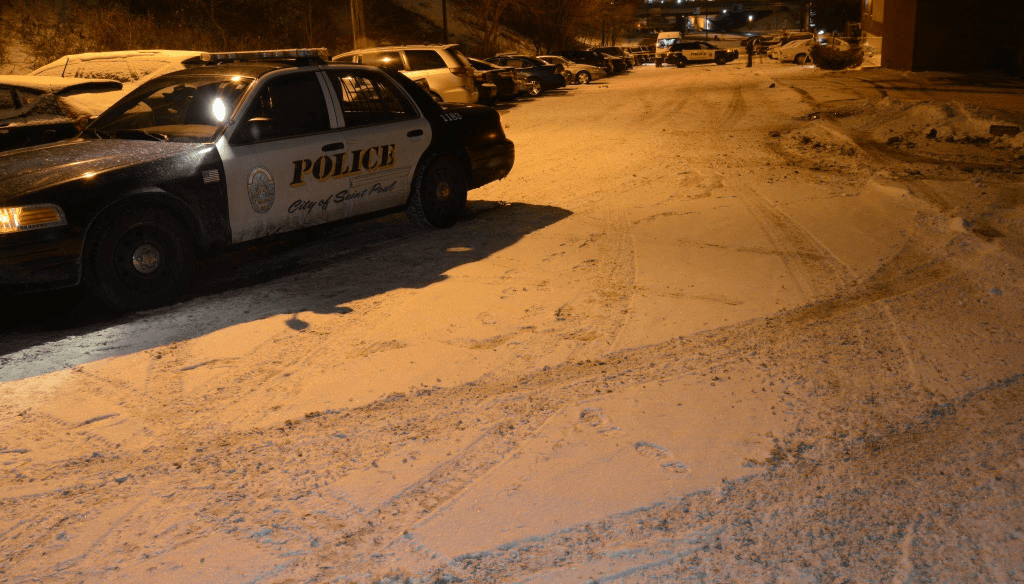

Here, you can see Doverspike’s footprints. Doverspike runs out behind Marcus’ vehicle and then runs slightly towards the squad car. He then runs towards the east end of the lot, chasing alongside Marcus’ car.
Because of the length of his stride, and other qualities of the footprints, we believe that he was running. An analysis of Officer Doverspike’s footprints also appears to show that the officer was running towards the direction of the car as it drove around them and ultimately crashing into the fire hydrant. See the graphic below for more information.
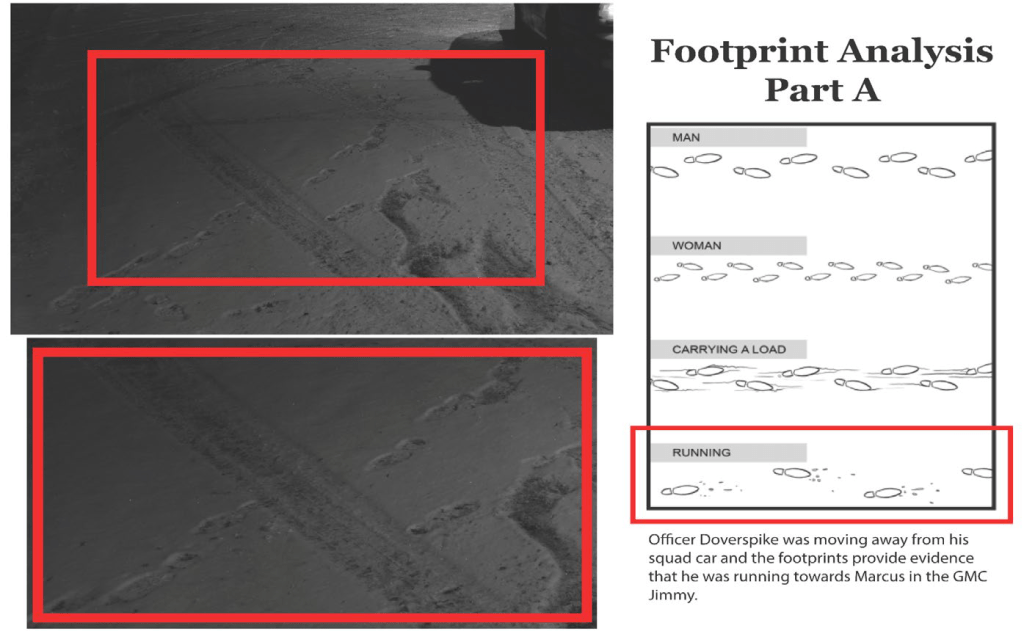
Photo 5 illustrates the distance Officer Doverspike was from Marcus’ tires. Officer Peck claimed in his statement that he thought his partner was going to be “sucked” underneath Marcus’ car and run over. As shown in this photo, Officer Doverspike was not close enough to Marcus’ car to be run over and it would be physically impossible and irrational to believe a person could be “sucked” underneath the SUV.
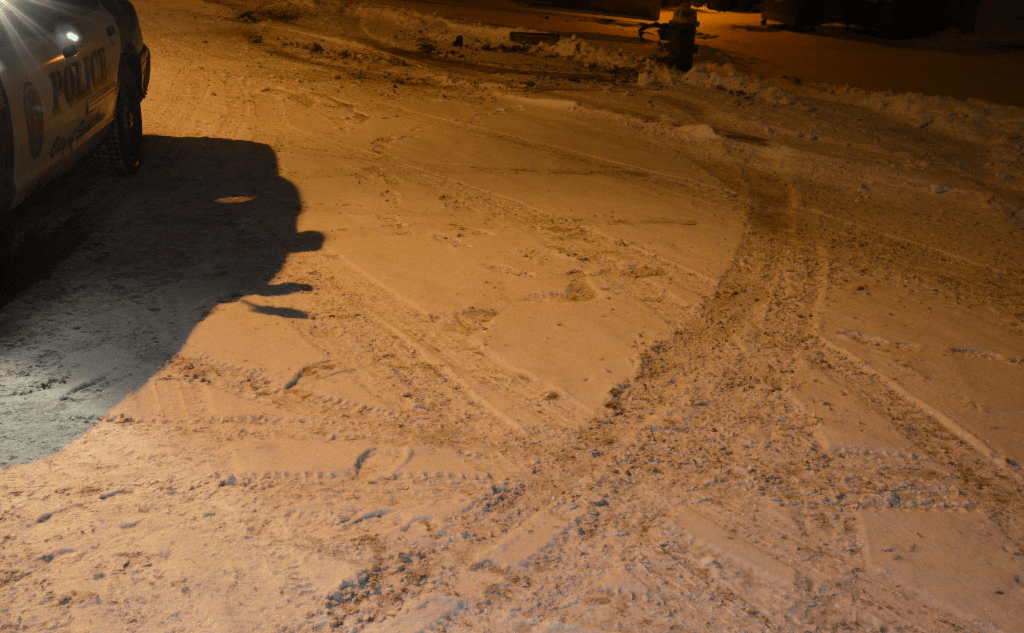
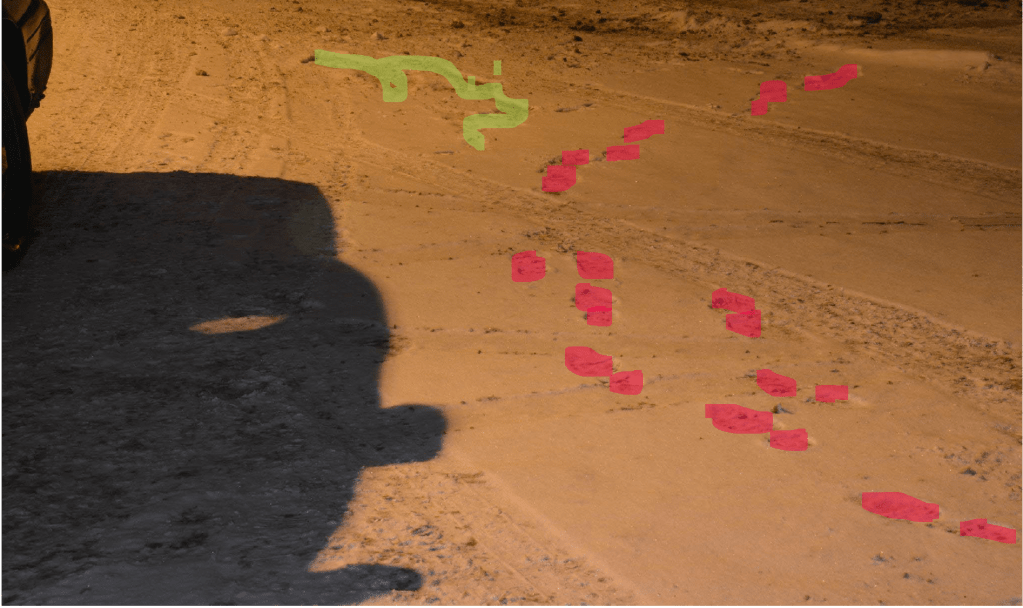
Photo 6 shows Officer Doverspike’s footpath as he followed Marcus’ car as it was attempting to exit the parking lot. The footprints suggest that Doverspike was not only following the car but running after it.
As seen in photo 7 below, Officer Doverspike slipped and fell.
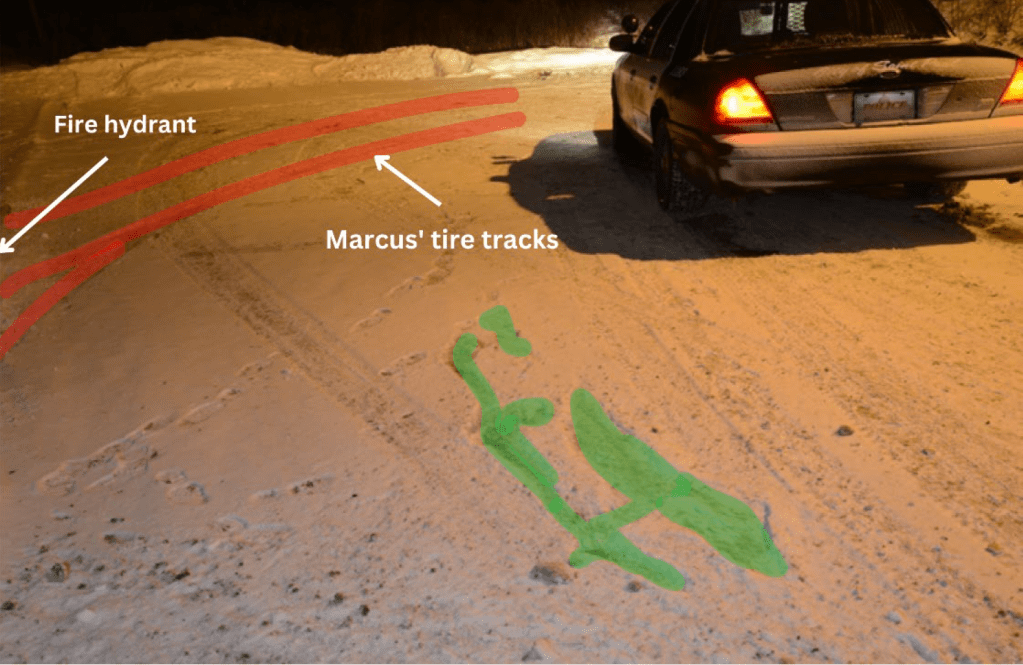
The area in green shows where Officer Doverspike slipped and fell. He fell about 8 ft away from the fire hydrant that Marcus had hit. The two small yellow cones show where Officer Doverspike’s cartridge casings ended up after firing. Typically, shell casings land 6 to 10 feet in the 4 o’clock position from where the shooter was standing. This suggests that Officer Doverspike fired his weapon near the spot where he fell.
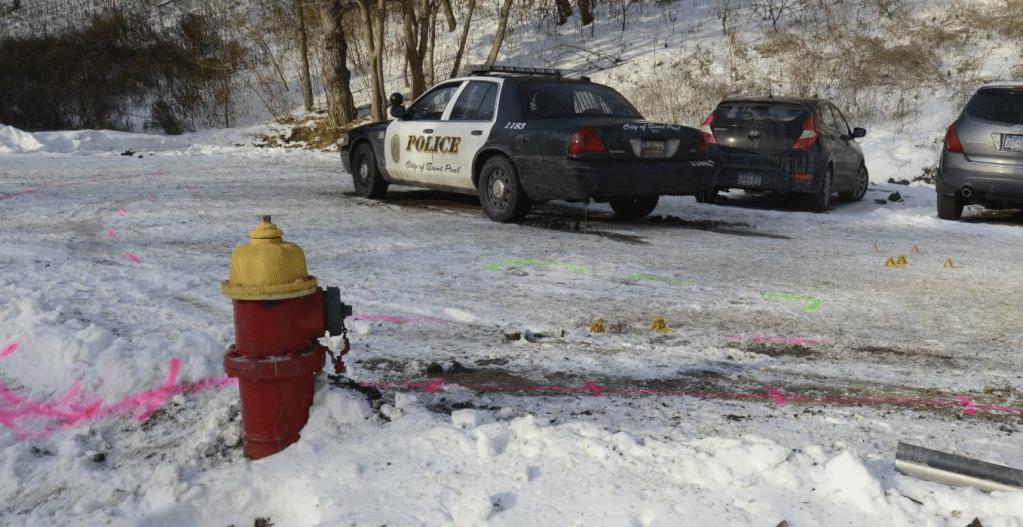
In the eighth photograph, you can see the broken glass from Marcus’ GMC Jimmy. The yellow evidence signs near the middle of the photograph are Officer Doverspike’s casings and the evidence tags on the right of the photograph are Officer Peck’s casings.
The ninth photograph shows another angle of the broken glass from Marcus’ vehicle. This photo also shows Marcus’ tire tracks, and how after he hit the fire hydrant and had his window shot out, he corrected his vehicle again to avoid hitting the corner of the apartment building.
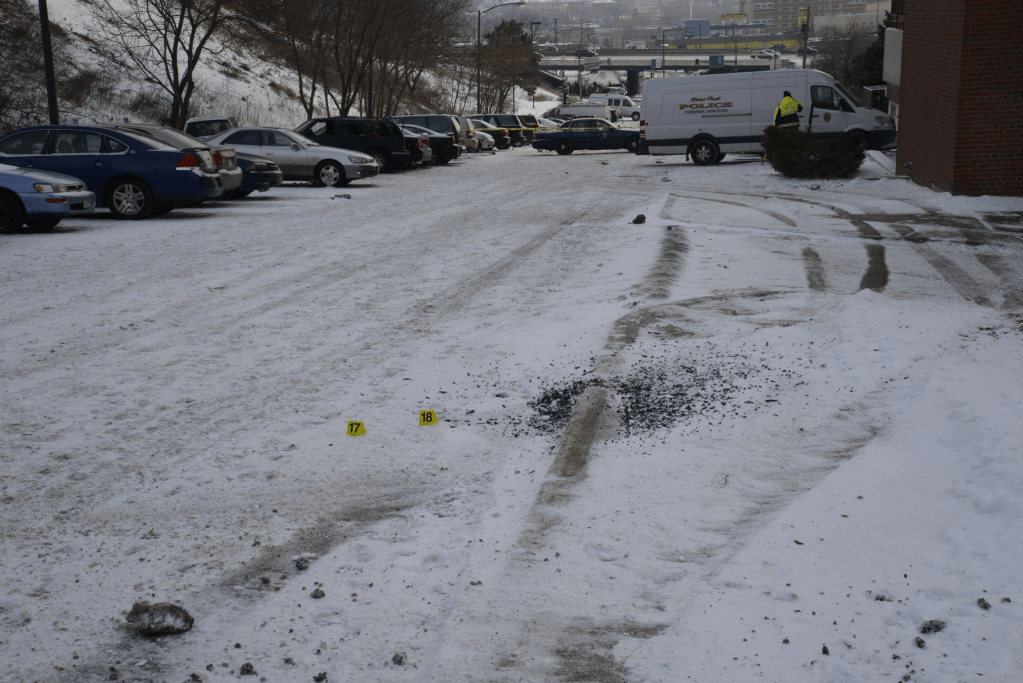
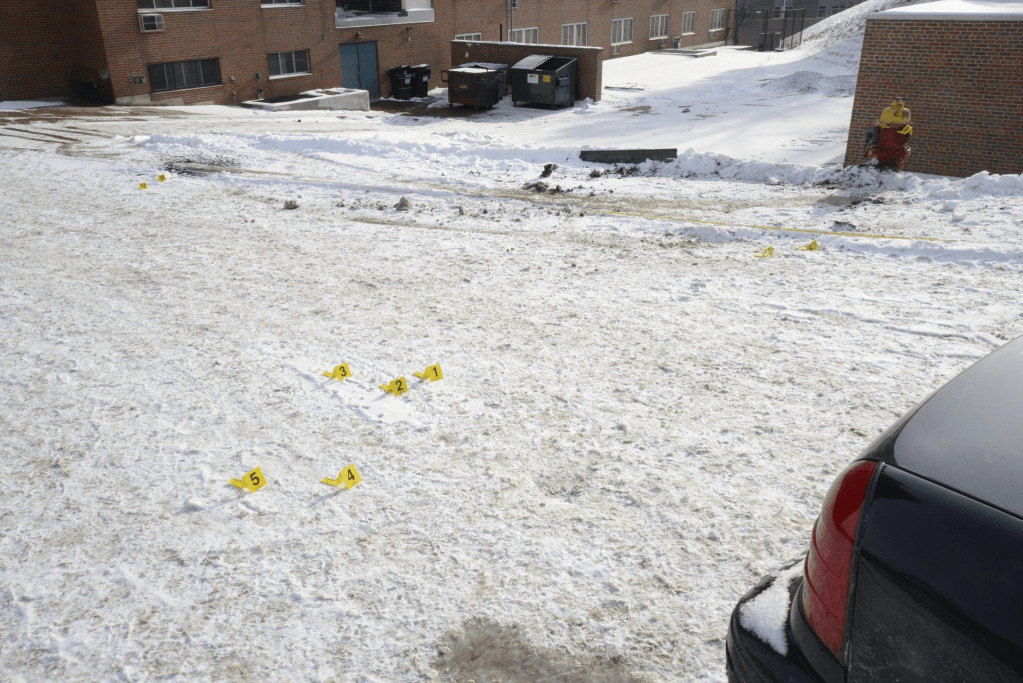
The tenth photo shows the shell casing locations for both Officer Doverspike and Peck. The casings for Officer Doverspike were closer to the broken glass in the right-hand corner. Officer Peck’s are in the center of the photo.
An Analysis of Officer Peck’s Footprints
Officer Peck was on the passenger side of squad car 1183. Unfortunately, there are not good photos of the ground on that side of the vehicle, therefore it is hard to do a succinct footprint analysis for Officer Peck. We have some photos, however, that can show his approximate path.
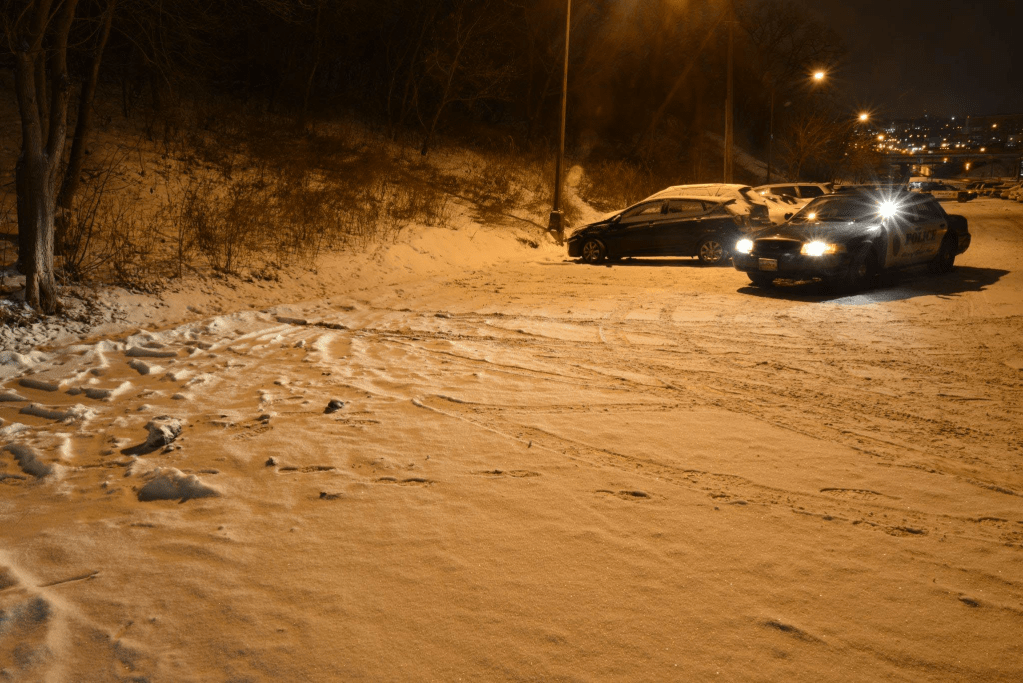
Photo taken from the northwest corner of the parking lot, looking down at where Marcus’ car was parked and where squad car 1183 had pulled up. Officer Peck would have exited the passenger side, walked around his car door, and said in his statement that he had a conversation with Marcus at Marcus’ driver’s side window.

Officer Peck would have a difficult time seeing his partner because of the spotlight.
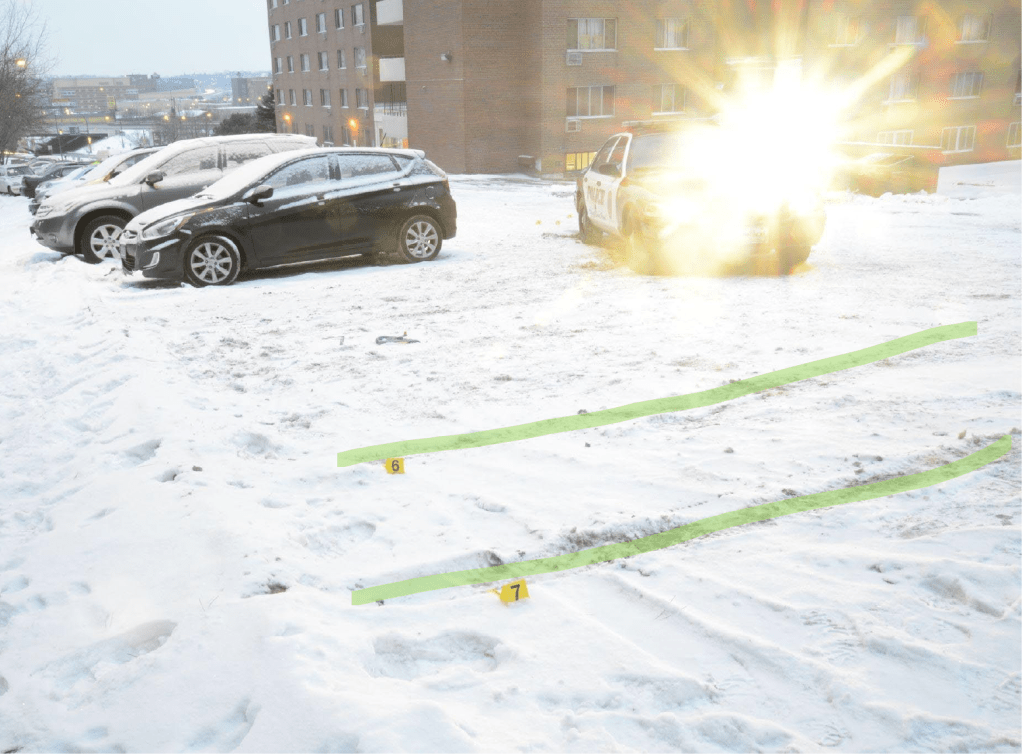
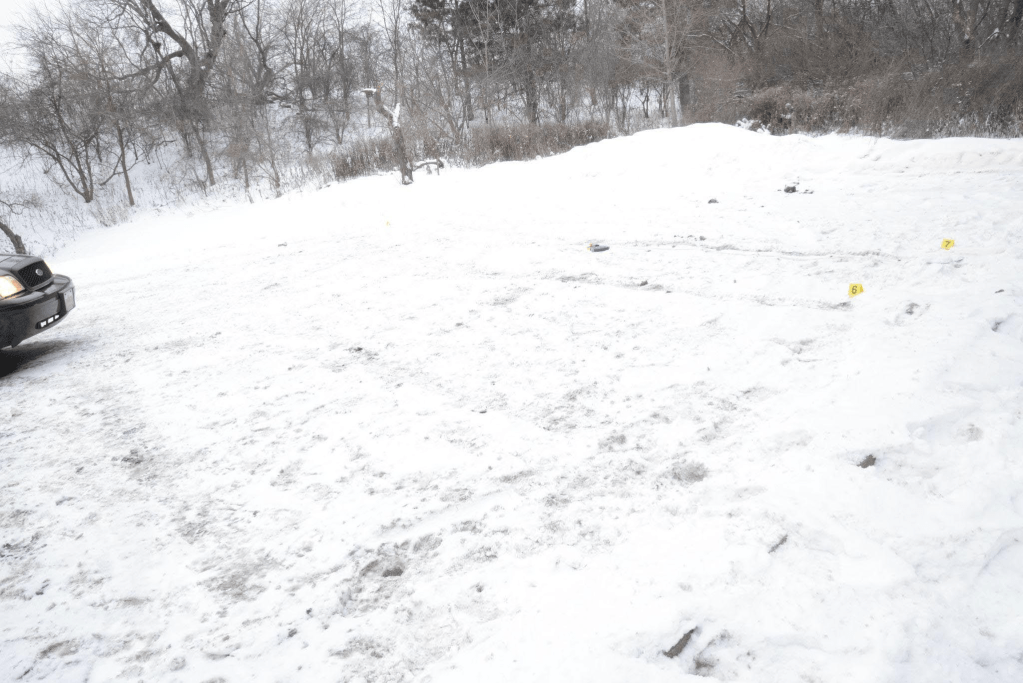
Photo 3 – another angle where the officers parked their car in relation to Marcus’ vehicle. It is clearer here that the squad’s spotlights were pointed directly at Marcus’ car. It also shows the relative distance between where Peck got out of the passenger side of the vehicle and where Marcus’ driver’s side door was located. Keep in mind that Marcus’ car was backed into the parking space.
Photo 4 – another angle of where Marcus’ car was parked. The front bumper of the officers’ squad car is scene in the far left of the photograph.
Physical Evidence: Marcus’ Tire Tracks
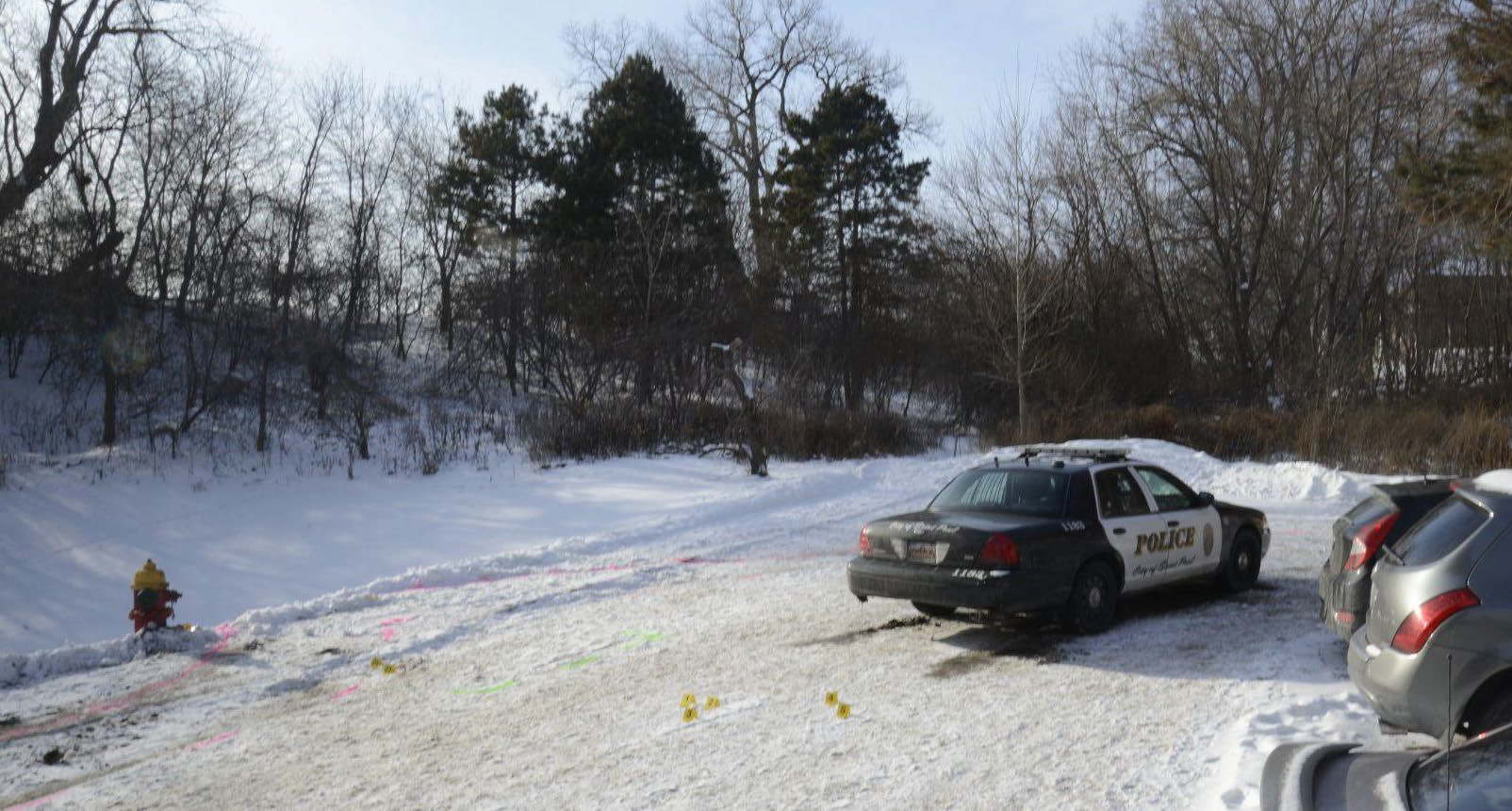
Both Officers in their interviews claimed that Marcus drove straight at Officer Doverspike. For example, Officer Doverspike said in his interview, “All the sudden he reaches his right hand up and puts the car in drive I’m assuming, ’cause I can hear it – see him get the steering, or the center uh, or the drive shaft or whatever in gear. He’s looking right at me… All the sudden he pops his head up just enough where he can see over the dashboard, I see him looking at me and then he takes off,” (italics added). Peck, in his interview, adds, “And, I see Jeremy kind of sidestep to his right, like getting out of the way of the vehicle.” The investigators later ask Peck, “So you’re giving a bunch of commands, he’s [Marcus] not complying, he decides he’s going to take off. He drives straight at your partner.” Peck responds, “Yep.”
Once again, this reinvestigation team needs to emphasize the real concerns about Officer Pecks credibility.
He initially stated he ran to the passenger side of the car and now is saying he saw Marcus put the car into gear and drive straight at his partner?
Sergeant Donahue, in his initial scene report also commented on the tire tracks,
“As I looked towards the west, I observed a set of tire tracks heading in the direction of MN 745EEA. I followed the tracks to the original location where they started.”
According to the tire tracks, the vehicle was parked backed into a north side parking spot facing south. The tracks lead from the parking spot in a south direction. It appears the vehicle begins to leave then accelerates at a high rate of speed just in front of a parked squad car marked 1183. The squad was parked in the middle of the lot facing northwest. The squad was running with its lights on and spotlight illuminating the area in the direction of where MN 745EEA was parked. As the vehicle accelerates from the parking spot it turns and heads east around the squad car still accelerating.
These tracks appear to be within 8 feet of the squad’s front driver’s side corner.
There appears to be a set of footprints in the snow within 2 feet of the tire tracks that are leaving and accelerating away. These prints are in between the squad car and tire tracks. Those footprints appear in the snow as though a person was retreating or attempting to get out of the way of the vehicle. The prints appear as though the person is sliding.
As you follow the vehicle’s tracks, it hops up over the curb and sidewalk heading in a southeast direction then more easterly prior to striking the fire hydrant. There were vehicle parts on the ground by the hydrant as well as hanging from the hydrant. The footprints head in an easterly direction until about even with the fire hydrant then, according to the disturbance in the snow, it appears as though the person slips or falls. After striking the fire hydrant the vehicle appears to abruptly lunge to the north coming within 6 feet of where it appeared someone had fallen. Then the vehicle continues in an easterly direction while still accelerating, jumping the curb up onto the sidewalk to the south of the lot.
Where the vehicle jumped the curb between the hydrant and the building on the ground, I observed a large amount of broken glass. Then the vehicle continues east over the curb across a driveway then up over the curb onto the sidewalk. The vehicle then changes course just missing striking the building and heads in a north easterly direction.
It is this reinvestigation team’s opinion that at this point, Officer Peck or Doverspike shot at the retreating Marcus causing the glass to break. This is well past both officers. The officers would have been shooting into the apartment building.
The vehicle continues in the direction through a garden area onto the sidewalk over the curb into the lot until it strikes MN 149LYR then comes to rest. It appears once the vehicle left the parking spot at the west end of the parking lot it never stopped accelerating until coming to rest and being turned off by assisting officers.
While walking around and looking in the area of the squad car I observed five shell casing. The shell casings were located.”
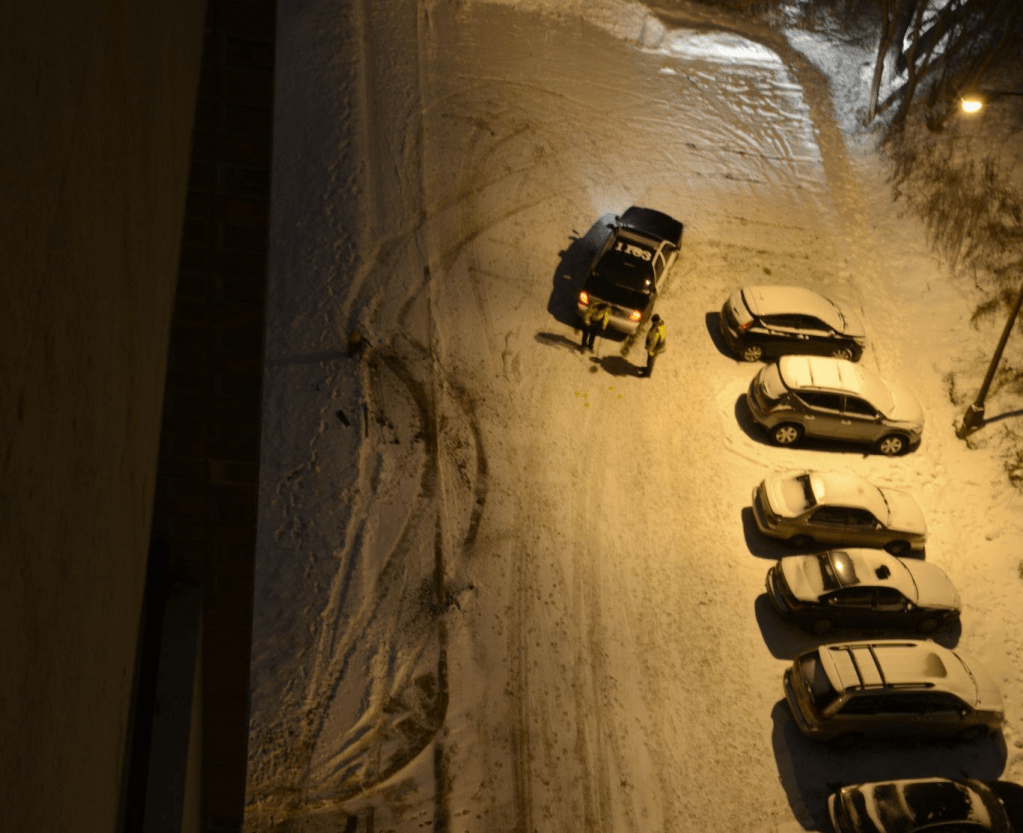
However, the images of the tire tracks from the crime scene show an alternative theory of how Marcus was driving that morning.
Marcus was sitting in his vehicle at the end of the lot. It is hard to see from photos, but the parking lot sits atop a hill. The slope is at its highest point near the northeast end of the lot. Directly across from where Marcus was parked in the lot is a sidewalk and then a hill that has a steep drop off. Marcus, having been to the apartment many times before, was surely aware of the steep hill ahead of where he was parked.
Marcus had few options to exit the parking lot. He could drive directly at the officers. Or he could drive close to the steep hill on the east side of the lot and try to skirt around the officers and their squad car.
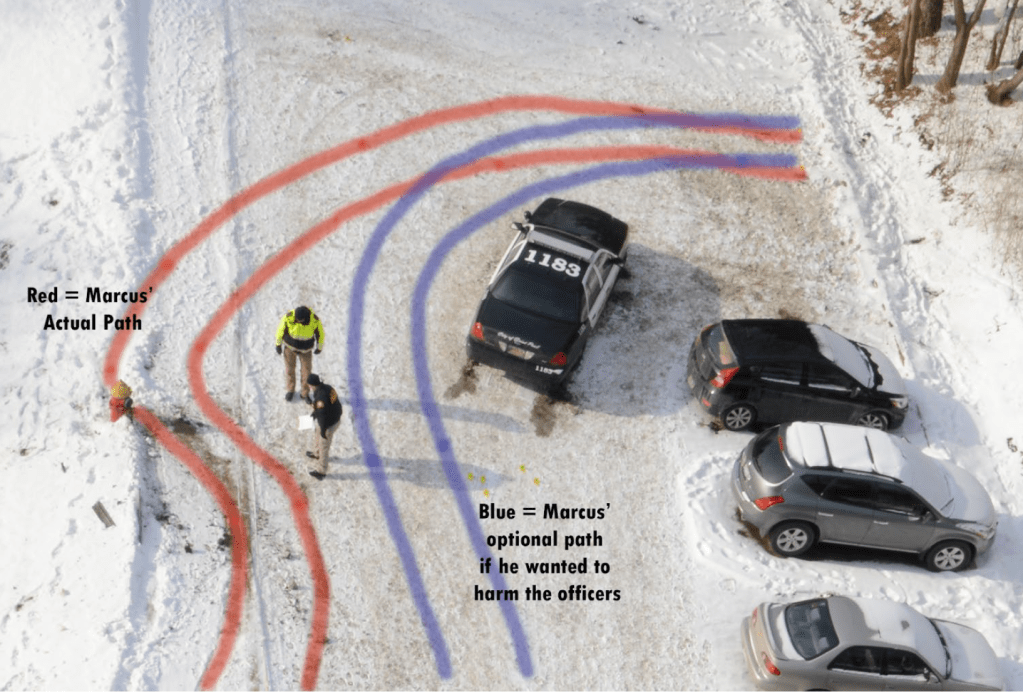
The path Marcus took to drive out of the lot put him at risk of going over the steep hill that lay on the other side of the curb and sidewalk. If Marcus had wanted to intentionally drive straight at the officers, he could’ve made a sharper left turn, drove straight at them, and avoided the steep hill. Instead, he made a wide arc around the officers, wide enough that he ended up hitting the fire hydrant that lay on the opposite side of the sidewalk.
After hitting the fire hydrant, Marcus continued driving. He drove up on the sidewalk, continuing southeast through the parking lot. He drove over a small driveway that was perpendicular to the building. Further down the sidewalk Marcus again corrected the wheel on the GMC Jimmy, turning the wheel to the east to avoid the fast-approaching squad car 221T coming towards him from the driveway. It is in this investigation’s belief that Marcus was shot after that last turn.
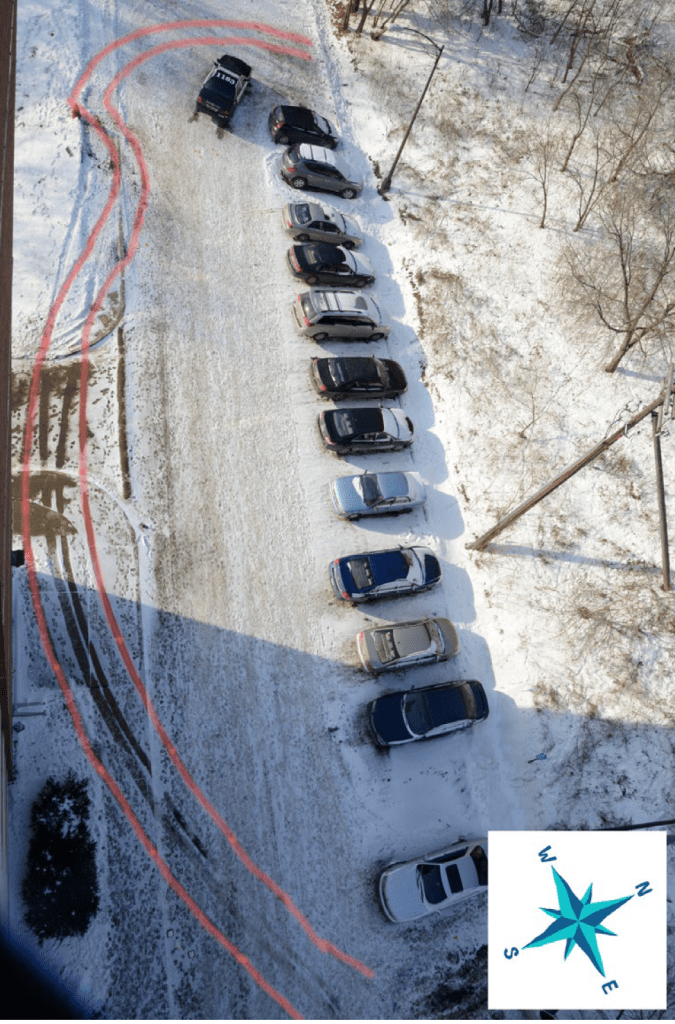
We also know that Marcus’s tracks in the snow go from strong to light halfway across the driveway. It appears to this investigation team Marcus was no longer pressing hard on the accelerator.
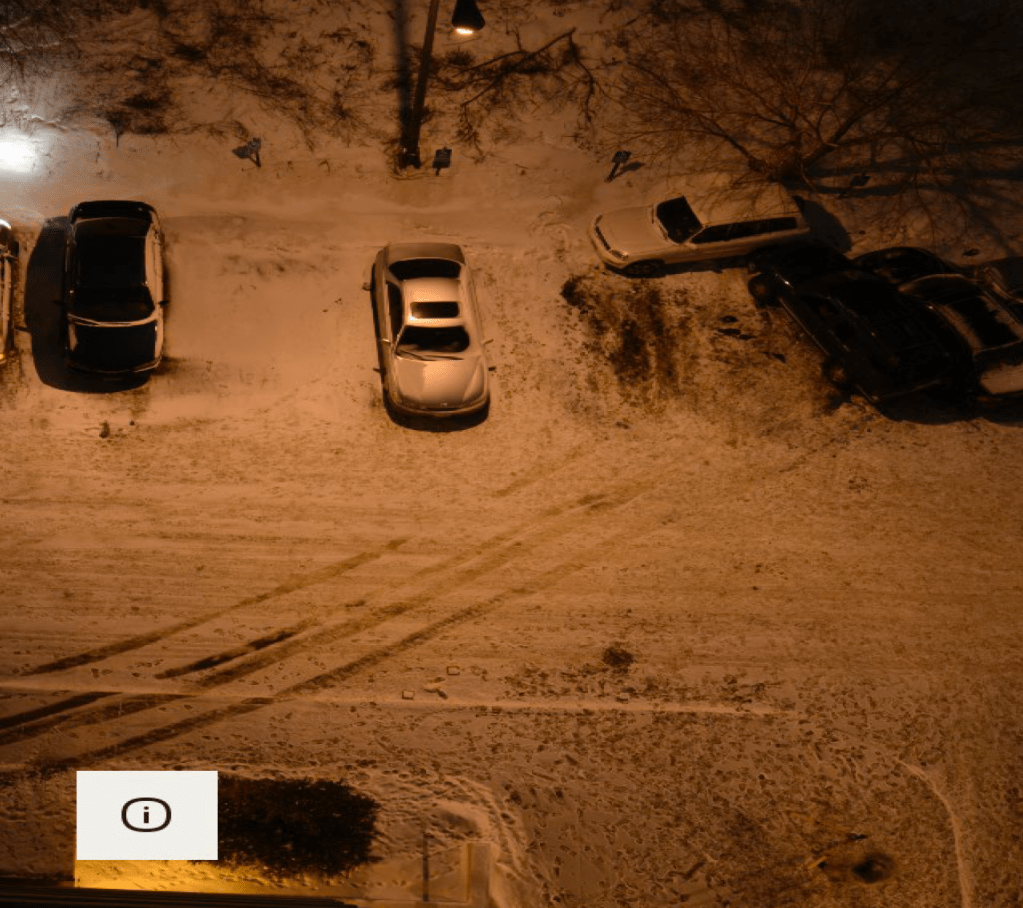
K & L are aerial photos of the parking lot showing Marcus’ tire tracks after he made his last correction of the car.
As the car drove off of the sidewalk and back onto the lot, the tire tracks went from dark to light impressions in the snow, indicating that Marcus was no longer pressing on the accelerator. It also tells us:
Marcus never tried to brake before he crashed into the line of cars on the east side of the parking lot.
Autopsy Review
| Basic Info |
| An autopsy was performed on Marcus Golden by Principal Assistant Medical Examiner Kelly Mills, M.D., with the Ramsey Count Medical Examiner’s Office on 01/14/2015 at 9:45 a.m. SPPD sergeants Pat Cheshier and Bob Donahue were present for the entirety of the examination. It is important to note that the Ramsey County Medical Examiner did not include photos taken of Marcus’ body before the autopsy was performed. The autopsy photos we have are post-autopsy. |
Gunshot Wound Details
| Gunshot Wound | Description | |
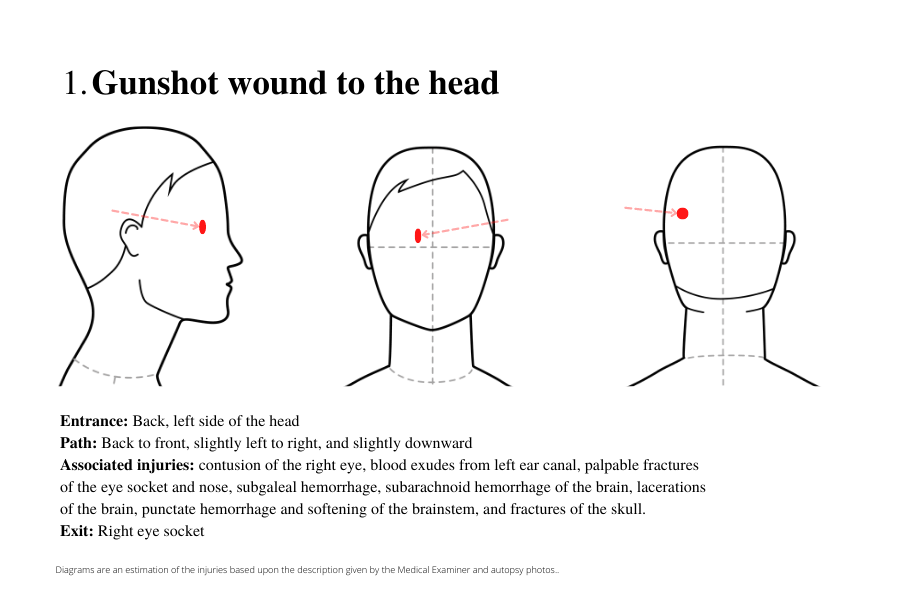
| 1. | Gunshot wound to the left back of the head | Entrance: Back, left side of the head Path: Back to front, slightly left to right, and slightly downward Associated injuries: contusion of the right eye, blood exudes from left ear canal, palpable fractures of the eye socket and nose, subgaleal hemorrhage, subarachnoid hemorrhage of the brain, lacerations of the brain, punctate hemorrhage and softening of the brainstem, and fractures of the skull. Exit: Right eye socket |
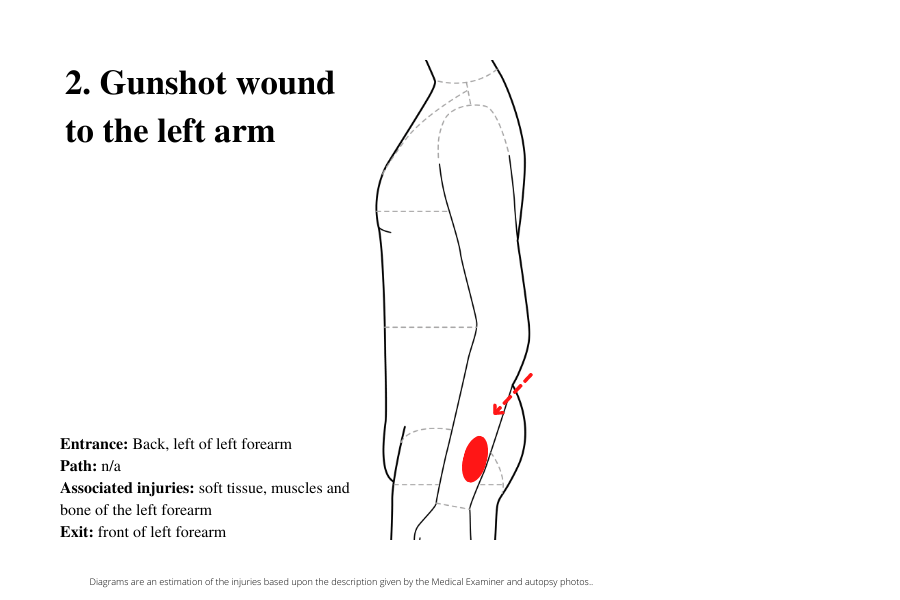
| 2. | Gunshot wound to the left forearm | Entrance: Back of left forearm Path: n/a Associated injuries: soft tissue, muscles, and bone of the left forearm Exit: front of left forearm |
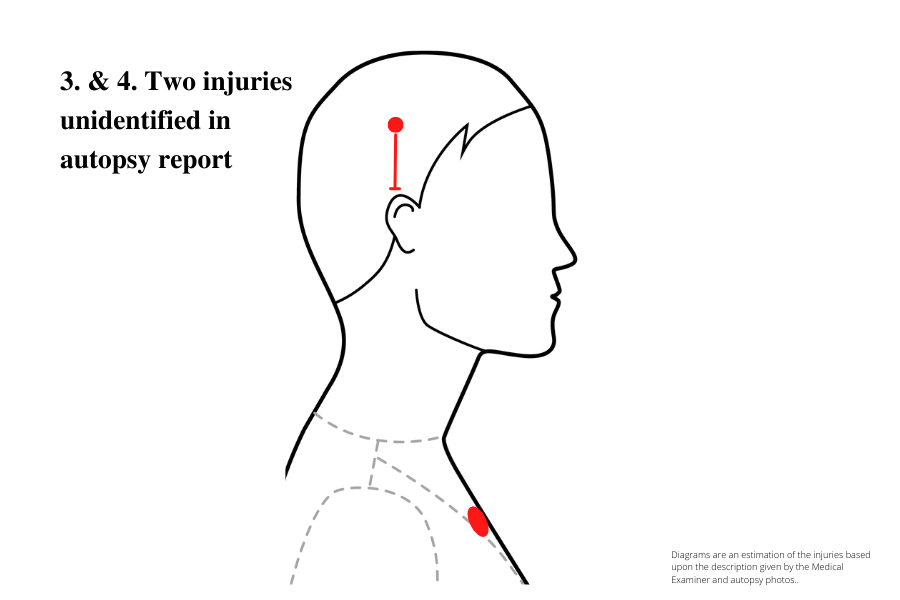
| 3. | Unidentified injury to the right side of the head | On the right side of Marcus’ head, there is a vertical wound path that extends from the top right side of Marcus’ head to the top of his right ear. This wound was not noted in the autopsy report. |
| 4. Unidentified injury in the pit of the neck | At the pit of Marcus’ neck, or the suprasternal notch, there is a small hole. This wound was not noted in the autopsy report. | |
Typically, CUAPB’s reinvestigation team reviews the ballistic information to compare it to the injuries listed in the autopsy. Unfortunately for this case, SPPD either did not do ballistic testing or they failed to turn it over to us in our numerous data requests.
Policy Analysis
There are three broad categories of issues present in the Marcus Golden case. First, policy violations in Officer Peck and Doverspike’s arrival. Second, flagrant public and officer safety violations in the officers’ pursuit and engagement of Marcus in the parking lot. And lastly, the handling of the investigation by the SPPD.
The full SPPD policy manual from 2015 was not included in the data CUAPB received from SPPD. For the purposes of our policy analysis, we used the current SPPD policy listed on the Saint Paul website.
Officer Arrival Issues
There are three notable policy violations made by the officers upon their arrival:
1) their failure to notify dispatch,
2) their failure to activate their lights, sirens, and ICC, and
3) their failure to determine if a crime had been committed.
According to Saint Paul Police Department policy 423.00, patrol officers are responsible for the preliminary investigation of all crimes and incidents that are assigned or reported to them or which they discover. SPPD Officers Doverspike and Peck were not assigned to the alleged harassment complaint call at 261 University Avenue South, however, the alleged crime was reported to them via the radio and the officers took it upon themselves to respond to the call. Before we discuss the policy violations that occurred throughout the officers’ arrival, we need to discuss the failure of the officers to notify dispatch that they were arriving at the scene.
Decision to not notify dispatch
It is imperative for officers to notify dispatch where they are and if they are going to respond to a call. Dispatchers are officers’ lifeline while out in the field.1 If a situation goes wrong and becomes dangerous, dispatchers are only able to send backup squads and EMS if officers communicate when and where they are conducting any type of investigation. Officers Doverspike and Peck did not notify dispatch that they were responding to this call or that they were conducting a vehicle stop in the parking lot at 261 University Avenue.
SPPD policy 625.00 requires officers should notify the Ramsey County Emergency Communications Center (RCECC) of “ the intended location of the stop, the license number, and the number of occupants of the vehicle.” By choosing not to notify RCECC of their stop, the officers compromised their own safety while arriving on the scene. They also compromised the safety of the officers who were sent to the call by dispatch. The other responding officers were not given important information about the scene they were about to arrive at.
After the initial call was aired out, an officer in squad 223T entered into the call comments that Marcus “has been known to be a violent person and has made threats against St. Paul Police Officers that he would kill them.” The comment seemingly refers to an incident on November 24th, 2014, just a few months earlier, during which Marcus was beaten at the Ramsey County Jail and released with no charges, according to the family. See Appendix X for Marcus’ full history with SPPD. CUAPB’s reinvestigation team speculates whether this call comment triggered Officers Doverspike and Peck to arrive at the call unannounced.
At this point in SPPD’s history, they were still investigating themselves for misconduct and officer involved killings. Officers acted with impunity and were not held accountable for their actions. Knowing this, we have reason to believe that Doverspike was motivated by something other than his crime-fighting urges to respond to this call. Officer Doverspike knew who Marcus Golden was. He had previously responded to a call involving Marcus on 11/09/2014. Some studies suggest that officer misconduct spreads like a contagion2 and given the history of the SPPD at this time, it is quite possible that it spread to officers Doverspike and Peck in this case.
Failure to activate squad lights, sirens, and camera
The officers created another officer safety issue when they arrived at the scene and pulled up to Marcus’ car in the parking lot without activating their overhead lights. Officers are trained in their law enforcement education that vehicle stops must be initiated by activating lights and/or sirens.3 They are also taught how to operate that equipment in their law enforcement education4 and by their department. The SPPD policy manual also outlines mandatory procedures when stopping and approaching a motor vehicle operator to “provide maximum safety” to the officer, the motor vehicle operator, and other users of the roadway. SPPD policy 625.00 states,
The officer should signal the violator to stop. This signal should be with the red emergency lights, hand signals, sounding the horn, and if necessary, the siren. These signals also alert other drivers of the intent of the officer and will usually facilitate securing the right of way for the stopping maneuver.
There is a possibility that because the officers failed to activate their overhead lights, Marcus did not know he was being stopped by police. Any reasonable person who was approached by an unfamiliar vehicle at the far end of a parking lot around 2 in the morning would have driven away. As far as Marcus was concerned, he did not know the police were attempting to stop him from leaving.
By not activating their overhead lights, the officers created another officer safety issue: their in-car camera, or squad camera, was not activated. The in-car camera system (ICC) in SPPD squad cars is automatically activated when the vehicle emergency lighting has been activated.5 Per SPPD policy 442.17, “to the extent practical without compromising officer safety, the ICC system must be activated in preparation for, when initiating, or under the following circumstances and conditions:
- Traffic stops
- Priority responses
- Vehicle pursuits…”
The officers had a responsibility to activate both their emergency lights and ICC system when they initiated a stop on Marcus’ car. They failed to do so and compromised everyone’s safety.
It is not an insignificant point that Doverspike and Peck did not notify dispatch of their stop or follow proper traffic stop procedures. SPPD’s traffic stop procedure policy also contains this rule, “ Never — take the traffic stop lightly. It is the most formal and official exercise of police authority that we conduct and is closely observed by every other citizen in view.” Traffic stops are also dangerous – to both the officer and the person being stopped. The officers were aware or should have been aware of this through their law enforcement education and training with SPPD.
Failure to determine if a crime had been committed
The officers’ decision to approach Marcus’ vehicle immediately when they arrived on scene is also suspect. According to SPPD policy 423.00, “The patrol officer is responsible for the preliminary investigation of all crimes and incidents which are assigned or reported to her/him or which s/he discovers.” Besides caring for the injured at a possible scene of a crime, it is the duty of the first officers on scene to determine if a crime has been committed by conducting a preliminary investigation (SPPD Policy 423.00). Given these policies, it is only common sense that the officers should have at least attempted to speak with the 911 caller before approaching Marcus. At the very least, the officers should have waited for additional squads to respond so that two officers could speak with the 911 caller and two other officers spoke with Marcus. The officers had not established that a crime had been committed nor talked with the complainant or witnesses before approaching Marcus. SPPD attempted to make statements after the fact that Marcus had sent the 911 caller and E.E. threatening text messages in an attempt to justify the officers’ pursuit and ultimately, killing of Marcus Golden. Let it be clear that at the time the officers stopped Marcus they had not even spoken with the 911 caller or seen said text messages. They had nothing more than reasonable suspicion6 to stop and question Marcus. The SPPD has also failed to produce any of these alleged text messages to this day.
Next, we will discuss the relevant policy issues in the officers engagement and pursuit of Marcus Golden.
Pursuit and Engagement Issues
In addition to the officer arrival issues, the officers made severe policy violations throughout the incident that led to Marcus’ death. These violations include not letting Marcus drive away even though it was the safest option and shooting at a moving vehicle, Before our discussion of these issues, first, we want to address discrepancies between the officers’ statements in their initial interaction with Marcus.
| Discrepancy #1 |
| 1. The officers’ description of their initial interaction with Marcus differs. Peck describes a conversation with Marcus, while Doverspike describes Peck yelling at an unresponsive Marcus. Ofc. Peck describes how he immediately got out of the vehicle and saw Marcus sitting in the GMC Jimmy with his hands down. Peck states that he told Marcus, “Let me see your hands,” and Marcus kept asking him questions, “What’s this about? What do you want? What’s this about?” Peck recalls asking against to see his hands, and Marcus responds again with questions about what the officers wanted. Doverspike recalls getting out of the vehicle and Peck yelling at the driver. Doverspike claims that Peck was asking to see Marcus’ hands and that the driver, Marcus, raises his left hand in the air but does nothing with his right. Peck repeats himself several times, according to Doverspike. If we recall from the timeline above, the officers were only with Marcus for 46 seconds before his vehicle appeared in the surveillance camera video and the officers fired at him. |
| Discrepancy #2 |
| 2. Doverspike claims Peck asked Marcus if his name was Marcus and Doverspike heard Marcus say no. On the contrary, Peck said in his statement that Marcus said, “yeah, what’s this about?” |
| Discrepancy #3 |
| 3. The officers differ significantly in the order of events that followed the alleged conversation with Marcus. Doverspike, according to his statement, already had his weapon out at the low ready when Peck was yelling at Marcus to show his hands. Doverspike claims Marcus kept dropping his right arm from the steering wheel. Then, “all of the sudden, he reaches his right hand up and puts the car in drive.” According to Doverspike, Marcus looks directly at him and Doverspike raises his weapon from the low ready to point at him. Marcus apparently drops down to the side, covering the passenger seat, pops back up just enough to see over the dashboard, and takes off. Doverspike says, “and all I can think is oh fuck. The next thing I know, his car hits my gun, I fire two rounds.” Then, his car hits the fire hydrant. Peck’s version of events tells a wildly different tale. Peck claims that after Marcus puts the car in gear, he creeps forward slowly, “maybe a mile per hour at the most.” Then, Peck states that he hears the engine rev and Marcus “gunned” it right towards Jeremy. Peck turns to run back to the squad because he believes they are going to chase “this guy” but then when he gets to the door, he sees Doverspike with his gun out. Doverspike supposedly steps to the right to get out of the way of the vehicle, slip and begin to fall. Peck then says he thought, “Jeremy was going to get sucked underneath the car.” Peck claims he heard gunshots, and says, “this gunshot did not sound like it came from Jeremy.” Peck, who also had his gun out already, then fired rounds at Marcus’ drivers’ side window. Then, according to Peck, Marcus hits the fire hydrant. |
What actually happened when the officers got out of their car?
The officers’ statements significantly differ and there is no video evidence to corroborate their statements. Despite these discrepancies, the SPPD investigators (and colleagues of Officers Peck and Doverspike) accept the statements as fact. More about the issues in the investigation will come later.
Allowing Marcus to leave was the safest option for everyone
After the officers initiating approached Marcus’ vehicle, Marcus began to leave the apartment parking lot. The officers had not made it clear, either verbally or by signaling with their lights, that Marcus was officially being stopped. Despite this, the officers began to pursue Marcus down the parking lot on foot. SPPD policy 443.00 defines vehicle pursuits as,
A vehicle pursuit is an active attempt by a law enforcement officer to apprehend the occupant of a moving motor vehicle where the officer has reason to believe the driver of such vehicle is aware of the attempt and is resisting the officer’s attempt to stop them.
CUAPB’s reinvestigation team believes it is possible that Marcus;
- Was not aware that he was being stopped by the SPPD and
- That he was resisting their attempts to stop him.
Again, the officers did not use their lights or sirens to signal he was being stopped. It was 2 o’clock in the morning in dark parking lot in early January. It is reasonable to believe Marcus didn’t know he was being stopped by the police. Following this, if Marcus didn’t know he was being stopped by the police, he couldn’t have been resisting their attempts to stop him.
Allowing Marcus to leave was the safest option and what any reasonable, unbiased officer would do in the circumstances. This tactic is also known as tactical disengagement, which is described in SPPD policy 404.00;
There may be incidents involving a person who is not a threat to officers or others that a responding officer or supervisor believes can be handled more safely through the use of tactical disengagement. This policy recognizes that the legal authority to take a person into custody does not override law enforcement discretion to pursue other safer courses of action.
The situation with Marcus could have warranted tactical disengagement, as it was the safest option given the circumstances.
Shooting at a moving vehicle
SPPD policy 443.10 states;
Officers should not shoot from a moving vehicle at a fleeing vehicle unless it is in response to a threat of great bodily harm or death. It is best to attempt apprehension from a position of superior tactical advantage, if possible, by using police communications and cooperative police work rather than by firing at a moving vehicle.
By firing their weapons at a moving vehicle, they violated this policy and put numerous people in harm’s way. Not only did they shoot Marcus, but he occupants of the apartment building, parking lot, and the other arriving officers could have been shot.
Officer Peck stated that he was afraid his partner would be sucked under Marcus’ car, and this was one of his and Officer Doverspike’s justifications for shooting. This, however, does not comply with SPPD policy. Policy 443.10 states,
The moving vehicle itself does not presumptively constitute a threat that justifies an officer’s use of deadly force. An officer threatened by an oncoming vehicle should make every attempt to move out of the path of the oncoming vehicle unless such an attempt would unreasonably expose the officer or another to the risk of death or great bodily harm. The officer must consider the obvious danger of firing at a moving vehicle since bullets may miss their target and/or the driver may lose control. Such risks, in most cases, weigh against firing at a moving vehicle.
Investigation Issues
There are numerous concerns with SPPD’s investigation of the death of Marcus Golden. First and foremost, SPPD investigated themselves. Police departments, like any government entity, cannot be trusted to investigate themselves. Investigations should be independent and impartial in order for them to be legitimate and come to a truthful outcome. In this case, SPPD’s investigation of themselves only served their own interests and shielded Officers Doverspike and Peck from any shred of scrutiny for their actions.
Days after Marcus was killed, the Star Tribune published an article titled, “St. Paul cops tops in deadly force use.”

By Nicole Norfleet and James Walsh
FEBRUARY 7, 2015
No other law enforcement agency in Minnesota has used deadly force more often over the past six years than St. Paul police.
Beginning in 2009, St. Paul officers have shot and killed 11 men, nine of whom were people of color. By comparison, Minneapolis police were involved in at least four fatal shootings, according to state Bureau of Criminal Apprehension data.
In every St. Paul case, police said the suspect posed a threat to officers or the public.
“I believe our decision making is very good,” said David Titus,
president of the St. Paul Police Federation, which represents
every St. Paul officer involved in a shooting. “It’s the suspect’s actions that dictated an officer’s response.”
But now, just weeks after the fatal shooting of a 24-year-old black man near the State Capitol, and against the national backdrop of increased tension and scrutiny of fatal encounters between police and black men, community leaders are asking hard questions about the department’s use of deadly force and whether any of those killings could have been avoided.
“Did all of these 11 people have to die?” asks Chuck Samuelson, executive director of the American Civil Liberties Union of Minnesota. “What is it about these encounters that is different from 20 years ago?”
Law enforcement officials say the reasons for the spike aren’t clear. But what is certain is that fatal shootings by police across Minnesota are on the rise — 46 people were killed from 2009 through 2013, more than twice as many as were killed in the five years prior, according to BCA data. From 2004 through 2008, St. Paul police shot and killed only two people; Minneapolis police killed four. But BCA data may not be complete because agencies report their own shooting totals to the state…
Issues with the Investigation
At this point in SPPD history, deadly force was an epidemic in the police department. And despite this increase in deadly force between 2009 and 2015, SPPD were still allowed to investigate themselves for wrongdoing.
Leading Interviews
The Star Tribune article goes on later to note,
Minnesota statute allows police to use deadly force to protect themselves or others from apparent death or great bodily harm, or to prevent the escape of a person who used or threatened deadly force against others. Police can shoot someone if they believe that person is a danger to cause death or great bodily harm if they are not stopped.
SPPD Sergeant Cheshier, one of the lead investigators in this case, knew this well. There are several parts of the laws on deadly force that Sergeant Cheshier made sure to fulfill in his interviews with the officers. First, under Graham v. Connor, officers are allowed to make split second decisions. Cheshier ensured Peck’s answers reflected this, see the interview transcript below.
| Sergeant Cheshier interview Dan Peck over timing of incident Interview date: 01/15/2015 at 5:37pm |
| Um, you, you you’re very descriptive. How long did this incident last in your mind from the time you got out and started giving him commands to the point where he was Cheshier already past and you’re done shooting? |
| Peck [pauses] |
| Cheshier I know that’s really hard. |
| Peck Yeah, |
| But was this a very rapid series of events? Or was this very long and drawn out and Cheshier almost like a negotiation that you’re having at the window? |
| At, like, from the point when I got out of the vehicle to when I started talking to him, engaging him, um, that all seemed fairly slow in my mind. Um, when he started driving off, that whole, from, ’til when I was done firing, that whole incident or that Peck whole portion of it seems like [finger snaps] it was over in a second. |
| Cheshier Okay, maybe I should clarify a little bit. You’ve had people run on you before? |
| Peck Mhm. |
| Cheshier And you said you, you looked at this guy and you knew that he was going to run. |
| Peck Mhm. |
| Um, so when you’re engaging somebody in conversation and you realize by the Cheshier suspect’s actions or by what he’s doing, |
| Peck Right. |
| Or saying that he’s going to run, sometimes they use delay tactics to be able to get, get Cheshier them time and give them a point of advantage, |
| Peck Mhm. |
| A lot of times, there’s a time frame in there that I realize that slows down a little bit because you’re really looking at the scene and trying to see, but I’m trying to estimate how fast this happened. Is this something that he, you guys were having a conversation for several minutes or is this something that you gave him a few Cheshier commands, and he decided to run and get [inaudible]. |
| Um, it was, I’d say it was more than a few commands but I wouldn’t say it was two Peck minutes worth. I would say it was maybe, twenty seconds worth of commands. |
| That’s pretty fast. So you’re giving a bunch of commands, he’s not complying, he Cheshier decides he’s gonna to take off. He drives straight at your partner, |
| Peck Yep. |
Sgt. Cheshier also knows that the next most important part of the law justifying an officers’ use of deadly force is that the officer feared for his life or the life of others. Cheshier continues his interview,
| Cheshier | Did you fear for your partner’s life? |
| Peck | Oh absolutely. |
| Cheshier | And you thought you saw him in the process of falling or going down? |
| Peck | Mhm. |
| Cheshier | And you thought that he’d either been shot, shot at, or possibly run over by the vehicle? |
| Peck | Yes. |
| Cheshier | So you believed at that time that your, your partner was in peril? That he was in the risk of dying? |
| Peck | Yes, absolutely yeah. |
Sgt. Cheshier also made sure Officer Peck met the requirements of the fleeing felon section of the law. At the time, officers were justified in using deadly force to effect the arrest or capture of a fleeing felon.
| Cheshier | As the vehicle was, is running away and this guy is, um, let’s back up. Before Jeremy shot, you see that this guy is fleeing, okay. Um, in your experience, as you approach people why would people flee from you? |
| Peck | Um, either I would say that they don’t want to be caught in what they’re doing or that, um, he like, yeah like maybe he was hiding something. |
| Cheshier | Sure. You’re called there with what? A man that’s sending death texts, in essence, right? |
| Peck | Right |
| Cheshier | So, if you were threatening to kill somebody via text, over the telephone, would that be a terroristic threat? |
| Peck | Yeah. |
| Cheshier | Would that be a felony level crime? |
| Peck | Yes. |
| Cheshier | Him possessing a gun, sending text messages, and then all of the sudden start fleeing from you, at any point in time were you scared that if he were to get away that he may be on a mission to go carry, carry out those death threats and kill the person or the complainant that called this in? |
| Peck | Absolutely. ‘Cause I mean, not only, we get a lot of these harassment calls, where, you know, someone’s calling and they’ve been circling the block, you know, I’m just giving an example here. Circling the block, we show up, no one’s to be found. That happens all the time. But, to, to, to get, um, this kind of call with death threats, really, and then to have the description of the vehicle, the description of the male on scene, still there, it really like, the antennas kind of went up. And, |
| Cheshier | So everything was validating the original call? |
| Peck | Absolutely. |
| Cheshier | So, you could believe that there was actually death text messages sent, |
| Peck | Yes. |
| Cheshier | Because now we find the suspect who’s in the parking lot as, as described, |
| Peck | Mhm. |
| Cheshier | And now, he supposed to have a gun, |
| Peck | Right, |
| Cheshier | And you say that he was dropping his hands down at different points, you couldn’t see it. |
| Peck | Yes. |
| Cheshier | He wasn’t listening to your commands, did you feel like you, like he had a gun? |
| Peck | Oh absolutely. |
| Cheshier | Or was reaching for a gun? |
| Peck | Yeah, there was something in that vehicle that he did not want. |
| Cheshier | And then when you heard the pop, you thought potentially it could’ve came from his vehicle? |
| Peck | Absolutely. |
Despite Peck’s claims, the officers did not have enough information to prove that Marcus had committed or intended to commit a felony. The officers were operating off of hearsay and they did not even speak to the 911 caller before interacting with Marcus. And secondly, the SPPD has yet to produce any actual evidence of these “threatening text messages.”
This brings us to our discussion of the issues with the investigation by the SPPD.
Timeline of Search Warrants and Issues with Evidence Collection
There are numerous questions that remain about the investigation into Marcus’ death. First and foremost, why were they investigating Marcus? Marcus was the victim in this shooting. Secondly, why were the officers so focused on finding Marcus’ legally owned guns that weren’t at the scene of the crime? We will look into these questions, and others, by looking at the timeline of the search warrant and evidence collection.
Throughout the Saint Paul Police Department’s investigation of Mr. Golden’s death, the investigators acquired six search warrants. Three of these warrants involved a search or seizure of Marcus’ car, the 1996 GMC Jimmy with Minnesota license plates 745EEA.
Warrant One – Search of 1268 Ashland Avenue
Timeline: 9:00am to 11:52am on 1/14/15
The first warrant was applied for by SPPD Sergeant and Homicide/Robbery Investigator, Sheila Lambie. In her search warrant application, Lambie requested to search 1268 Ashland Avenue and the GMC Jimmy located at the apartment complex in order to “recover any firearms, firearm indicia, ammunition, electronic equipment as well as notes, papers and photographs.” Lambie included that the victim of the threatening text messages stated Marcus was known to carry a gun. She also included information about an interview between Sgt. Cheshier and E.E. where E.E. described text messages showing Marcus holding a gun. It does not appear that Sgt. Cheshier actually saw the text messages and it does not say whether the text messages were sent the night of January 14th. SPPD has still not produced these alleged text messages. In addition, E.E. was not the 911 caller. The search warrant application was filed at 9:56am the day of the shooting, January 14th.
Sgt. Lambie stated that she gave the search warrant for the GMC Jimmy to Officer Lindquist. It is unclear how she physically gave the search warrant to this officer, so it is assumed that Sgt. Lambie made the six-minute drive from the Ramsey Courthouse to the apartment complex to hand it off. Sgt. Lambie, along with Sgt. Shanley then presumably drove thirteen minutes to arrive at 1268 Ashland Avenue around 10:20am. This is confirmed by the search warrant receipt, which lists the time of search at 10:25am. Officer Sims and Lego were already at 1268 Ashland Ave per Lambie’s request and had been there since 9:00am. The family, however, believe the officers actually arrived around 8:00am. These two officers waited in the living room with the Cullars family while Sgts. Lambie and Shanley searched the home.
Sgt. Sheila Lambie never lists the time of collection for all the evidence collected at the Ashland home. Among other things, Sgt. Lambie recovered a box for a Hi Point firearm in the bedroom closet under the dresser. We do know based upon Officer Lego and Sims’ supplemental reports that they and Sgts. Lambie and Shanley left the Cullars’ home at 11:52am.
Warrant One (part 2) – Search of the GMC Jimmy at 261 University Ave.
Timeline: 9:15am – 1:30pm
Prior to Sgt. Lambie applying for the search warrant, Sgt. Cheshire and Donahue returned to the crime scene at the apartment complex at 9:15am. Based upon his interview with E.E. , who was not the 911 caller, Sgt. Cheshier believed there was a gun in the GMC Jimmy. He requested the car to not be moved until the gun was located. He also states that upon viewing the vehicle in the daylight, he observed the “butt end (magazine area) of a black handgun that was under some loose papers on the passenger side floorboard.” Sgt. Donahue also observed “what appeared to be the butt end of a gun or taser on the passenger’s side floor. It appeared to be black in color. Only approximately the inch of the butt was exposed, the rest was covered with numerous personnel properties strewn about. The vehicle appeared to be that of a hoarder, that is how much stuff was strewn about in the vehicle.”
However, despite Sgt. Donahue and Cheshier’s observations at 9:15am, Sgt. Lambie did not include this information in her search warrant application which was signed at 9:56am. Additionally, crime scene photos of the gun in the car do not show the “numerous personnel property” laying on top of the gun on the passenger’s side floor. Rather, the gun appears to be lying on top of personnel property and broken glass. Cheshier and Donahue sign out and exit the crime scene at 9:44am. They go across the street to the Ramsey County Medical Examiner’s Office to attend Marcus’ autopsy at 9:55am, about the same time Sgt. Lambie is getting her search warrant signed.
It is during the autopsy that Sergeant Cheshier observes the Medical Examiner, Dr. Mills, recover a deformed, fully jacketed bullet lying next to the left side of Marcus on the autopsy table near his head as she removes his clothing (pg. 204, 207, part 1) In addition, she recovers a bullet jacket in the hood of Marcus’ sweatshirt, although this bullet jacket was not collected by Sgt. Cheshier nor entered into evidence. (p 176, p. 214) Marcus was only shot two times, once in the left forearm and in the back, left side of the head (p 204).
Back at the crime scene, it is believed that Sgt. Lambie handed Officer Lindquist the search warrant for the GMC Jimmy around 10:07am. We know from the crime scene sign-in sheet that Officer Lindquist did not leave the scene at all that day. According to the crime scene sign-in sheet, Officer Lindquist belonged to the Forensic Science Unit (FSU). He signed in at 4:47am and left at 6:55pm. He also collected crime scene evidence between 8:40am and 11:09am. So presumably, the Officers in control of the GMC Jimmy had a search warrant for the car at 10:07am. However, they did not start the search of the car until 12:50pm because that is the time listed on the search warrant receipt.
In other words, they did not search the vehicle for the gun for one hour and 43 minutes even though they had a search warrant. Also, they started their search for the car after Sgts. Lambie and Shanley finished their search of the Ashland home. 58 minutes later, to be precise. Sergeant Cheshier and Officer Wilson are listed as the officers conducting the search on the vehicle, even though the search warrant was given to Officer Lindquist. Once they search the vehicle, they recover a “pistol” in the car. The search warrant receipt does not list specifically where they found the gun nor the type of “pistol” they recovered. However, on the property record, Officer Lindquist lists recovering a Hi Point Model JCP .40 caliber pistol, serial number X7219332. The search of the vehicle likely was completed by 1:30pm because Officer Wilson and Sgt. Cheshier began apartment canvassing at that time. Only one photo of the gun laying on the passenger side floorboard was taken. The timestamp on the photo lists 12:53pm. Unlike Sgt. Cheshier and Donahue’s description of the gun under “loose papers” and “numerous personal properties,” the photo shows the gun laying on the floor, unobstructed by any other item. The gun is, however, lying on top of papers, a CD, cords, and broken glass.
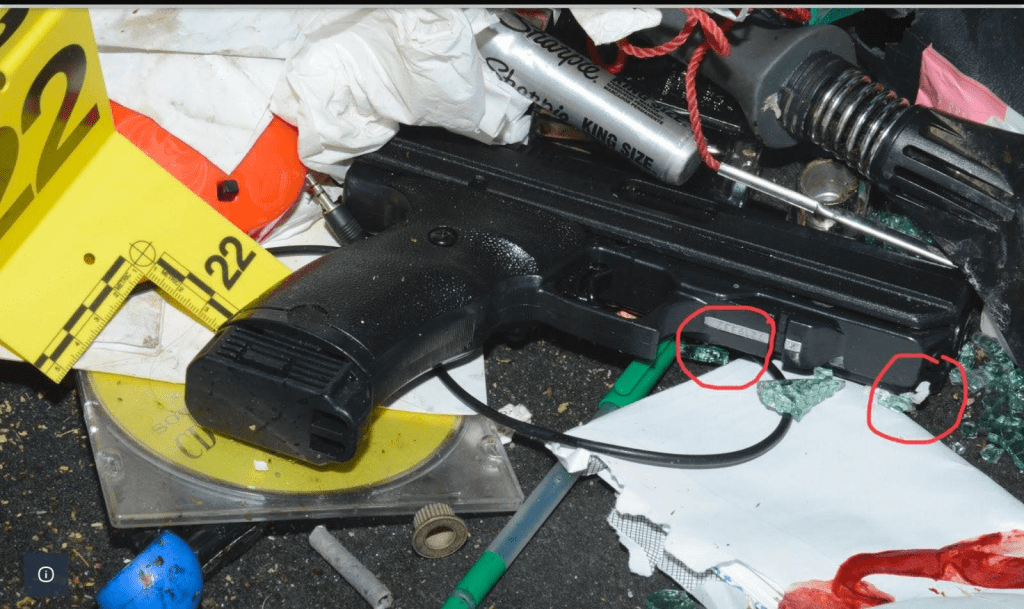
Photo M is the only crime scene photo of the pistol found in Marcus Golden’s car. There is broken glass underneath the gun, almost like the gun was placed on top of the other items in the car. Not only that, but the gun is completely visible, not covered up by paper and garbage as described by Sergeant Donahue. There is no blood on the gun. Given that Marcus suffered a head wound, which are known to bleed profusely, it is extremely suspicious that there is no blood visible on the gun.
Sergeant Donahue, when he visited the scene at 2:44am, stated in his scene report,
“The front compartment also contained numerous other personnel items strewn about. I also observed what appeared to be the butt end of a gun or taser on the passenger’s side floor. It appeared to be black in color. At no time did I enter the vehicle or take anything out of it.”
Sgt. Cheshier also described seeing the gun when he observed the scene at 9:14am, saying,
“I also told them based on the interview I conducted with E.E. I believed that there was a gun inside of that vehicle. I requested that they not move the vehicle until the gun was located and the parking lot was searched to the best of their ability to locate all the spent casings or live rounds.
I also requested that they use care with the vehicle because I was unsure if Golden had fired a weapon at the officers and gunshot residue tests may be needed inside of the vehicle.
I viewed the green Jimmy in the daylight and could see various defects in the vehicle that were consistent with bullet holes and damage done by bullets. I also could see what appeared to be the butt end (magazine area) of a black handgun that was under some loose papers on the passenger side floorboard. This is exactly where Officers described, Golden’s head and shoulders were located as he was slumped over into the passenger seat area.”
The two sergeants observed the scene a short while after Marcus was killed. However, Officer Tyrone Karst Adams (squad 211T) was one of the first officers on scene and looked into Marcus’ vehicle in the immediate aftermath. He said in his statement to Sergeant Donahue that he looked inside the car and “could not see a weapon.”
Warrant Two – GMC Jimmy at the Impound Lot
Timeline: 7:00pm 01/14/15 to 9:15am 01/16/15
While the GMC Jimmy is at the crime scene of the apartment complex, the investigators only collect one piece of evidence from inside the vehicle. The pistol. Swabs for DNA, blood, gunshot residue, and other items in the car weren’t collected for two more days.
The GMC Jimmy was towed from the apartment complex to the St. Paul Impound Lot at 7pm on 01/14/15. Sgt. Lambie then writes another search warrant to search the GMC Jimmy the following day. She writes, “The vehicle was briefly searched at 261 East University, in the parking lot, and a firearm was recovered in the vehicle. It is unknown at this time if the firearm recovered from MN plate 745EEA had been fired. Gunshot residue will help to determine if the firearm had been fired or not. Sergeant Cheshier observed a cell phone inside of the vehicle, MN plate 745EEA. The vehicle was towed to the secured police impound lot garage due to weather and lighting conditions.” Weather reports for January 14th, 2015, state that the temperature was a high of 23 degrees and it was sunny or partly sunny from 9:53am until 4:53pm. Why did the investigators wait this long?
Sgt. Lambie, in this second search warrant, requests to search for firearms, bloody clothing or shoes, blood, bodily fluids, body tissue, papers/documents to show ownership of the vehicle, papers/documents/photos to show threatening messages or statements, and cell phones or electronic devices that could be used to send threats. It was signed by Judge Gilligan at 10:26am on January 15th, 2015. One day later, the search warrant was executed by Officer Wilson and Sgt. Cheshier at 9:15am.
Why did the officers risk losing important evidence from the vehicle by waiting so long to process the vehicle?
From the vehicle, the following pieces of evidence were collected: empty gun boxes and its contents, DNA and blood, suspected bullet and/or fragments, papers, phone/cell, latent prints, MN I.D., gunshot residue, and ammunition. There were two boxes of ammunition recovered. The first was a Brassmaxx .40 S&W and the second was an Aguila .45 auto. They collected two firearms boxes. The first belonged to the HiPoint .45 and the other to a HiPoint .40. They also recovered a bullet fragment in the dashboard and another from the passenger front visor. Bullet fragments were also recovered from the rear of the vehicle by the amp, the rear storage, and the rear side of the front passenger seat. They also collected two suspected bullet fragments from the roof area and rear of the vehicle frame. As far as the paperwork they collected, they collected state patrol summons, a permit to acquire a handgun, a vehicle purchase contract, and vehicle title. DNA swabs were taken from the exterior and interior door handles, steering wheel, and shift lever. Two blood swabs each were taken from the driver’s seat, passenger seat, ceiling, and interior of the front passenger door. In addition, one gunshot residue kit was taken, labeled #1358.
Warrants Three and Four – Cell Phone Electronic Data
On January 14th, 2015, Sgt. Arnold wrote a search warrant for the contents of Marcus ex girlfriend E.E. E’s cell phone. The warrant was signed by Judge Bryan at 11:04am on January 14th.
Sgt. Arnold wrote the search warrant after interviewing J.T., the 911 caller who accused Marcus of sending him threatening messages. J.T. tells Sgt. Arnold that he had been dating E.E. for a few years and broke up with her six months earlier. After they broke up, E.E. began dating Marcus. According to J.T.’s mutual acquaintances, Marcus had assaulted E.E., took all of her possessions, and allegedly threatened her with a gun. In Sgt. Arnold’ search warrant application uses J.T.’s statement to characterize Marcus as a “violent stalker of E. A. E. and her family.” Sgt. Arnold includes that there were several police involved incidents between E.E., her family, and Marcus in November 2014. The next day, January 15th at 3:10pm, Sgt. Lambie applies and gets signed a fourth warrant for call records, SMS text messages, and all electronic data from Marcus’ cell phone number.
We are not aware that SPPD ever received the cell phone data and if they did, they have not shared it with the family despite repeated data requests.
Warrant Five – Nexus Tablet and HP Laptop
After searching the GMC Jimmy twice and searching Marcus’ grandparents’ home, Sgt. Sheila Lambie acquired a fifth warrant. Signed on January 16th at 1:38pm, Sgt. Lambie requested to search the Nexus tablet and HP laptop she found at the Ashland residence (Marcus Grandparents house)for all electronic data. According to the application for warrant number five, Sheila wanted access to the laptop and tablet in order to recover any passcodes to Marcus’ iPhone 5 which they had recovered in the GMC Jimmy. In addition, she wanted any electronic data showing threats or photographs of any firearms. Marcus’ grandmother owned the Nexus laptop but told Sgt. Lambie only Marcus used it.
The SPPD still has the laptop and has not returned it, according to the family.
Treatment of Marcus Golden’s Family Members
It is extremely unfair that Marcus Golden’s loved ones were not treated compassionately as survivors by the police officers. CUAPB recommends that after a police shooting, the police officers on the scene should make every effort to communicate quickly to the victim’s loved ones and to treat the victim’s loved ones with compassion, as they too are victims.
Marcus’ family, like many families of police violence, not only had to experience reading and viewing lies on the news and by law enforcement officials about their loved one who was killed, but they also were then forced to trust those same officials to investigate their death neutrally and thoroughly. Many families, including Marcus’, have also experienced many unexplainable malfunctions and irregularities of their phones, electronics, computers, and social media profiles. This may possibly be due to surveillance by law enforcement. Families have been making this claim for years and the recent Minnesota Department of Human Rights investigation into the Minneapolis Police Department found that MPD officers had used covert social media accounts to surveil the online presence of Black activists, groups, and organizations in the Twin Cities. This surveillance was done improperly, as MPD officers were not using the covert accounts to investigate criminal activity as required by policy.
As mentioned above, the family were mistreated by SPPD investigators at the time of Marcus’ death and possibly surveilled from thereafter. Here are some different situations that the family experienced during the course of the SPPD’s investigation.
Pauline Cullars and Monique Cullars-Doty, Marcus’s Grandmother and Aunt
SPPD’s first contact with Marcus Golden’s family took place around 8:00 a.m., when Officers Charles Sims and Benjamin Lego went to the home of Marcus’s grandparents at 1268 Ashland Ave. in St. Paul. Their primary concern should have been properly and compassionately notifying the family of Marcus’s death, but their real priority was to secure the home while Sgt. Sheila Lambie obtained a warrant for a needless search.
Marcus’s grandmother, Pauline, was at home; her husband was in the hospital at the time. The officers sat down in the living room, and Pauline did not feel she could prevent them from entering or staying, nor did she feel free to leave. This was intrusive. The officers could have waited in their squad car. Marcus’s aunt and uncle, Monique Cullars-Doty, and her husband, arrived sometime later.
Sims and Lego told Pauline that Marcus had died around 2:30 a.m. but would not elaborate. She asked many times for an explanation, but they refused to provide one. They would not say that he was killed by police. They sat in the living room for over 90 minutes. Sgt. Sheila Lambie and Sgt. Shawn Shanley arrived to execute a search warrant of the house. All of the officers left sometime between 9:30-9:45 a.m., when the search was finished.
Before she left, Sheila Lambie harassed Monique Cullars-Doty to come down to the station. Sheila told Monique that she would send a squad to give her a ride to the station or Monique could drive herself. Sheila also offered to call the police department’s clergy to meet with the family. Monique then looked up “saint Paul police shooting” on her cell phone and found a photo of the scene online. Monique showed it to Sheila, saying that the news was telling a different story of what happened to Marcus than what the officers had told the family. Sheila and the other officers left soon after that.
Shortly after the officers left, Monique Cullars-Doty received a phone call from Regions Hospital. Marcus’s mother, Ericka, had been brought there by SPPD.
Ericka Cullars-Golden, Marcus’s Mother
Ericka Cullars-Golden was a member of the volunteer St. Paul Police Reserve for 20 years, even serving as a Sergeant. She loved the work, was friends with many people in the department, and had a greater inside understanding of the department than the average person. She volunteered over 400 hours some years and received numerous awards.
Around 8:15 on the morning of Marcus’s death, Sgt. Patrick Cheshier and Officer Jody Larsen went to US Bank in downtown St. Paul, Ericka’s place of work. Jody Larsen was chosen to go because she was a friend of Ericka’s.
Sgt. Cheshier questioned Ericka at length before telling her that Marcus had been killed. According to his report, he asked Ericka about when she had last seen Marcus, and whether she was close with him. He asked for her parents’ address. He asked whether Marcus owned a gun, and where the gun was currently located. He asked if Marcus had made threats to the police or to E.E., and he wanted to know what Ericka thought of E.E.. He asked about Marcus’s recent hospitalization at Regions Hospital. After all of this, he finally told Ericka that her son was dead.
Sgt. Cheshier was clearly motivated to get information from Ericka, especially about possible threats against the police (he even returned to this topic after breaking the news), and he prioritized this over telling a mother that her son had died. It is simply cruel. Additionally, Cheshier wrote in his report that Ericka “did not seem particularly shocked by the news…it appeared she expected something to happen to him,” as if there is one appropriate way for a person to act after receiving devastating news. Cheshier described her reaction in a way that suited SPPD’s narrative about the incident.
After receiving the news, Ericka stopped at the nearby Downtown Patrol Unit office to talk to a friend, Officer Burton. She was, of course, extremely upset. Burton later wrote that Ericka said “I have only one son left. I have nothing left to live for.” The sergeant on duty, John Riley, considered this a suicidal statement and called Sr. Commander Mathison, who said Ericka should be taken to Regions Hospital for a mental health evaluation.
While at the hospital, Ericka was not told that Marcus was in the very same building. She was not told that officers were currently searching her mother’s house. She was isolated from her family and not given the opportunity to contact them. SPPD held a lot back from Ericka, which would be unfair in any case, but it is especially egregious given Ericka’s long relationship with and service to the department.
Scott Golden, Marcus’s Father
Sgt. Cheshier called Scott Golden, Marcus’s father, on January 14. He was seeking information about Marcus’s guns and where they were located. This is very odd–why would it matter where any gun belonging to Marcus was located? Cheshier and Donahue both reported seeing the butt end of a gun in Marcus’s car early that morning. If he had a gun at his father’s house or elsewhere, how does that help the investigation of what occurred in that parking lot?
Not only did Sgt. Cheshire call Scott Golden, but Sgt. Gaden was also asked to make the death notification to him and to inquire about Marcus’ firearm. Sgt. Gaden went to Scott’s home, no answer. Gaden did end up speaking to Scott on January 16th on the phone, but it is not clear if he asked about Marcus’ gun.
Treatment of the Family at 261 University the Following Week
A week after Marcus had been killed, the family visited the apartment building to pass out flyers for an event they were holding in memory of Marcus. Two officers responded to the apartment building. Officer Morgan attempted to escalate the situation with the family. He told them that they were frightening the residents and they couldn’t be there. Ofc. Morgan and Ofc. Wong also took the flyers the family had put in the building and Ofc. Morgan told them they couldn’t put flyers on the car. Ofc. Wong attempted to play “good cop” with Ericka Cullars-Golden. He gave her his condolences and said he would call her, which he later did.
The family left the scene. However, a reporter later told them that more squads had been dispatched to the scene too.
In considering SPPD’s treatment of Marcus’s family, some other questions stand out:
Why not give the family accurate and truthful information while informing them of Marcus’s death?
It seems SPPD’s intention was not to support a grieving family. They were more concerned about locating evidence to shore up their evolving narrative about what happened earlier that morning. They lied and continue to lie to the family.
Why was SPPD so intent on collecting incriminating information about Marcus in the aftermath of the shooting?
Was it really necessary to take Ericka to Regions Hospital for a psych evaluation? SPPD’s treatment of her suggests they wanted to keep her isolated from her family and friends, including friends in the NAACP, to make her look unstable and secure more time to create their narrative. Ericka was quickly released by the psych ward at 10am, so obviously her mental health checked out.
Why did SPPD pull Ericka’s driving record? And while providing the reason for accessing the record, why did they say it was to “prosecute a crime?”
Handling of Marcus’ Car by the Saint Paul Police Department
The treatment of the families themselves aren’t the only thing the St. Paul Police Department degrades; they also mistreat and damage the property and evidence of their loved one’s case as well. Marcus Golden’s car is a critical piece of evidence in this case. The car had been wrapped when it was transported to the SPPD Impound lot to be processed by the forensics unit. It was searched and photographed multiple times by SPPD and SPPD Forensics before being temporarily kept in covered storage at the impound lot. The photos show the car in a garage, protected from the elements.
The former Golden family’s attorney had submitted a data preservation letter shortly after Marcus’ death requesting that all evidence, including the car, be preserved in case the family wanted to go forward with a lawsuit. However, the car was not preserved. In May 2019, a letter was sent by the SPPD Impound lot to Marcus Golden at his mother’s address. His mom, Ericka, was signed up for informed delivery with the US Mail, which is a service that allows you to digitally preview your incoming mail for that day. Ericka saw the letter from the Impound lot on digital preview but when she went home, the letter was not there. Ericka called the Impound lot about the letter and was told that the letter was back at the SPPD Impound lot. They refused to resend the letter to her. A few days later, they called to tell her that they were preparing to auction off Marcus’ car and if she wanted to retrieve the car, she would have to pay the impound lot fees. The fees totaled more than $900. The Golden family held a press conference to stop the impound lot from auctioning off Marcus’ car. Community members and a few St. Paul City Council members called on the SPPD to respond. Shortly after the family’s press release, the SPPD reported to the media that they did not know how to get in touch with the family to confirm whether or not they wanted the vehicle and that is why they attempted to move forward with auctioning it off. The SPPD attempted to destroy this very crucial piece of evidence for the family without giving them notice or an opportunity to retrieve the car. This is in spite of the fact that Ericka Golden had been a SPPD Reserve Officer for over twenty years and SPPD had collected the family’s contact information at the time of their interviews. Interestingly, the SPPD called Ericka in the morning before the press conference took place to say that they would not be auctioning off the vehicle and they would waive the impound lot fee.
When the family went to view the car, the person working at the impound lot was extremely rude and hostile towards the family. It appeared to the family that the worker already knew who they were. The worker told the family that there were no photos allowed inside and that only one person could go in at a time. When the family saw the vehicle, it had been left outside, uncovered, and appeared as if it had been burnt out. The car was a mess and it appeared that animals had been living in it. The car had been exposed to the elements for four Minnesota seasons, potentially destroying critical evidence that the family may have needed in case of a lawsuit against the city and the police department.
St. Paul City Attorney Refuses to Represent Officers Due to a “Conflict of Interest”
This past January, the St. Paul City Attorney’s Office put in a request to the St. Paul City Council to hire outside counsel for the two officers who killed Marcus Golden: Jeremy Doverspike and Dan Peck. The request was snuck onto the St. Paul City Council consent agenda before their meeting when a community activist noticed it. The city council intended to discuss the matter in a closed-door meeting. Closed sessions of the city council are permitted for “attorney-client discussions about litigation strategy.”
As Michelle Gross, President of CUAPB wrote at the time,
“any discussion of hiring outside counsel is not a matter of attorney-client privileged discussions about litigation strategy but is, instead, a contractual matter that must be conducted in an open meeting, thus cannot be part of the closed-door session [that was] scheduled for January 26, 2022.”
St. Paul city council members were supposed to vote on the agenda item, but their decision was delayed after community pushback.
The city attorney’s office said that they were requesting the outside counsel since “each (officer in the Golden lawsuit) is entitled to their own defense of their respective actions” and their office “cannot handle defense of both of them in the instance where defense of one may” work to the detriment of others. According to them, representing the two officers presents a conflict of interest to their office.
Marcus Golden’s aunt, Monique Cullars-Doty, opposed the move saying, “Why would the St. Paul city council write two blank checks to pay an independent law firm to do the work that the St. Paul city attorney’s office has been doing for other officers?” She was joined by relatives of three other people who had lost loved ones to the St. Paul police.
Ultimately, the city council did move forward and approved the city attorney’s office request to hire outside counsel for the two officers.
After More than Six Years, Golden Family Attorney Adds Wrongful Death Claim
Pioneer Press reporter, Mara Gottfried, wrote,
“Wrongful death claims generally have to be filed within three years under Minnesota law. The Golden family’s attorney, Paul Bosman, argued they should be allowed to amend the lawsuit to include wrongful death because of the law’s “murder exception,” which says a wrongful death claim can filed later if it was “caused by an intentional act constituting murder.”
U.S. Magistrate Judge Elizabeth Cowan Wright wrote in a December order, allowing for the wrongful death claim to be added, that for the officers to prove their use of deadly force was justified under state law,
“it will need to be shown that Doverspike and Peck had reasonable grounds to believe that the fleeing Golden had committed or attempted to commit a felony involving the use or threatened use of deadly force or that he would cause death or great bodily harm if his apprehension was delayed. The complaints do not set forth what Doverspike and Peck knew at the time they shot Golden.”
In a transcript of a 911 call, a man reported he’d been receiving death threats from his ex girlfriend’s former boyfriend, who he said was named Marcus and “always has a gun.”
The city’s original response to the lawsuit last February said injuries or damages alleged in the lawsuit “were caused solely by reason of … Golden’s own wrongdoing and/or misconduct,” and the officers’ actions “were legally reasonable, proper and necessary under the circumstances and authorized” by U.S. and state laws.
The family’s lawsuit is seeking at least $100,000 in damages, though Cullars-Doty said it’s not about the money. “I want accountability and change,” she said Monday.”
Interaction with Former Washington County Attorney Pete Orput
Former Washington County Attorney Pete Orput made comments to Monique about Marcus’ case and Jaffort Smith’s case. S. Mattson, a filmmaker, caught the incident on film. We have had trouble locating the film and this section will be completed once the footage is acquired.
Limitations
CUAPB began this reinvestigation into Marcus Golden around January 2021. Over the span of the last year and a half, we have submitted numerous data requests to the City of St. Paul. The City and SPPD have failed to comply with Minnesota Government Data Practices Law, MN. Stat. Chapter 13. See the list below for the data requests that are still outstanding.
Our investigation was obstructed because SPPD did not comply with state law and our requests for data. In particular, we are missing crucial information about whether SPPD completed ballistics testing on the officers’ weapons and the pistol they allegedly found in the car. We also did not receive officer training or complaint data.
Data Requests Yet to be Fulfilled by the City of Saint Paul
| Data Requested | Date Requested |
|---|---|
| Complaint and discipline records for Officer Dan Peck | 02/18/2021 |
| Complaint and discipline records for Officer Cohlman Rutschow | 02/18/2021 |
| Complaint and discipline records for Officer Ler Htoo | 02/18/2021 |
| Complaint and discipline records for Officer Bobby Donahue | 02/18/2021 |
| Complaint and discipline records for Officer Patrick Cheshier | 02/18/2021 |
| Complaint and discipline records for Officer Sheila Lambie | 02/18/2021 |
| Complaint and discipline records for Officer Jeffrey Rothecker | 02/19/2021 |
| Training records for Officers Doverspike and Peck | 3/22/21 |
| Any and All Mobile Digital Communicator (MDC) messages between Saint Paul Police Officers on the night of 1/14/2015 and the following two days. | 02/22/2021 |
| St. Paul Police policy for use of emergency lights and dash cameras | 4/14/21 |
| In car camera video card from Squads 1183 and 1375 | – |
| 911 and Radio Transmissions from the incident | – |
| All photos taken during the search warrant of Marcus’ grandparents home on 11/14/2015 | 3/22/21 |
| Laboratory testing requests and reports involving the crime scene evidence from Marcus’ death | 02/17/2021 |
| All ballistic and firearms testing and laboratory reports | 4/12/21 |
| Any records and/or photos of repair for squad 1183 | 02/22/2021 |
| Forensic sketches of the crime scene | 02/18/2021 |
| All supplemental incident reports filed for the Marcus’ case | 4/1/21 |
| Details about Doverspike and Peck’s scheduled shift on 1/13/14 & 1/14/14, including the start and end times, location, and assignment | 4/21/21 |
| All emails and correspondence concerning Marcus Golden’s green GMC Jimmy | 02/22/2021 |
| All emails and correspondence concerning Marcus Golden’s name within the Saint Paul Police Department | 02/22/2021 |
| All data including Marcus’ name on the SPPD’s Computer-Aided Dispatch system 02/22/2021 | |
| All police reports and criminal records concerning Marcus Golden | 02/22/2021 |
| All audio, video, and speech notes for former St. Paul Public Information Officer Paul Paulos for Marcus’ case | 3/18/21 |
| All text and Glide messages between Marcus, J.T., E.E., Marcus’s Mother | 4/7/21 |
| The names of all deputies working at the Ramsey County Jail when Marcus was being held from 11/26/204-11/28/2014 | 4/21/21 |
| All audio, video, and other documents regarding Marcus’ interview with Sgt. Ken Jensen in Ramsey County jail on 11/26/2014 | 4/20/21 |
| Incident and supplemental reports for the 11/09/14 911 call involving Marcus. | 4/21/21 |
| All information on the Saint Paul Police Department Chaplains including their qualifications, training, and job details. | 5/27/21 |
| The name and training record of the dispatcher who spoke with the 911 caller who called about Marcus | 5/27/21 |
| All public training and policies for the Saint Paul Police Department dispatch | 5/27/21 |
Conclusion
On Wednesday, January 18, 2023, eight years and three days after killing Marcus, Saint Paul voted to settle his family’s lawsuit by placing a memorial bench to Marcus near the Lake in Como Park, adding one of his family members to the City’s public safety committee and paying the family $1.3 million.
Despite what internet cynics might say, there is no dollar figure that a mother would accept in trade for her son, nor grandmother for her grandson, nor auntie for her nephew. What is remarkable is not that the City paid the family for their killing of Marcus, but that despite the sorrow, the denials, and the temptation to despair, the family was able to continue fighting until the City cried uncle.
What is also remarkable is the City’s long and wide resistance to the truth. From the instant vilification of Marcus at the press conference the day after his death, through the lies in the officer’s statements regarding the events of Marcus’ death, to the slow resistance to the release of public information, Saint Paul fought the revelation of the truth. Even in settlement, the City denied fault, while paying one of the largest settlements in its history.
What the City does not realize is that in its resistance to the truth, it helps to create the forces that will expose it. Settling Marcus’ case begins to expose the pattern of Saint Paul Police use of deadly force against Black men, exposing the City to liability instead of just blaming a few bad apples. Forcing the family to court resulted in recognition of the Murder Exception to the Wrongful Death statute of limitations, giving an opportunity for justice to the families whose chance is long past. Forcing the fight for truth created a family of fighters for justice, both Marcus’ birth family and the volunteers who helped created this report.
The fight for justice for all stolen lives continues.
Appendicies
A. Footprint Analysis, Continued.
A key element in the case of Marcus Golden is where Officers Doverspike and Peck were standing throughout their interaction with him. By looking at the photos taken by the SPPD FSU early in the morning, we are able to approximate the location of the officers by the footprints in the snow. Remember that on January 14th, 2015, it had lightly snowed in St. Paul, MN. In order to see the footprints clearer, we used the brush tool in Photoshop to shade the footprints in and make them more visible to the eye.
Doverspike’s Footprints In his interview with SPPD homicide detectives, Ofc. Doverspike stated that after he angled the car off of a 110-degree angle from Marcus’ car in the parking lot, he opened the driver’s side door and exited his vehicle. Without closing the door, he “stepped to the side just in front of it to see the license plate” of Marcus’ car.
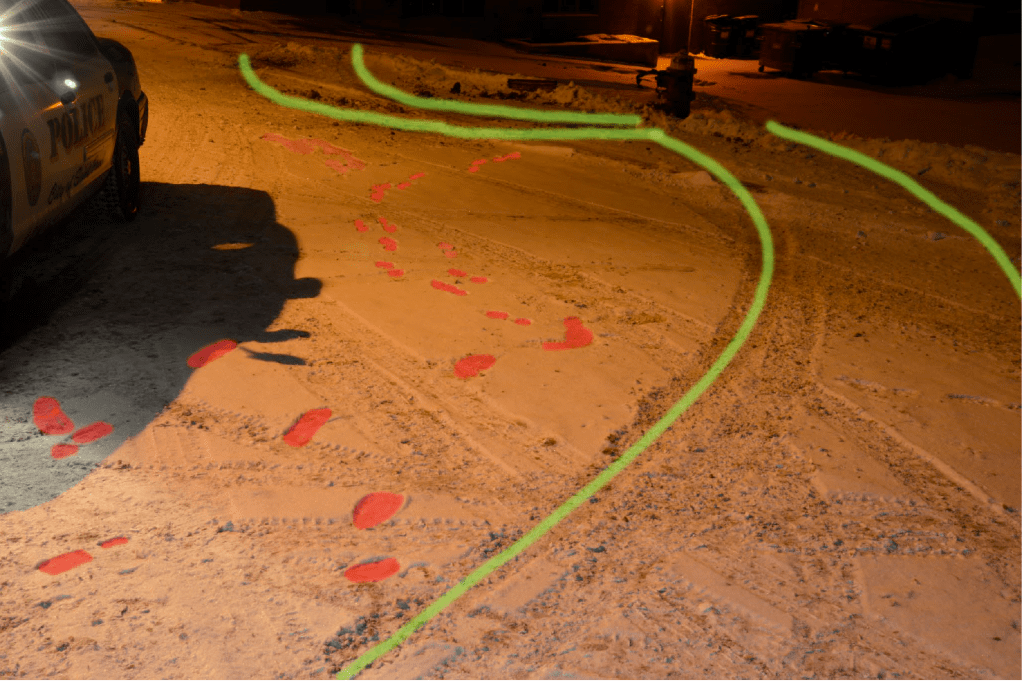
Looking at the physical evidence of the footprints in the snow, it does appear that Doverspike stepped out of the police car and walked towards the front of the squad car. Then he turned, walked two steps in the southwesterly direction, then turned and ran east.
At this moment, Doverspike says that Peck is yelling at the driver (Marcus) to show him his hands. Marcus, who according to Doverspike had part of his window down, raises his left hand in the air but does nothing with his right. Peck repeats himself several times and “finally, the driver puts his hands on the steering wheel.” And as Doverspike is airing the license plate, Doverspike can “hear Peck ask the guy if his name is Marcus something. He says no.” When Doverspike is done “airing the plate” or reading the plate number over the police radio along with their location on scene, he all of a sudden sees the driver drop his right hand. Doverspike states that Peck begins yelling at him again and all of a sudden Marcus “reaches his right hand up and puts the car in drive.” Doverspike raises his gun up from the low, ready to point at him. (Note: Doverspike never states in his interview when he took his gun out of his holster and put it in the low ready position.) Doverspike states Marcus then drops down to the side, covering the passenger seat, and then pops his head back up enough to see over the dashboard. Doverspike claims Marcus looked at him and then took off driving. Doverspike then states that Marcus’ car hits his gun, and he fires two rounds. Then Doverspike says he saw “the rear of [Marcus’] car either hitting the fire hydrant or came really close to hitting it. Then he veers left, or north, through the parking lot and hits a couple cars.”
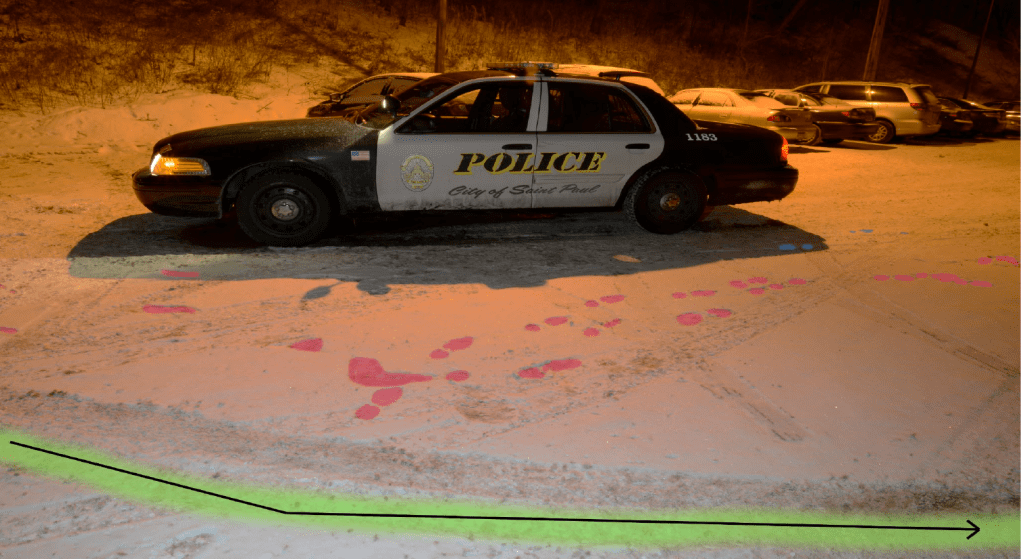
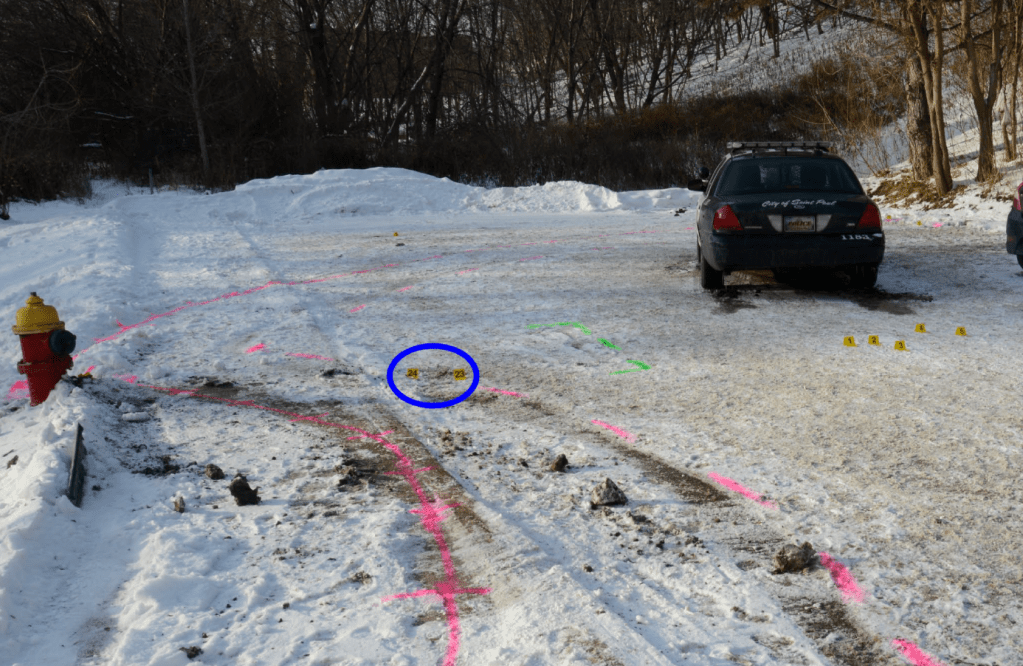
As stated above, Doverspike states that when he was near the front of his vehicle airing out the GMC Jimmy’s license plate, Marcus put the car in gear, looked straight at him, and started driving. He then stated that Marcus’ car hit his gun, causing him to fire two rounds. Typically after a firearm has been fired, the shell casings fly out of the gun on the right side between the 45- and 90-degree angle. They also land 6-10 feet away from where the gun was fired. In this case, the location of the casings (highlighted in blue in the image above) relative to Doverspike’s footprints and the tire tracks of Marcus’ car disagree with Doverspike’s story of events. Alternatively, the casings appear to show that the officers were standing almost parallel to each other when they fired their handguns.
Tinted Windows
Officers Doverspike and Peck in their statements repeatedly claimed that they could see Marcus’ movements and hands through the windows of the GMC Jimmy. However, another officer who arrived on scene after the car crash said that the tint on the GMC Jimmy’s windows were too dark to see through, so he had to bust out the rear window in order to look in.
Handling of Evidence
In the aftermath of Marcus’ death, investigators came in to look at the scene. One of the windows in the Jimmy was shattered, which removes any investigator’s ability to see whether a bullet exited this window.
In addition, the passenger seat footwell was manipulated. We know this because there is a photo of a gun sitting on top of broken glass. Before the incident, all the windows of the Jimmy were intact, so this gun had to have been moved. Previous investigative statements also indicated that the gun (?) was buried under many things in the footwell.
This investigation also knows that in the morning after Marcus’ death, the house where Marcus had been staying was entered and searched with little-to-no explanation as to why they were searching. They were allegedly looking for evidence of firearms.
The evidence of this incident was poorly managed and led to a lack of clarity on the details of Marcus Golden’s death.
Video Timeline
As mentioned earlier, there was no body-worn camera or in-car camera footage of the event. However, there is surveillance footage from the apartment complex lobby. The camera only captured footage of the lobby and a small portion of the parking lot, so we are not able to see the full picture of what happened to Marcus. See Appendix X. below for the full video timeline.
The surveillance video evidence disputes the accounts of the responding officers to the scene. First, it tells us that the officers responded to the scene earlier than they stated and secondly, the second responding squad car was much closer to the scene than they reported.
Overview of the Video Footage
The surveillance footage begins at 1:31am. A few people enter the apartment building and then at 2:06am, a dark car drives through the lot towards the end. This is the only time a car drives through the lot, which differs from the 911 caller’s claims that Marcus came and went from the parking lot numerous times.
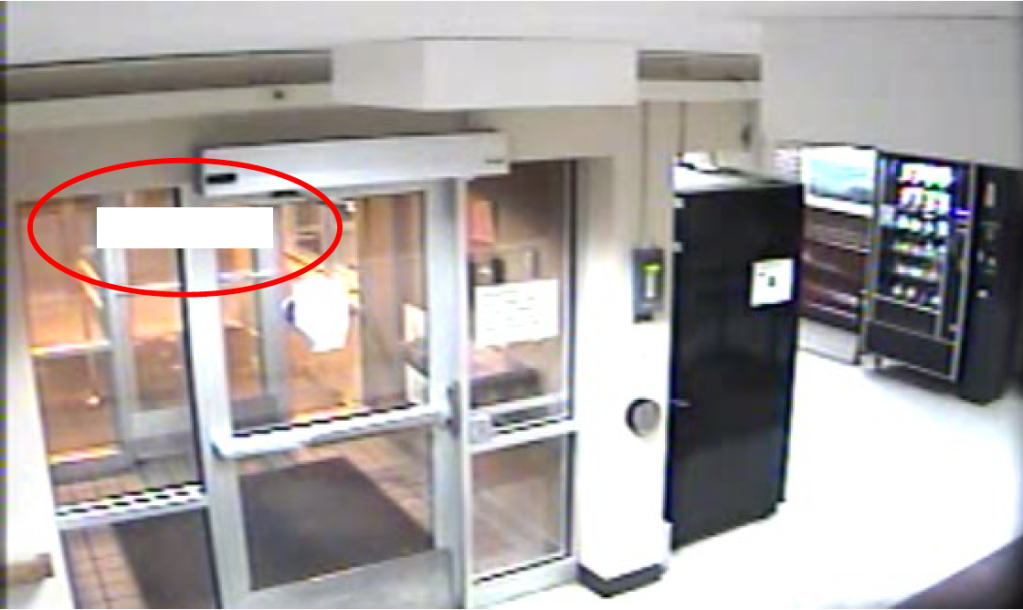
2:19:24am, a squad car rolls into the frame. We know from the radio communications that at about 2:20am, the officers radioed “shots fired.” At 2:20:10am, the GMC Jimmy drives southeast, towards the exit of the lot, before crashing into the row of parked cars.
At 2:20:25am, there is movement towards the GMC Jimmy. It appears as though an officer from the southeast end of the lot walks up to the car. At this point, it is believed that Officers Peck and Doverspike were approaching from the other side of the lot, from the northwest.
At 2:20:50 The movement appears to be officers walking towards the Jimmy with their flashlights on. Two officers slowly walk up to the scene and towards the Jimmy at 2:21:09am.
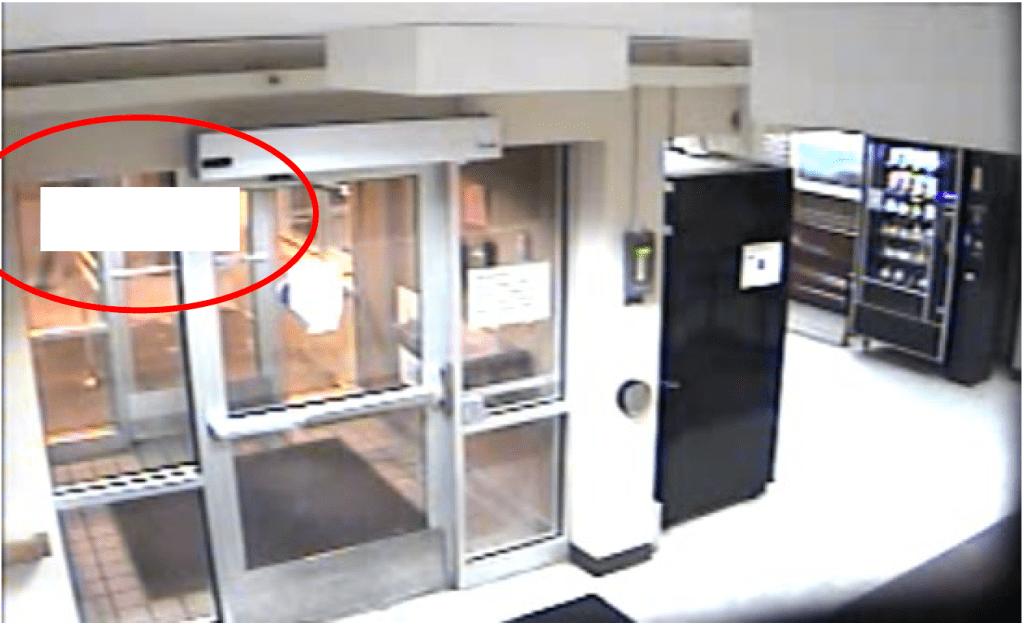
At 2:28:03am, another squad arrives from the southeast with its lights flashing. At 2:28:29am, multiple officers are seen running or walking on the scene from the east and going to the middle of the parking lot. Then at 2:35:02, there is an unexplained white flash
B. Aftermath of the Shooting
There are several important issues when analyzing the immediate aftermath of Marcus’ death at the hands of Saint Paul Police Officers Jeremy Doverspike and Dan Peck. They are as follows:
- Number of Shots
- Rendering Aid
- Key Witness Statements
Number of Shots
The SPPD collected seven discharged cartridge casings at the scene. Two casings were found, according to Sergeant Donahue, between the fire hydrant and “where it appeared a person had fallen next to the tire tracks,” (p. 25). These two casings (evidence number #23-24) were from a FC 9mm Luger. The other five shell casings, according to Donahue, were “located approximately 6 feet behind the rear of the squad,” (p. 24). These five casings (Evidence number #1-#5) were from an FC 9mm Luger.
According to Sergeant Donahue, two of which came from Officer Doverspike’s gun. Five came from Officer Peck’s gun. It does not appear that SPPD forensically examined the bullets collected by the Medical Examiner from Marcus’ body nor did they run ballistics tests on the officers’ weapons. Because of this, we are unable to determine which officer fatally wounded Marcus. From the evidence collected and information from officer statements and crime scene photos we know that:
- Officer Doverspike fired two shots after running alongside the tracks of the GMC Jimmy.
- Officer Doverspike claimed that his gun was hit by the moving GMC Jimmy. He fired twice.
- That action caused Officer Peck to start shooting because he mistakenly thought Marcus Golden shot at them instead of his partner Officer Doverspike shooting.
- Officer Peck shot at Marcus five times as he drove away from the officers.
- Officer Doverspike was in Officer Pecks line of fire.[109]
- Officer Doverspike fell to the ground; we must ask was it to avoid the gunfire by his partner? .
- Officer Scott Sandell’s witness statement was that Officer Peck and Officer Doverspike fired 6-10 shots and then Marcus Golden hit the fire hydrant. This statement does not fit the evidence.
- Officer Tyrone Karst-Adams’ witness statement was that Officer Peck and Officer Doverspike both fired before Marcus hit the fire hydrant.
Render Aid
Part of our analysis of critical incidents is whether or not the police officers gave medical aid after using deadly force. Minnesota State law[111] and SPPD Police Department policy[112] require officers to render aid to people who have been injured by them. In addition, police officers are required by the Minnesota Peace Officer Standards and Training licensing board to be certified Emergency Medical Responders (EMR).[113]
However, we found that in several investigations of police-involved shootings, officers did not render any medical attention.
In Marcus Golden’s case, the officers did render aid. The officers pulled him out of the car by his feet and allowed him to fall to the ground with a head injury. The officers also called for an ambulance and fire rescue to respond to the scene. They discussed applying pressure to the wound, making sure Marcus’s airway was clear and put him on his side to breathe. This is from an officer statement:
Officer Butchin came on scene and covered security while Marcus was removed from the vehicle and aid was rendered. Butchin wrote that Marcus was having trouble breathing and was placed on his back then Officer Lokhorst did jaw thrust to help Marcus breath. Medics arrived and Marcus was placed in an ambulance. Lockhorst grabbed Marcus’ wallet out of his pants and gave it to Off Sweeney who took Marcus’ ID out of the wallet. Butchin brought wallet to the property dept. Butchin kept the crime scene log. Page 93-96
Responding Officers
“On 01/14/2015, at about 0214 hours, Officer HTOO and I (Officer RUTSCHOW), squad 223T responded to a call of Harassment at 261 E University Ave. Call comments stated that the complainant was receiving threatening texts from GOLDMAN has been known to be a violent person and has made threats against St. Paul Police Officers that he would kill them. Furthermore, as the call developed, information was dispatched that the comp knew GOLDMAN had recently purchased a handgun. As we continued to the call, it was at about Jackson/University we heard squad 215 air shots were fired. Officer HTOO and I arrived on scene seconds later and ran to the back parking lot which was on the north side of 261 E University.”
Officer RUTSCHOW
C. The Role of Training
Police Departments in Minnesota train their officers using multiple different training designs that are accredited by the Minnesota Peace Officers Standards and Training Board as well as their own individual police department training and academies. SPPD Police have a variety of training opportunities available to them throughout their careers. Below is a sequence of training the officers had at the time of the shooting, how they failed to follow it, and how the state of police training is ineffective- or even dangerous when responding to such calls. This is a growing problem.
St. Paul Police Department
SPPD Use of Deadly Force Initial Analysis Compared to other jurisdictions, St. Paul has a troublingly high rate of police homicides. According to data compiled by mappingpoliceviolence.org, SPPD’s police homicide rate, 9.18 police killings per 1,000,000 population, is more than double the national average (3.95 per 1,000,000).
The St. Paul Police Department is 16th out of 100 departments tracked for rate of deadly force between 2013 and 2017. The average annual SPPD police homicide rate for black people is 20.4 police killings per 1,000,000 population compared to a national rate of 7.971 per 1,000,000.
Those rates far surpass other urban areas such as New York (1.77), Minneapolis (2.9), Boston (3.24), Pittsburgh (3.63), and Milwaukee (4.48). Local murder and violent crime rates do not appear to explain St. Paul’s high rate of police killings. Among jurisdictions with relatively low murder rates, St. Paul (3.69 homicides per 1,000,000) has one of the highest rates of police killings. By the department’s own data, St. Paul’s police killings numbers have edged and consistently remained up, averaging more than two per year since 2012.
While the base numbers are small, they represent lost human lives, and the trend is concerning. Notably, the crimes against persons rate are down 12% for that same period of 2012-2016. Also of note are the number of police killings of individuals armed with weapons other than firearms. Based on available data from SPPD and news reports and the Pioneer Press database on police killings in Minnesota, nearly half of all SPPD police homicides from 2004 involve police killing of persons armed with weapons other than a firearm. Of the 22 SPPD police homicides from 2004, 10 involved weapons other than firearms, including rocks, screwdrivers, knives, moving vehicles, and blunt objects.
While officers are not expected to put themselves in lethal danger and the facts regarding each of the 10 incidents might shed important light on imminent threats, this area warrants further analysis and scrutiny for ways to improve outcomes for police and communities.
Note that all five policies and the IACP consensus we compared to SPPD’s draft (Cleveland, Las Vegas, Seattle, Philadelphia, IACP) have narrower parameters for use of force to require a degree of imminent threat, yet St. Paul’s draft allows for the shooting of suspected felons who are fleeing as well as discouraging but not prohibiting shooting at moving vehicles. Many policies also prohibit shooting at moving vehicles (NYC). St. Paul’s policy on use of deadly force and shooting at vehicles must be examined in light of this and other data.
Officer Training
In the Saint Paul Police Department’s summary report of use-of-force incidents in 2016 and 2017, they state that officer use-of-force training “places a heavy emphasis on using time and distance to de-escalate situations and using multiple officer tactics so fewer, potentially injury causing, techniques are required.”
The 2014 SPPD Use of Force training which CUAPB has reviewed is deficient in several respects. First, the training materials are of generally poor quality. The accompanying slide deck is a hastily-put-together list of bullet points which clearly relies on the presenter to fill in most details. Typos and inconsistent formatting are found throughout the content, such as a quote attributed to “Plutrach.”
The training provides questionable information such as the 21-foot rule and “Tempe Study.” It is clearly designed to encourage officers to use force and frame it in the most legally advantageous way. Law and policy are glossed over or prominently listed among officers’ reasons for hesitation (which is discouraged). The application of force, meanwhile, is treated much more positively with slogans such as “Everyone in Prison worked out today, did you?”
Unless the St Paul Police Department’s Use of Force training was delivered by a phenomenal public speaker who went out of their way to elevate the importance of restraint in the application of force, it is unlikely that this content helped trainees develop a responsible outlook on the use of force in their duties. The department appears to have invested the bare minimum effort required to comply with their training requirements.
D. Saint Paul Police Department Use of Deadly Force Analysis
Compared to other jurisdictions, St. Paul has a troublingly high rate of police homicides. According to data compiled by mappingpoliceviolence.org,
- SPPD’s police homicide rate, 9.18 police killings per 1,000,000 population, is more than double the national average (3.95 per 1,000,000).
- The St. Paul Police Department is 16th out of 100 departments tracked for rate of deadly force between 2013 and 2017.
- The average annual SPPD police homicide rate for black people is 20.4 police killings per 1,000,000 population compared to a national rate of 7.971 per 1,000,000.
Those rates far surpass other urban areas such as New York (1.77), Minneapolis (2.9), Boston (3.24), Pittsburgh (3.63), and Milwaukee (4.48). Local murder and violent crime rates do not appear to explain St. Paul’s high rate of police killings. Among jurisdictions with relatively low murder rates, St. Paul (3.69 homicides per 1,000,000) has one of the highest rates of police killings. By the department’s own data, St. Paul’s police killings numbers have edged and consistently remained up, averaging more than two per year since 2012. While the base numbers are small, they represent lost human lives, and the trend is concerning. Notably, the crimes against persons rate are down 12% for that same period of 2012-2016. Also of note are the number of police killings of individuals armed with weapons other than firearms. Based on available data from SPPD and news reports and the Pioneer Press database on police killings in Minnesota, nearly half of all SPPD police homicides from 2004 involve police killing of persons armed with weapons other than a firearm.
Of the 22 SPPD police homicides from 2004, 10 involved weapons other than firearms, including rocks, screwdrivers, knives, moving vehicles, and blunt objects. While officers are not expected to put themselves in lethal danger and the facts regarding each of the 10 incidents might shed important light on imminent threats, this area warrants further analysis and scrutiny for ways to improve outcomes for police and communities.
Note that all five policies and the IACP consensus we compared to SPPD’s draft (Cleveland, Las Vegas, Seattle, Philadelphia, IACP) have narrower parameters for use of force to require a degree of imminent threat, yet St. Paul’s draft allows for the shooting of suspected felons who are fleeing as well as discouraging but not prohibiting shooting at moving vehicles. Many policies also prohibit shooting at moving vehicles (NYC). St. Paul’s policy on use of deadly force and shooting at vehicles must be examined in light of this and other data.
E: Other Failures to Follow SPPD Policy
The policies referred to below come from the St. Paul Police Department Manual dated 1/17/2014. 1) 365.00, Homicide and Robbery Unit (Revised May 16, 2013)
Under “First Officers at the Scene”:
(4) (C) The officer assigned to guard the crime scene will record in a report the names of all persons entering the scene. This officer will be responsible to start a Crime Scene Sign-in (PM 607-10R). This form requires all personnel entering the scene to provide the following information: printed name and signature, their agency and unit assignment, the time of entry and exit, and the reason for entry into the crime scene.
Under “General”:
(2) No one will enter the crime scene without approval from the officer-in-charge and will only enter after having signed the crime scene log sheet.
(3) All personnel entering crime scene will prepare a written report detailing why they were there, what they did and what they observed.
Many officers did not sign in and out of the crime scene, most notably around mid-day on the 14th when the search warrant was executed on the Jimmy (and a pistol was reportedly found). Sgts. Cheshier and Lambie were there, along with [who else], and no one signed in or out.
The following additional officers are listed as having been at the scene, but did not sign in (see the CN report on part II, p. 96): Tyrone Karst-Adams, Peter Baldwin, Craig D. Campbell, John Conrad Jr, Dominic Dzik, Christopher Hamblin, Nicole Erickson, Thomas Erickson, Christopher Hoyt (Doverspike’s monitoring officer), Krystel Karels, Emao Morgan, Joshua Nyhus (guarded the crime scene later in the day), Nicole Obrestad, Francisco Ortiz, Justin Paulson*, Mark Ross, Gregory I. Williams, and Carlos Wong.
Note: *Justin Paulson took photos of the scene of Marcus’s arrest at the park in 2012 (dom assault/gun charge)
Many officers did not write a supplemental incident report. (If these reports exist, SPPD has withheld them.) Most notably, Ler Htoo, one of the very first officers at the scene, did not write one. He was in the same squad car as his trainer, Colman Rutschow, and it would have been important to get Htoo’s account as well. Other officers who did not write a report: Ger Vue, Zach Juntunen, Sgt. Jeff Lewis.
2) 441.04, Radio Procedures (Revised July 1, 2011)
The first squad sent on the call is in charge at the call and will make the original report. This is true even if assisting squads arrive first. If an assisting squad or closer squad wishes to volunteer for the call (“I’ll take the call”) and if the dispatcher approves, then responsibility for the call and report shifts to them.
Under “Radio Communications”
District Units: All district squads shall communicate with the dispatcher upon arrival at the scene of an incident by designating their call number and saying, “arrived at scene.”
Doverspike and Peck did not radio to dispatch that they would take the call. They just went.
Doverspike and Peck did not radio to let dispatch know they were on the scene until they had both already gotten out of the car, were allegedly interacting with Marcus, and were moments away from shooting him. Why didn’t they radio to dispatch as soon as they arrived? There was no rush for them to drive up to Marcus and get out of the car. They could have called dispatch much sooner, and this one action could have slowed things down enough to alter the trajectory of events. How would things have been different if the second car was already there when Doverspike and Peck approached Marcus?
| Time | Speaker | Transcription |
| 0:00 | Paul Paulos | Everybody ready? |
| Unknown Speaker | Yep. | |
| Paul Paulos | Alright, goodmorning, before we get going here, it’s going to be a very brief statement today. As you know this is very fast, this is very ongoing. This is now. | |
| Paul Paulos | We have limited information uh to give you, but we’re going to give you something because of what’s going out there and what people are hearing. | |
| 0:24 | Paul Paulos | So this morning at approximately 2:15am, we were called to 261 East University. And the call was pretty normal and [inaudible] where we get a call where it says, um, our complainant is being threatened via cell phone messaging that she’s going to be harmed. |
| 0:41 | Paul Paulos | Also there was information given to the officers at this point in time that a gun possibly could be held by the suspect in this matter. |
| Paul Paulos | He’s been known to carry a gun in the past and that was relayed to the officers upon arrival. | |
| Paul Paulos | Once at that location, the officers uh did encounter the suspect. I can tell you at this time gun shots were fired. The suspect was struck. | |
| Paul Paulos | Saint Paul uh fire-medics were called immediately. He was pronounced dead at the scene. Uh one officer is a seven-year veteran and the other officer is about two years on the job. | |
| Paul Paulos | We do have preliminary investigation – uh, preliminary identification of the suspect but we’re working with the medical examiner to positively ID him. | |
| 1:30 | Paul Paulos | No further information is going to be given out at this time. Uh, unless it comes across Twitter, the reason being this is ongoing. You guys all been out at the scene, you know the crime lab is out there. |
| Paul Paulos | Information is coming back slowly, we’re working it, we’re talking to witnesses. We’re talking to people that were possibly involved. So once this all comes available, we’ll get to you as soon as possible. Be patient with us, we’re asking that today. | |
| Paul Paulos | And as this comes out, uh we’ll make sure you get there. Um, some of the questions you guys may want to know is how many shots were fired. | |
| Paul Paulos | That’s being determined. What was the action taken? That’s all being determined. This is so fresh. It’s just that, there’s a few things that were brought out. The text messaging. The suspect being deceased and so forth that we thought we’d give you a brief statement. | |
| 2:19 | Paul Paulos | And I’ll be open for a couple questions. |
| Female reporter | What about people who live there at the apartment complex, are they able to come and go as they please? | |
| Paul Paulos | At this time, yes. | |
| Female reporter #2 | Did the suspect fire shots? | |
| That’s all being determined at this point. Like I told you, that’s all part of the investigation and also like I told you, that was the information relayed to us from the complainant. That the suspect may be in possesion of a weapon. | ||
| Male reporter #1 | Did the suspect live at the apartments? | |
| Paul Paulos | That is also being determined at this time. | |
| 2:50 | Male reporter #2 | Did he try to flee? In his car? |
| Paul Paulos | You know, these are all questions, like I said, this is very fresh. This is new. And that;s, we just want to give you a update of what we have currently and confirm those things and one other thing. The officers were not harmed. And they will be, they will be put on a three day mandatory leave. | |
| Female reporter #3 | Is the, is the suspect an adult or a juvenile? | |
| Paul Paulos | The suspect is an adult. | |
| Female reporter #3 | A male? | |
| Paul Paulos | Yes. | |
| Female reporter #4 | Do you know the relationship between the woman and the suspect? | |
| Paul Paulos | That will all be given out here later on. Probably later on today if not, tomorrow. | |
| Female reporter #4 | Is it safe to say she knew the [inaudible], he wasn’t a stranger? | |
| Paul Paulos | That’s safe to say. | |
| Female reporter #4 | And the woman who recieved the alleged texts [called the police?]. | |
| Paul Paulos | That is correct. One more question. | |
| 3:40 | Female reporter #5 | Is this the first time either of these officers have been involved in a police-involved shooting? Is this the first time? |
| Paul Paulos | That will come out tomorrow, we’ll talk a little bit more about all, everything tomorrow. Okay, thank you. |
F. Investigation of the Harassment Complaint After Marcus’ Death
On January 17th, 2015, Sgt. Cheshier went to meet with E.E. ‘s Mother Kathy Ford to look at some threatening text messages that were sent from Marcus Golden’s number concerning this 11/09/14 incident to Kathy Ford’s phone.
What he recovered was critical to understanding the factors that led up to the night of Marcus Golden’s death:
- J.T. called 911 on that night anonymously to report Marcus Golden for allegedly assaulting E.E. . On 01/14/15, the night Marcus was killed, he claimed he did not know Marcus and this was his first interaction with him.
- The texts dated 10/29/14 on Kathy Ford’s phone were actually directed to her daughter E.E. . The text messages were threats to E.E. and her family IF they show up to his grandparents or mother’s home. This shows that clearly Marcus was the one concerned about his family’s safety.
- This is not the first time Marcus told E.E. to stay away from his family and grandparents’ home. On xxxx Marcus questioned E.E. about sending people by his grandparents home.
- Could this be the reason Marcus purchased a handgun on 11/25/2014 from Monticello pawn and gun? He purchased a Hi point JHP .45 caliber.
- On 12/10/14 Marcus purchased a second Hi point JCP .40 caliber. This gun was found lying on top of glass in Marcus GMC Jimmy.
- These texts and the gun purchase are factors that show Marcus was in fear for his family’s safety. November 26th, 2014 Incident
On 11/26/14, Marcus visited E.E. , his ex-girlfriend, at her father’s apartment. Marcus had taken E.E. grocery shopping for Thanksgiving. Afterwards, Marcus sat in his parked car outside. E.E.’s father called 911 to report that Marcus had been playing loud music for the last 45 minutes.
Officers Chris Kasal, Tom Menton, Michael Biagini, and Mark May responded to the call. Kasal immediately recognized Marcus, who was suspected of property damage at 407 Grand — throwing bricks through windows and breaking out the windows of a vehicle — on five separate occasions that same month (E.E.’s father and his roommate had also reported receiving threatening texts from Marcus). Two days earlier, on 11/24/14, Kasal had pulled Marcus over when he recognized Marcus’s vehicle. He didn’t have cause to arrest him, but he warned Marcus to stay away from 407 Grand.
Upon arriving on 11/26, Kasal ordered Marcus to get out of his vehicle. He drew his gun on Marcus immediately, saying that he saw Marcus’s hand reach toward the center console. Marcus got out and was handcuffed and brought to the squad car. Based on E.E.’s father and his roommate’s reports of threatening texts and emails, Marcus was arrested for terroristic threats against E.E.’s father and taken to Ramsey County LEC. Marcus was angry and berated Kasal and Menton on the way to jail (e.g., saying they would “burn in hell” and “I hope you get killed soon”). Kasal characterized Marcus’s statements as threats.
Marcus was booked at Ramsey County LEC at 5:58 a.m. on Wednesday 11/26/14 and held until 1:32 a.m. on Friday 11/28/14.
- Upon release Marcus reported to his family that he was beaten up by the SPPD Officers while in jail.
- Marcus was concerned he might have a concussion.
- Marcus spoke to some family members about hiring an attorney to sue the police department.
H. Marcus Golden’s Previous Contact with the St. Paul Police
November 26th, 2014 was not the only time that Marcus had contact with the St. Paul Police Department. In addition to the SPPD officers mentioned below, many other officers were involved in calls in which Marcus was a suspect from late October through December of 2014. By the time dispatch aired the call to Valley Hi Rise on 1/14/15, Marcus was well known to St. Paul police officers, including Jeremy Doverspike,who was a responding officer on 11/09/14. Here is a complete account of Marcus’s history with SPPD.
| Date | St. Paul Police Officers | Time | Report page/ Case No. |
| 5/28/11 | 7:09 PM | Pt. II, p. 20211-106824 | |
| 4/19/12 | Jeffrey Gilsrud and Michael Lenarz | 2:50 PM | Pt. II, p. 38,p. 25012-091406 |
| 5/31/12 | Pt. II, p. 4012-403590 | ||
| 10/29/14 10/30/14 | 12:03 AM | Pt. II, p. 19814-236861 | |
| 11/09/14 | Brian McAlpine and Robert Buth and Jeremy Doverspike | 12:15 AM | 14-244586 |
| 11/09/14 | 1:38 AM | Pt. II, p. 15914-24464 | |
| 11/09/14 | 3:08 AM | Pt. II, p. 20014-244689 | |
| 11/17/14 | 2:56 AM | Pt. II, 160-16514-250046 | |
| 11/18/14 | 10:50 AM | Pt. II, p.16014-251444 | |
| 11/24/14 | 5:54 AM | Pt. II, p.115 14-255172 | |
| 11/24/14 | 12:20 PM | Pt. II, p. 140 14-255425 | |
| 11/26/14 | Chris Kasal, Tom Menton, Michael Biagini, and Mark May | 1:30 AM | Pt. II, p.17814-256580 |
| 12/20/14 | 14-273758 | ||
| 1/11/15 | 3:38 AM | Pt. II, p. 15515-006805 |
As you can see Marcus was involved with the SPPD police 7 times in the few months prior to his death. A more complete description of each incident is below.
In the two arrests described below, police escalated the danger of the situation by immediately drawing their guns on Marcus. Marcus was tased during the first arrest, and beaten up in jail after the second. It’s understandable that he would react with fear while being aggressively confronted by Peck and Doverspike, who had their guns drawn, the morning of January 14.
April 19, 2012
Marcus and his ex-girlfriend, Young Yang, met in Linwood Park to talk on 4/9/12. Marcus had been drinking, so Young decided to leave. They argued, and Marcus prevented her from leaving by standing in the way of her car. Young thought he might have a gun since he had mentioned buying one the day before, so she called the police.
Officers Jeffrey Gilsrud and Michael Lenarz arrived as Marcus was walking toward a wooded area on the south side of the park. When he saw the squad approaching him on the grass, he started walking back to his car. Gilsrud and Lenarz got out. Lenarz drew his gun right away. Gilsrud asked Marcus to show his hands, and he complied immediately. Gilsrud described Marcus as “agitated,” and when Marcus did not comply with the order to get down on the ground, Gilsrud tased him. Marcus was arrested for carrying a weapon without a permit and assault in the first degree.
Officer Eric Skog interviewed Young in his squad. In a follow-up interview with Officer Paul Meffert a few days later, Young said she was not afraid of Marcus. Asked about a comment that Officer Skog reported Young had made, that Marcus had said “I’ll pop your head off,” Young said that she had not used that expression. Speaking with family members later, Young emphasized that she did not say anything like that, and doesn’t even know what that means.
November 9, 2014
Around 3 a.m. on 11/9/14, J.T. made an anonymous call to 911 from E.E.’s mother’s apartment at McCarron’s Village, 99 W California. He reported that his girlfriend (E.E.) had been assaulted by her ex boyfriend, Marcus Golden. He declined medics but wanted police to respond. He gave Marcus’s description and said he last saw him driving around near the apartment. He later saw Marcus walking in a direction leading out of the complex.
- Officers Brain McAlpine and Robert Buth arrived at 3:18 a.m., and Jeremy Doverspike arrived at 3:51. It is not clear from CAD comments whether they actually saw and spoke with Marcus, but it appears they did not.
- This is a noteworthy incident, though, because Doverspike would have become aware of Marcus, and the description of his vehicle, if he wasn’t already.
I. SPPD Policies
SPPD’s policy on use of firearms at/or from a moving vehicle reads,
“Firearms must not be discharged at a moving vehicle unless a person in the vehicle is immediately threatening the officer or another person with great bodily harm or deadly force. The moving vehicle itself does not presumptively constitute a threat that justifies an officer’s use of deadly force. An officer threatened by an oncoming vehicle should make every attempt to move out of the path of the oncoming vehicle unless such an attempt would unreasonably expose the officer or another to the risk of death or great bodily harm. The officer must consider the obvious danger of firing at a moving vehicle, since bullets may miss their target and/or the driver may lose control. Such risks, in most cases, weigh against firing at a moving vehicle.”
SPPD Policy manual, 444.01 Emergency Runs, reads,
“Department vehicles may be operated as emergency vehicles only within the scope of the law and department policy. Members of the Saint Paul Police Department will attend Emergency Vehicle Operations training (E.V.O.C.). The training shall consist of at least eight hours of classroom and skill based training every five years as required by Minnesota Statute 626.8458.
Saint Paul Police Department policy supersedes Minnesota Statute 169.17 regarding emergency vehicles. Therefore emergency lights and siren are both required whenever a Saint Paul Police Department squad is operating as an emergency vehicle.
Emergency operation of department vehicles is authorized when:
- Responding to assist at a fire scene.
- Responding to a call for assistance from another officer.
- Responding to a crime in progress. (See exception below)
- Responding to a sick or injured party.
- Responding to an accident with injuries.
- In pursuit of a law violator.
- Time is essential to the response.
The only exception to the use of the siren is responding to a crime in progress. When responding as an emergency vehicle to a crime in progress, red lights are required, however, when pedestrians are present in or around the intersection, the siren will be sounded to notify pedestrians of an approaching emergency vehicle. When pedestrians are not present in the intersection, the siren is optional provided the officer can specifically articulate facts that justify not using the siren. Revised October 26, 2015
| Number | Policy |
| 365 – Homicide and Robbery Unit | Homicide Scene Procedures/First officers at the scene, under point #4: “The officer assigned to guard the crime scene will record in a report the names of all persons entering the scene. This officer will be responsible to start a Crime Scene Sign-in (PM 607-10R). This form requires all personnel entering the scene to provide the following information: printed name and signature, their agency and unit assignment, the time of entry and exit, and the reason for entry into the crime scene.” |
| 365 – Homicide and Robbery Unit (general) | No one will enter the crime scene without approval from the officer-in-charge and will only enter after having signed the crime scene log sheet. |
| All personnel entering crime scene will prepare a written report detailing why they were there, what they did and what they observed. | |
| 447.00 – Search Warrants A. Procedures for Tier 1 warrants: | |
| Photographs must be taken at all locations if applicable; it is required to have both “before” and “after” photographs to show condition/damage/etc. of the location searched. Items located during the warrant execution must be photographed whenever possible. | |
| Items will be collected and reported in accordance with the evidence collection policies. Any item collected will be documented on the receipt/inventory form to be left at the location. | |
| 439.13 | Chain of Evidence: The first officer seizing an item of evidence should be the only one to handle same between the scene and the time it is placed in a locker or turned over to property room staff. All items will be described sufficiently in a police report and the Evidence Manager to enable the officer to identify the item at a later date and to provide the investigator with the necessary information to determine evidentiary value. Marking the evidence should be done with care and in an area that will not contaminate the evidence, i.e., do not write on paper to be tested for fingerprints, on shell cases, etc. Whenever possible, mark the evidence container rather than the evidence itself. |
| Section 441.04: Radio Procedures | (Tons of redacted information in this section, unfortunately) |
| –No personal messages of a non-emergency nature will be allowed on the air. | |
| –There will be no levity on the air, nor will anyone be referred to by first name. Rank, title and call numbers are required on all . | |
| –Care will be exercised in putting out names or phone numbers of complainants. Data privacy will be adhered to in all cases. | |
| –Squads checking out on details will do so on air giving location and an estimate of time until return to service. | |
| –The first squad sent on the call is in charge at the call and will make the original report. This is true even if assisting squads arrive first. If an assisting squad or closer squad wishes to volunteer for the call (“I’ll take the call”) and if the dispatcher approves, then responsibility for the call and report shifts to them. | |
| [Note: Squads can speak to each other “C2C” or car-to-car and it’s not recorded. But it sounds like the squad has to request this from the dispatcher, who then facilitates the connection. Would there be a record of this? Just wondering if cops use this as a way to gossip. It’s intended for less formal, non-emergency “administrative” communications.] | |
| First paragraph under “Radio Communications:” | |
| District Units: All district squads shall communicate with the dispatcher upon arrival at the scene of an incident by designating their call number and saying, “arrived at scene.” | |
| [Note: They should have done this before getting out and talking to Marcus, and they easily could have. There was no rush to get out of the car.] | |
| Last paragraph under “Radio Communications:” | |
| All district squads are required to notify the dispatcher whenever checking in or out of calls for service, self-initiated activity, special details, or any incidents not assigned by the dispatchers. Upon completion of a call for service or other police action district units will notify the dispatcher of the disposition of the incident. | |
| Section 441.07 Radio, Computer, MDC Communications | (Revised May 4, 2018) |
| The use of MDCs to relay non-police related business will not be tolerated. | |
| All radio, computer and mobile data communications shall be of an official police nature. | |
| All radio, computer and mobile data communications shall be preceded by an officer’s identifier, i.e., call number for that date and assignment. | |
| All radio, computer and mobile data communication shall be delivered clearly and concisely in the English language. All editorial comments, jokes, or innuendoes directed toward any individual or group, in explicit or cryptic form, which may be offensive, hostile or intimidating, are strictly prohibited. | |
| All radio, computer and mobile data communications are preserved and available for review. | |
| While using a MDC device, as defined in 440.00: Digital Evidence and Data Practices 235.00, and 235.50 Evidence, all imagery, video and audio recordings, media vault, items from Records management systems or other similar items that are taken, recorded or obtained while within the scope of the officer’s authority are the intellectual property of the department. Storage, destruction, copying, releasing or other dissemination will be in compliance with general orders and laws. | |
| 246.01 | De-escalation |
| Minnesota Statute 609.487 | 609.487 FLEEING PEACE OFFICER; MOTOR VEHICLE; OTHER. |
| Subdivision 1.Flee; definition. | |
| For purposes of this section, the term “flee” means to increase speed, extinguish motor vehicle headlights or taillights, refuse to stop the vehicle, or use other means with intent to attempt to elude a peace officer following a signal given by any peace officer to the driver of a motor vehicle. | |
| Subd. 2.Peace officer; definition. | |
| For purposes of this section, “peace officer” means: | |
| (1) an employee of a political subdivision or state law enforcement agency who is licensed by the Minnesota Board of Peace Officer Standards and Training, charged with the prevention and detection of crime and the enforcement of the general criminal laws of the state and who has the full power of arrest, and shall also include the Minnesota State Patrol and Minnesota conservation officers; | |
| 169.17 | Law Enforcement and Police Lights |
| Minnesota law mandates in statute 169.17 that law enforcement vehicles sound a siren and display at least one red light in the front of the vehicle when in use. In addition, law enforcement vehicles may use flashing blue lights in the back of the vehicle and/or mounted on the passenger side as ordered by Minnesota statute 169.64 subd. 4(b). The flashing police lights must be seen by other drivers from no less than 500 feet away under normal night conditions according to 169.59. It must be noted in Minnesota, there are unmarked patrol cars without a police decal on the vehicle. These cars are authorized by the Commissioner of Public Safety and are primarily used by district investigators, crime units, administrative supervisors, as well as State Capitol Troopers. These vehicles must be properly lighted (red light in front and blue light in the back and/or on passenger side) and have a siren because they can make arrests and respond to emergencies as w |
E. Statements About Marcus From Various Witnesses and Others
E.E’s Statement About Marcus
E.E. was the ex-girlfriend of Marcus Golden. They met at a gas station when her card was declined when she tried to buy a lighter and Marcus bought it for her. They broke up around DATE. She told Officer Chesier that she was currently dating J.T., the 911 complainant, and spent a couple days of the week at J.T.’s apartment.
E.E. showed up on the scene shortly after Marcus was shot and spoke with Officer Rutschow. She agreed to ride with Officers back to Headquarters to speak with investigators. The statements she gave are paraphrased by the officers who spoke with her.
Before arriving at the Headquarters, E.E. stated that, “[Marcus] has numerous times held a gun to her head and threatened to kill her. One time, [Marcus] kidnapped [E.E.] and duct taped her ankles and hands. He said he was going to kill her but [she] was able to escape by getting the tape loose and running.” E.E. and Marcus communicated largely through a service called Glide, and E.E. said, “[Marcus] was sending messages to her threatening how he was going to kill her. In some videos, [Marcus] held a gun up to the video screen and threatened [E.E.] via message with it.” Some of these messages and videos were sent throughout the night that J.T. called the police on Marcus for stalking him at his apartment. It is worth noting that this portion of the conversation took place in the squad car during the drive to Headquarters.
E.E. proceeded to give a more detailed report at the Headquarters. She said that she had worked as a cam model and lived in a hotel room with Marcus that Marcus paid for in September of 2014. Prior to this, they had stayed with E.E.’s father, but they fought often. E.E. claimed that at one point Marcus threw a brick through her father’s window, and E.E. left with Marcus to live in the hotel because she believed that “if she went with him that he would stop creating problems.” Marcus had not been working because he was dealing with the death of his brother and money had begun to run out. E.E. stated that Marcus pressured her into prostituting herself but she did not do it and they split up temporarily. E.E. provided emails showing Marcus threatening her and her family between the dates of 11/11/14 and 11/24/14.
She claimed that sometime in the fall of 2014, Marcus had beat her badly enough to warrant a hospital visit. He accompanied her to the hospital and told E.E. to “tell the nurse that she had been beaten up by a group of girls.” In a separate report, Officer Thomas D. Arnold says that he was forwarded a document from Sgt. Sean Johnson about this incident. In his account, Officer Arnold says, “The second incident occurred on Oct. 7, 2014, at 0731 hrs. at Allina Medical Clinic in Coon Rapids. E.E. and Marcus Golden arrived at the medical clinic where E.E. was seeking medical treatment after having been the victim of an assault. reported being assaulted by a group of females. Staff suspected Golden of having assaulted her. Coon Rapids Police were dispatched to this location and no official report was made.”
In the fall of 2014, “they left the hotel and [E.E.] stated that she needed a break. She said that he became possessive and controlling. She would try and get away from him and he would get angry and start threatening her. She said when she wouldn’t go with him he took it to the next level and he broke out her father’s windows and also threw an explosive into the hallway. She stated that this was reported to the Police.”
“She explained that on 1/9/14 he had put the gun in her face, pointed it at her, and had hit her face back and forth with the gun. Golden had told her that it was her “judgment day”. She said that this occurred in his car (green GMC Jimmy) parked in his driveway just before the sun came up.”
On the night of the fatal incident, Marcus had been messaging her throughout the night, saying things like, “she had better show her face if she wanted her family to live.” (Paraphrased.) E.E. told Officer Cheshier that on the night of the incident, “Golden threatened to shoot her with the gun that he was showing her. Golden also threatened to kill J.T. and her family.” Additionally, “Golden was telling her in these “Glide” messages that she had better show her face if she wanted her family to live. In these messages he was holding a gun up for her to see. She did not know what kind of gun it was but knew that it was real.”
In response to Officer Cheshier asking her if Marcus had made threats against anyone else, E.E. said, “he has made threats towards the Police. 1(Officer Cheshier) asked her what he said. She told me that he will shoot it out with the cops. She said that after he threatened to kill her, she told him that the cops would arrest him; he told her that he would shoot it out with the cops and get away. She said that Golden hates the Police and he often makes threats stating that he will shoot it out with the Police.”
E.E. had been texting Marcus from her mother’s phone around October of 2014. She also exchanged emails with Marcus through a service called Glide.
K. 911 Call Transcript
| TIME | Source | 911 Call Transcript for January 14, 2015 |
| 2:14 AM | 911 | 9-1-1 where’s your emergency? |
| State | State with a transfer for 2-6-1 University east go ahead sir. | |
| 911 | Thank you. Hello? | |
| Caller | Ah there’s a guy in the parking lot that’s been ah texting me death threats for hours and he’s got a gun,and he’s in my parking lot right now in a green Jimmy. | |
| 911 | Okay are your doors locked right now? | |
| Caller | Yeah. | |
| 911 | And you’re? | |
| Caller | Well he keeps coming back. He’s driving in and out of the parking lot now he’s got | |
| 911 | Okay. Are you in Saint Paul? | |
| Caller | Yeah | |
| 911 | Is this a house or apartment? | |
| Caller | It’s an apartment. | |
| 911 | What apartment number are you in? | |
| Caller | I’m not in an apartment I’m watching him through the window. | |
| 911 | Okay but do you live in that apartment building or where are the officers gonna come talk to you at? | |
| Caller | No but I don’t want to use my apartment number | |
| 911 | Okay. | |
| Caller | Because I don’t want to have my apartment number involved in this. | |
| 911 | Where are you going to meet the officers? | |
| Caller | Ah I can meet them right as soon as they pull I just want them to go in there and tell this dude to leave my property. | |
| 911 | Right they’re gonna, they’re gonna if you’re telling us that he’s making death threats,they’re gonna want to talk to you so you’re gonna meet them at the front door or back door? | |
| Caller | Yeah they can just call me when they’re here. | |
| 911 | Okay and what’s your name? | |
| NAME REDACTED- | ||
| 911 | What’s your last name? | |
| Caller | I don’t want to use my last name. | |
| 911 | Okay and your phone number? | |
| Caller | -PHONE NUMBER REDACTED- | |
| 911 | Mm mm. | |
| Caller | PHONE NUMBER REDACTED- | |
| 911 | Uh huh. | |
| Caller | -PHONE NUMBER REDACTED- | |
| 911 | Okay and what’s the guy’s name? | |
| Caller | Marcus. | |
| 911 | What’s his last name? | |
| Caller | I’m not a hundred percent sure. | |
| 911 | Okay what race is he? | |
| Caller | Ah I think he’s like I think he’s like mixed white and black. | |
| 911 | Is he light skin? | |
| Caller | Ah yeah, yup. | |
| 911 | 911: Okay do you know about how old he is? | |
| Caller | Caller: Ah he’s in his twenties. | |
| 911 | 911: Thin, medium or heavy set? | |
| Caller | Ah I’m not really sure he’s like medium. | |
| 911 | How tall? | |
| Caller | I’m not sure like I don’t know. | |
| 911 | Can you take a guess? | |
| Caller | Six foot or something. | |
| 911 | Okay then do you know what he’s wearing today, what color shirt and pants? | |
| Caller | I’m not sure he’s got a hat on and a beard. | |
| 911 | Okay and what kind of car is he in, you said a Jimmy? | |
| Caller | He’s in a green Jimmy a dark green Jimmy. | |
| 911 | Do you see it out there in the parking lot right now? | |
| Caller | Ah no I walked away from where the window was but yeah. | |
| 911 | How long ago did you see it? | |
| Caller | He’s been out there for, five minutes ago he’s been out there for a long time he left for like 10 minutes,and then came back. | |
| 911 | Okay. | |
| Caller | I told him I was gonna call the police like fifty times. | |
| 911 | Okay is he by himself in there or is there someone else? | |
| Caller | I can’t really tell, I can’t really tell. | |
| 911 | Okay and you know he has a gun or did he tell you he has a gun? | |
| Caller | He has a gun. | |
| Transcribed by: ES 3 March 4, 2015 | ||
| 911 | Do you know where he normally keep it? | |
| Caller | He always has, he always has a gun it’s a long story its its my ex-girlfriend’s, ex-boyfriend or something somehow he’s got I don’t know how the fuck he got my information and whats’s going on but this dude is straight up stalking me and he’s been chasing her all over pointing guns at her and shit. He’s got a gun so I know and I just want the dude to get away from my property because I don’t need problems at my house right now. | |
| 911 | Okay where is he known to carry the gun in his like in his person or in the vehicle? | |
| Caller | Um I’m really not sure I really don’t know this dude I never even spoken with this dude until today… | |
| 911 | Okay but | |
| Caller | when he like found me through some kinda like text app | |
| 911 | Right, I understand that. | |
| Caller | Caller: As far as I know. | |
| 911 | But you said, you know he carries a gun so do you know where he normally keeps it? | |
| Caller | It would either be on him or probably in like a center capsule I bet really I don’t know | |
| 911 | Okay. | |
| Caller | Either on him or center capsule. | |
| 911 | Alright we’ll send we the officers to you as soon as they’re available, if anything changes call us back. |
L. Video Timeline
| Time | Person Involved | Description |
| 1:31:55 | Start | Start of the video |
| 1:32:11 | 2 people with a baby walk through. | |
| 1:32:51 | People enter the apartment | |
| 2:06:04 | Dark car enters into the frame and drives up the ramp. | |
| 2:19:24 | Squad | Squad rolls into the frame. |
| 2:20:00 | Officer | SHOTS FIRED. Unknown exact time. |
| 2:20:10 | Jimmy | Jimmy drives down the ramp. CRASHES. |
| 2:20:25 | UNKNOWN | Movement towards Jimmy. |
| 2:20:50 | Movement towards Jimmy. | |
| 2:21:09 | 2 Officers | Two officers enter the frame and move slowly up the ramp. |
| 2:28:03 | Squad | Lights turn on and are flashing to the south. |
| 2:28:29 | Officers | Multiple officers seen running/walking from the east and go to the middle of the ramp. |
| 2:28:39 | Witness | A woman walks through the lobby. |
| 2:28:52 | Witness | A person walks back into the frame and watches out the window. |
| 2:29:13 | One Officer | Walks from the east to the car parked in the middle. |
| 2:29:28 | Officer | Officer running from the WB to the EB. |
| 2:28:45 | Officers | People in the frame gather around the GMC Jimmy. |
| 2:30:09 | Video | Acts funny. |
| 2:31:22 | Officers | Put up crime scene tape in the entryway. |
| 2:32:45 | Witness | Woman -leaves again. |
| 2:34:02 | 5 Officers | Enter the Apartment lobby. |
| 2:35:02 | FLASH | White flash. |
| 2:38:30 | Officer | Officer walks from the east towards the car. |
| 2:39:11 | Officer | Same officer walks from the car -front door. |
| 2:40:43 | Officer | Officer walks from the east towards the car. |
| 2:40:49 | Officer | Officer places a paper bag by the door. |
| 2:41:06 | Officer | Door officer walks back. |
| 2:41:52 | Officer | Door officer walks back. |
| 2:42:37 | Officer | Door officer walks back to the car. |
| 2:43:54 | Officer | Inside officer comes into talking on the phone. |
| 2:44:19 | Officer | Door officer comes back to the door texting. |
| 2:45:12 | Officer | Door officer walks away straight. |
| 2:45:31 | Officer | Inside officer walks away from the window sill on the phone. |
| 2:45:36 | Officer | Sgt on phone |
| 79:25:00 | Officer | Door officer comes back. |
| 2:46:59 | Officer | 2 inside officers in frame. |
| 2:47:11 | Officer | Officers move out of the way of the camera. |
| 2:47:37 | Officer | Sgt off phone goes inside. |
| 2:48:36 | Officer | Officers walk out of the building. |
Contents
- Case Overview
- Definitions
- Incident Chronology
- Saint Paul Police Narrative
- 911 Call
- Officer Interviews
- Physical Evidence: Footprints
- Physical Evidence: Marcus’ Tire Tracks
- Autopsy Review
- Policy Analysis
- Issues with the Investigation
- Treatment of Marcus Golden’s Family Members
- Limitations
- Conclusion
- Appendicies
- https://www.policemag.com/340827/10-things-dispatchers-want-you-to-know ↩︎
- https://www.science.org/content/article/police-misconduct-may-spread-contagion-new-study-suggests 3 Minnesota POST Board Learning Objectives, 3.12.16 ↩︎
- Minnesota POST Board Learning Objectives, 3.12.16 ↩︎
- Minnesota POST Board Learning Objectives, 4.5.2 ↩︎
- SPPD Police 442.17, In-Car Camera Policy ↩︎
- Reasonable suspicion is defined, according to Merriam-Webster, as an objectively justifiable suspicion that is based on specific facts or circumstances and that justifies stopping and sometimes searching (as by frisking) a person thought to be involved in criminal activity at the time. ↩︎
 The Reinvestigation Workgroup