

An Analysis by Communities United Against Police Brutality of the killing of Travis Jordan by Minneapolis Police on On November 9, 2018
Introduction
On November 9, 2018, Travis Jordan was shot three times and killed by Minneapolis police officers Neal Walsh and Ryan Keyes. Walsh and Keyes were responding to a call requesting a welfare check for Travis who was suffering from depression, anxiety, and possible suicidal ideations. The call was made by Travis’ girlfriend, Taren Vang, who first called 311 to connect with services to help Travis. 311 connected Taren with 911 dispatch. Taren clearly told dispatch Travis was coping with depression and anxiety with alcohol, and Travis told Taren he wanted to kill himself.
No charges were brought against the officers in the aftermath of this incident. Travis Jordan’s family, loved ones, and community deserve a complete explanation of this incident and the mistakes made by authorities throughout.
Travis Jordan did not pose an immediate threat to Neal Walsh and Ryan Keyes. Travis had an ordinary kitchen knife and stayed far enough from the police officers to allow them to slow down the situation and de-escalate. In fact, there were several times when Walsh and Keyes chose to escalate the situation by using antagonistic language. Further, the incident began in Travis’ home and he did not leave the house until the officers told him to do so. Letting Travis stay in the house would have been one of the many ways that Walsh and Keyes could have slowed down the situation and brought in a mental health professional to address Mr. Jordan’s mental health crisis.
The events that unfolded after Walsh and Keyes arrived at the scene will be described thoroughly in this report. Our investigation shows that Travis Jordan died due to:
· A failure of the MPD to provide proper training to dispatch and police officers and to provide non-lethal methods of apprehending Travis,
· A failure of dispatch personnel to collect the necessary information and to give the information to the police officers,
· A failure of Neal Walsh and Ryan Keyes to use their training and MPD policy to guide their response in order to de-escalate the situation and provide Travis with crisis intervention and the care he needed.
Additionally, we assert that several actors, including the Hennepin County Attorney and the Minnesota Bureau of Criminal Apprehension, failed to demonstrate appropriate accountability and investigate the incident more thoroughly to get the truth of what happened. The Hennepin County Attorney, Michael Freeman, offered an imprecise account of what happened before, during, and after the incident which we will also uncover in this report.
This report provides a thorough review of this incident, showing that this police killing should not have occurred and demonstrating the need for an official independent review of the case. The report includes conclusions and recommendations to prevent further needless death at the hands of Minneapolis police officers.
Definitions
BWC (Body-worn camera) – A body-worn camera is a purpose-built camera worn on an officer’s chest which is designed to capture an audio-visual recording when activated.
CAD (Computer-aided dispatch) – Computer-aided dispatch is a networked dispatch system used to coordinate emergency services.
EDP (Emotionally disturbed person) – Emotionally disturbed person is law enforcement jargon for persons suffering a mental health crisis.
Methodology
CUAPB’s re-investigation workgroup analyzed all the available evidence relating to the death of Travis Jordan. The workgroup analyzed the BCA’s 1,228-page investigative report which included officer and witness interviews, 911 call transcripts, CAD notes, and more. They also reviewed the Hennepin County Attorney’s report which included their statement of relevant facts, application of laws relating to deadly force, and their final legal decision. CUAPB submitted data requests with the City of Minneapolis to collect additional data. Finally, CUAPB interviewed and collaborated with friends and family members of Travis Jordan to complete their analysis.
Incident Chronology
Travis Jordan called his girlfriend Taren at 12:00pm on November 9th, 2018 from his home in Minneapolis.1 They had arranged for her to come over and bring him food, as he had not been feeling well but, he asked her not to come over. Taren became concerned about Travis’ mental and emotional state due to Medical problems and other stress he was experiencing at that time. Travis had told her he didn’t want to live anymore: he had nothing to look forward to and he wanted to die. Travis told her he was going to get a bottle of alcohol and drink it all day.
At 1:05pm, Taren received a Five Finger Death Punch video from Travis titled, “COMING DOWN.”2It is about committing suicide. He texted her, “Thinking of doing this in my mother’s house, lol.”3 Taren became scared for Travis and wanted to help him. She reached out to a healthcare professional that she knew for advice. As they spoke, Taren realized that Travis was in crisis. He was in the planning stage of suicidal ideation and crying out for help. Travis had self-medicated with alcohol in the past but given his health issues and stress Taren felt that he had progressed to a more serious stage. The health professional gave Taren what is still considered best practice advice: “Call the police.”
Following that advice, Taren tried to get Travis the help he needed by calling the non emergency line, 311, for a welfare check first. They transferred her to 911 at 1:58 pm.4 Taren went through the questions with dispatch explaining that Travis’ address was 3731 Morgan Avenue North, Minneapolis. She explained how he was having suicidal thoughts because of depression and anxiety. Travis was drinking and had sent her a video about suicide. He wanted to go to his mother’s house in Waseca, MN (1 hour, 15 mins away) and commit suicide. He was crying. Taren reiterated Travis’ mother’s house was in Waseca and he was at home in Minneapolis.5
Taren clarified that Travis knew she was calling for help. Travis told Taren he would talk to them when they arrived. Taren noted to dispatch that Travis did not own a vehicle.6 When asked, Taren explained that no one else was home. She told them how Travis had asked someone to find him a gun a few months ago. She confronted him about it, and he said he wasn’t going to do it.7
Dispatch added the call to the Computer Aided Dispatch (CAD) system that is accessible by the squad computers and aired it over the radio. Minneapolis Police Squad 410 self-assigned to the call.8 Officer Keyes was driving, and Officer Walsh was reading the CAD notes from the passenger seat.9
A heavily edited sample of the CAD the officers were reading that day. It was verified when possible using audio and video evidence which were also edited or redacted. It was compiled from the following sources:
- Squad Car Transmissions10
- CAD Note, CAD Edit Log, CAD Detail Log and CAD Activity Log in the CAD (Computer Aided Dispatch) Incident Detail Report11
- 911 Call Transcripts12
| Evidence Type | Time | Communications Activity | Comment |
| CAD Detail | 1:58:33 Phone pick up | 911 1st Call Begins | |
| CAD Edit Log | 1:58:33 Address 3731 MORGAN AVE N | ||
| CAD Note | 1:58:33 | CLRS (Caller) [REDACTED] STATING HE WANTS TO DIE AND IS GOING TO COMMIT SUICIDE IN MOTHERS HSE (House) | Dispatch was told in the beginning of the call his mother lives in Waseca, MN. |
| CAD Note | 2:01:07 [ProQA: Case Entry Complete] Chief Complaint, CCText: THREATENING SUICIDE |
| CAD Note | 2:01:49 [ProQA: Key Questions] > 3rd pty caller not on scene. > Time lapse (mins): 10 MINS AGO > THREATENING SUICIDE | ||
| CAD Edit Log | 2:01:49 Problem: Emotionally Disturb Person (P) | The officers were aware this was a crisis call. | |
| CAD Edit Log | 2:01:49 Incident_ Type 2: Officer Response+Sgt+CIT | This seems to indicate that an EDP (Emotionally disturbed person) priority level 1 response includes 2 officers, a sergeant, and a CIT trained professional. | |
| Squad Car Transmissions | 2:02:20 ”410 copy your self-assign. 3731 Morgan Avenue. The caller’s is now stating he wants to die and going to commit suicide. Still waiting on some clear information.” | Quoted verbatim, and as we have seen very misleading as to what was said by Taren to the dispatcher. | |
| CAD Note | 2:03:20 [ProQA Person Information] Person 1 Description: Subject, Race: ASIAN/BLK, Sex: MALE, Clothing: LIGHT GREY SHIRT / GREYWORKOUT PANTS, Age-: 36 DOB: 19820731, Name: JORDAN, TRAVIS MATTHEW, Relationship [REDACTED] Phone: 808-256-6651 | Both officers are given Travis’ phone number and demographics. This gives the officers an option to communicate with Travis without confronting him in person. | |
| CAD Note | 2:04:28 [ProQA: Key Questions] > Subj not violent. > Subj intends to inj self: caller STATING [REDACTED] WAS LOOKING TO BUY A GUN > Subj arrived on foot. | 2:04:28 Officers were told by the squad car transmission that Travis was looking to buy a gun. Dispatch did not explain that was months ago and dispatch was told he did not buy the gun. | |
| Squad Car Transmissions | 2:04:42 410, copy your arrival. Asian male about 36 years old, name of Travis. Uh that he did state he was looking to buy a gun. | 2:04:42 Officers are again told incorrect information from dispatch that he was looking to buy a gun. | |
| Squad Car Transmissions | 2:04:57 410 copy. And I see on his ID his address is 3754, uh just wanna make sure this is the right place. | Officer Walsh is getting out of his squad at this moment. Travis’ ID address is different from where he was currently living. |
What the above heavily edited CAD fails to tell is what happened when Officers Walsh and Keyes arrived at 3731 Morgan Ave N. The officers’ BWC, however, shows us what happened after they exited the squad car.
On the BWC footage13, both officers stood on the front steps knocking and ringing the doorbell. After no response, Officer Keyes walked around to the side of the house. He looked into the side windows and shined his flashlight in. He tapped on the glass with his Maglite. He yells to Officer Walsh in front, “I got somebody in the window back here…I think he’s gonna come to the front.” Officer Keyes motioned for Travis to come outside. Officer Keyes walked back to the front. He informed Officer Walsh he made eye contact with someone who he believed to be Travis and thought he may come to the front.
When Travis did not come to the front, Officer Keyes again went to the side of the house and made contact with Travis through a side window. Travis asked, “WHAT?” Officer Keyes asks Travis, “Can you come to the door and talk to us?” Travis responds, “FUCK YOU!” Officer Keyes responds, “Why?” Travis again responds with, “Fuck you!” Officer Keyes asks, “What’s your name?” Travis tells him, “It doesn’t fucking matter, fuck you, fuck both of you motherfuckers!” Travis slams the window shut. Officer Walsh joined him by the side of the house after talking to a neighbor.
The two officers agreed it was Travis – Officer Keyes suggested Officer Walsh call the sergeant while he stayed in front of the house. However, after a few seconds, Officer Keyes returned to the windows where Travis was. He then walks to the backyard. Moments later, he joins Officer Walsh out front, who is speaking to the sergeant on a cellphone. Officer Walsh tells the Sergeant that Travis is slurring his speech and yelling.
The Sergeant tells Officer Walsh to not force entry into the house but to call Taren and see if she can get him to come out peacefully.14
Officer Keyes sees Travis in the front porch area and tells Officer Walsh, who is still on the phone, “He’s right here, Neal. He’s at the door here. COME HERE!” Travis is yelling, “Let’s do this, for real, fuck off, let’s do this!”
Officer Keyes yells, “COME HERE DUDE!” to Travis. Travis responds to him, “NO! LET’S DO THIS! Come on!” Officer Keyes asks, “DO WHAT? He’s got a knife, dude! He’s got a knife! He’s got a knife!” Keyes draws his gun. Travis keeps yelling, “LET’S DO THIS!”
8
Officer Keyes says to Officer Walsh, “Get your mace.” Officer Walsh radios that Travis is coming outside. Both Officers start saying commands. Officer Walsh repeats, “Put the knife down! DROP THE KNIFE! DROP THE KNIFE DUDE! DO NOT COME OUTSIDE! I DO NOT WANT TO DO THIS!” Officer Keyes repeats, “Drop the knife, dude! DROP THE KNIFE BUDDY! Just drop the knife, dude!” Before Travis steps out of the house, he throws a piece of paper out the door. He steps down out of the doorway and walks down the sidewalk screaming, “LET’S DO THIS! FUCK YOU! COME ON! FUCKIN’ DO THIS!”
Officer Walsh was standing on the snow-covered grass by the middle of the walkway. He was facing west; the road behind is to the east. Officer Keyes was to the left of the tree facing south. There was a silver car parked behind the officers in the street. This could have provided cover. Both officers had their guns drawn and were pointing at the house, where Travis was near the door. Officer Walsh put his left hand up in a stop motion as he gave repeated commands. He began backing towards the sidewalk behind him. The sidewalk runs north and south, he took sideways steps to the north. Officer Keyes was to the left of the tree. He backed away on the grass to the north. Neither officer tried anything but commands to Travis. Even though they knew his name, neither officer said it once. Using someone’s name in a crisis situation establishes rapport and trust. The officers would’ve learned this technique in de-escalation training, but they failed to use it for Travis.

Travis was carrying the knife below his belt with his arms locked down by his sides, as if he were bracing himself for impact.15 The knife moved with his movements. He never raised it above his waist. He kept his arms out about 6 inches from his body as he walked east towards Officer Walsh. His steps were awkward, due to an injury. As Travis moved towards Officer Walsh, he never broke his stride. He took large steps the entire way.
Officer Walsh was saying, “Drop the knife, buddy! Drop the knife! Drop the knife, dude!” As he backed away slowly Travis walked forward. Officer Walsh turned and began to sidestep down the sidewalk. As a result of his turning, the distance between Officer Walsh and
Travis closed, and this would be the justification for Walsh beginning to fire at Travis. Officer Walsh took two firm steps and began firing. The BCA measured Travis was at 12 feet from Officer Walsh.16
Officer Walsh fired a total of seven shots at Travis Jordan. Travis fell to the ground after the first three shots, the knife falling in front of him. Officer Walsh lowers his weapon and fires four more shots at Travis, laying in the snow unarmed.
Meanwhile, Officer Keyes, who had been holding his weapon one-handed, fired one round, and stopped. The man fell to the ground and the knife dropped from his hand. Officer Keyes said the man was no longer a threat to the officers’ safety, so he re-holstered his gun, put the man in handcuffs, and began to render aid.17
The Start of the Incident
The following begins our in-depth discussion of all the factors that contributed to his death. The errors that led to Travis being killed began in the errors at the start of the incident, the 911 call. As discussed above, the incident began when Taren called 311 for a welfare check on her boyfriend, Travis Jordan at 1:58pm. Below are the transcripts of the call that provide critical details for the following events.
First 911 Call18
Note: The first call – according to the Freeman Report was placed at 13:58:33. The 1st Dispatcher 1 is noted as “Female Dispatcher (FD)”. The Freeman transcripts are so heavily redacted that we use the public transcription for the first call.
| Dispatcher 1 | Mpls Police and Fire Dispatch, how can I help you? |
| Mpls 311 | This is Mpls 311 with a transfer for a welfare check with suicidal ideation. |
| Dispatcher 1 | Yup. |
| Caller | Address they gave me was 3731 Morgan Ave. No. I’ll put them on the line now. |
| Dispatcher 1 | Thank you so much. |
| Caller | Go ahead for Dispatch. |
| Dispatcher 1 | Hi Caller, how can I help you? |
| Caller | Hi, um, I rerouted from 311. |
| Dispatcher 1 | Yup, and they said the address is 3731 Morgan Ave. No., is that correct? |
| Caller | Yes. |
| Dispatcher 1 | Is it a house, apartment, or a duplex? |
| Caller | It’s a house. |
| Dispatcher 1 | Okay, so tell me what’s going on. |
| Caller | Um, so, he was having like a really hard time yesterday and he always talks about. |
| Dispatcher 1 | And who is he? |
| Caller | Oh, TRAVIS JORDAN. |
| Dispatcher 1 | But who is he to you? |
| Caller | [REDACTED] |
| Dispatcher 1 | Okay, okay, so tell me what’s going on. |
| Caller | Um, he’s been having a lot of suicidal thoughts because, um, depression, anxiety, but he’s not taking any pills for that. Um, he’s just taking alcohol for it. Um, today I spoke to him and he said he wanted to die, and then he sent me a text of this music video about like people committing suicide, and he said he wanted to commit suicide in his mother’s house. I called him back, asked if he was okay, he said, he was crying to me today saying he doesn’t want to live, he doesn’t even think about his future anymore, um. |
| Dispatcher 1 | Okay. And is that 3731 Morgan Ave. No., is that his mother’s house or is that his address? |
| Caller | That’s his address. |
| Dispatcher 1 | That’s his address. Do you know where his mother lives? |
| Caller | They live in Waseca, Minnesota. |
| Dispatcher 1 | In Waseca, okay. Do you have any idea where he is right now? |
| Caller | I called him like five minutes ago and he was at home. |
| Dispatcher 1 | Okay. |
| Caller | I told him I was gonna call the cops, ‘cause I was really worried about him, and he threatened me and said go ahead and call the cops, I’ll talk to them when they get here. |
| Dispatcher 1 | Okay, stay on the line here. |
| Caller | And he’s threatened, he’s tried to call many times, I mean he calls me all the time saying he wants to die, and I don’t know how to deal with it. |
| Dispatcher 1 | Yup. |
| Caller | I don’t know how to help him, so. And today like he said he was gonna plan to go to his mom’s and. |
| Dispatcher 1 | Was sent to you in text message or did he speak to you directly? |
| Caller | He sent me a text message saying he wanted to plan to go his mom and do this. |
| Dispatcher 1 | Okay. |
| Caller | And he put LOL at the end. |
| Dispatcher 1 | Okay. |
| Caller | I don’t. |
| Dispatcher 1 | Alright, stay on the line, I’m just gonna get some more information from you, we’re gonna get somebody to check on him, okay? |
| Caller | Okay. |
| Dispatcher 1 | Um, and when did this happen? |
| Caller | The text message? |
| Dispatcher 1 | Yup. |
| Caller | It was today, it was just, um. |
| Dispatcher 1 | Like when did you last speak to him? |
| Caller | The text message was at 1:20, and I last spoke with him at 1:45. |
| Dispatcher 1 | Okay, so it’s been a little bit, okay about. Were weapons involved or mentioned? |
| Caller | No. |
| Dispatcher 1 | I need to get his description, what race is he? |
| Caller | Um, he’s mixed Japanese and black. He’s like 5’7”. I think he’s probably the only one in the house right now, [INAUDIBLE] |
| Dispatcher 1 | About how old is he? |
| Caller | He’s 36. |
| Dispatcher 1 | And do you have any idea what he’s wearing today? |
| Caller | Um, I think he’s wearing gray workout pants and probably like a light gray shirt. And he might be wearing his matching gray sweater that matches his pants. |
| Dispatcher 1 | Okay, and spell his last name for me. |
| Caller | JORDAN, J-O-R-D-A-N. |
| Dispatcher 1 | And his, uh, is that his last name or his first name? |
| Caller | Last name. |
| Dispatcher 1 | Okay, what’s his first name? |
| Caller | TRAVIS, T-R-A-V-I-S. |
| Dispatcher 1 | And his middle name? |
| Caller | MATTHEW, M A T T H E W. |
| Dispatcher 1 | And his date of birth? |
| Caller | 07/31/82. |
| Dispatcher 1 | And um, does he have a cell phone number? |
| Caller | Yes. |
| Dispatcher 1 | Can I have that number when you’re ready? |
| Caller | Hold on. [REDACTED]. |
| Dispatcher 1 | Does he have a vehicle? |
| Caller | No. |
| Dispatcher 1 | Is anyone else in danger right now? |
| Caller | No, I don’t think anyone’s home, just him. |
| Dispatcher 1 | Okay, is he violent? |
| Caller | No. |
| Dispatcher 1 | How did he say he was gonna hurt himself? |
| Caller | He said he was, well he told me that he just went to the liquor store and got a big bottle, but then I’ve looked through his text messages before and he’s asked for like to find a gun for him from someone. And then I confronted him about that a long time ago and he said he wasn’t gonna do it. Um, so I don’t know what, I don’t know who he’s been contacting today. I mean he wouldn’t let me go over. |
| Dispatcher 1 | Okay, so he was looking to purchase a gun from someone? |
| Caller | A few months ago. |
| Dispatcher 1 | Okay. And do you, how old is his son? Is he possibly in the house? |
| Caller | Um, he doesn’t have a son. |
| Dispatcher 1 | I thought you said he lives there with his son. |
| Caller | No, he lives there with his friends. |
| Dispatcher 1 | With his friends, okay. |
| Caller | Yeah. |
| Dispatcher 1 | What is your name? |
| Caller | [REDACTED] |
| Dispatcher 1 | [REDACTED] |
| Caller | [REDACTED] |
| Dispatcher 1 | What’s a good callback number for you? |
| Caller | [REDACTED] |
| Dispatcher 1 | Okay, call us back immediately if anything changes or if you have any further information, but I do have officers pulled up now, okay? |
| Caller | Thank you. |
| Dispatcher 1 | Thank you, bye, bye. |
| Caller | Bye. |
| 2:05:23pm | END OF CALL 1 RECORDING 2:05:23pm |
In the time between the two 911 calls placed by Taren:
● At 2:02:09pm, Squad Car 410 “self-assigned” to the call. Officer Keyes was driving, and Officer Walsh was the passenger.19
● At 2:04:00pm, Officers Keyes and Walsh arrived at 3731 Morgan Ave North, Minneapolis, MN.20
Second 911 Call21
| 14-11-56 11/09/2018 | The second call was placed at 2:11:56 pm and Dispatcher 1 is noted as “Male Dispatcher (Dispatcher 2)” in the Freeman Report. Requesting less redacted transcript and audio. |
| Minneapolis 311 | [INAUDIBLE] 37, uh, hello? |
| Dispatcher 2 | Go ahead, what is the address? |
| 311 | 37, 3731 North Morgan Avenue |
| Dispatcher 2 | Okay. And are you there now? |
| Caller | No. |
| Dispatcher 2 | Okay. |
| Caller | [REDACTED] |
| Dispatcher 2 | 3731 Morgan Avenue North? |
| Caller | Yes [REDACTED] |
| Dispatcher 2 | Okay. Is he gonna open the door for the police? |
| Caller | I don’t know. [REDACTED] |
| Dispatcher 2 | Okay. Hang on here just a seconds let me find the call. |
| [BACKGROUND NOISE] | |
| Dispatcher 2 | [REDACTED] |
| Caller | Uh [REDACTED] |
| Dispatcher 2 | [REDACTED] |
| Caller | [REDACTED] |
| Dispatcher 2 | Called you |
| Caller | [INAUDIBLE] |
| Dispatcher 2 | at 2:07. |
| Caller | Yes [REDACTED] |
| Dispatcher 2 | Okay. Okay. Looks like we’ve got people there [CLEARS THROAT]. Ok. Why don’t I get your name and phone and um, I’ll let ’em know what going on. Okay. |
| Caller | Um-hm. |
| Dispatcher 2 | What what’s… |
| Caller | My name is [REDACTED] |
| Dispatcher 2 | And what phone number are you calling from? |
| Caller | [REDACTED] |
| Dispatcher 2 | Okay. And what phone number did he call you from? Can you tell me that? |
| Caller | [REDACTED] |
| Dispatcher 2 | Okay. Alright he said he saw ’em outside and you don’t know if he’s gonna open the door for the police. Do I understand that correctly? |
| Caller | Yes but he said [REDACTED] |
| Dispatcher 2 | Alright, yep. I’m gonna let them know that too. Okay. |
| Caller | So, can you kinda tell me what’s gonna happen? |
| Dispatcher 2 | I-I really… |
| Caller | Are they gonna arrest him or? |
| Dispatcher 2 | I-I really don’t know what they’re gonna do if he’s in the mental state, they’re gonna need to take him to the hospital if, if he’s in okay mental state. you know it’ll just depend on what’s going on in there. So you’ll have to let the officers handle it and then, and then uh go from there. |
| Caller | [REDACTED] |
| Dispatcher 2 | Okay. And why don’t you give me his name again. I just wanna make sure that we’ve got everything correct here for him. |
| Caller | Yep. it’s Travis Matthew Jordan. |
| Dispatcher 2 | Travis Matthew Jordan? |
| Caller | Yes. |
| Dispatcher 2 | Okay. I’m just updating ’em on what’s going on. Okay. And we’ll let the officers handle it and they’ll figure it out from there. |
| Caller | Okay. |
| Dispatcher 2 | Alright I-I… |
| Caller | Thank you. |
| Dispatcher 2 | don’t, I-I if somebody needs to call you back I just wanted to make sure that, you know, we had the correct phone for you. Okay. |
| Caller | Okay. |
| Dispatcher 2 | Alright. |
| Caller | Alright. Thank you. |
| Dispatcher 2 | You bet. Bye-bye. |
| Caller | Bye. |
| 2:16:52 PM | END OF CALL 2 RECORDING 2:16:52 |
The Role of Dispatch
Dispatchers were responsible for transmitting all the above information from the 911 calls to the officers. The importance of dispatch is in any 911 call cannot be overstated. It is crucial that all relevant information is gathered in a concise and compassionate way and then fully transmitted to police officers. After review of the 311 and 911 calls and the body camera footage of Officers Walsh and Keyes, CUAPB has determined that much of the information Taren was trying to articulate about Travis’ situation to dispatch was not gathered, clarified, and transmitted properly to Officers Walsh and Keyes.
For instance, in the following dialogue between Taren and dispatch22, the dispatcher gathered information from Taren about an alleged gun Travis thought about buying in the distant past. The dispatcher then relayed the information about the gun to the police officers in a confused way. This is such a vital piece of information because whether or not Travis has a gun would dictate Walsh and Keyes’ alert level and response which, in turn, could have played a part in Travis’ death.
| Dispatcher 1 | How did he say he was gonna hurt himself? |
| Caller | He said he was, well he told me that he just went to the liquor store and got a big bottle, but then I’ve looked through his text messages before and he’s asked for like to find a gun for him from someone. And then I confronted him about that a long time ago and he said he wasn’t gonna do it. Um, so I don’t know what, I don’t know who he’s been contacting today. I mean he wouldn’t let me go over. |
| Dispatcher 1 | Okay, so he was looking to purchase a gun from someone? |
| Caller | A few months ago. |
The information that the caller told the Dispatcher was very clear. In the past, Travis had sent some texts about a gun. After a confrontation between Taren and Travis, he said was not going to do it. Taren made a point of clarifying with dispatch that this was a few months ago, not that day.23 In contrast, what Dispatch relayed to the two officers in the CAD notes made a very twisted interpretation of the conversation, placing the Officers on high alert. This put Travis, a person in crisis, now in danger from those who were called to help.
The dispatcher added to the CAD notes on the squad computer:
“Subj intends to inj self: CLR STATING [REDACTED] WAS LOOKING TO BUY A GUN”24
Adding information about a possible gun to the call notes drastically changes the response of Officers Walsh and Keyes. Instead of responding to an emotionally disturbed person, the officers now must be hyper aware of an emotionally disturbed person with a gun. The dispatcher misstated what Taren explained about Travis looking for a gun months ago to that day on November 9th, and placed Travis in a more dangerous position.
Dispatch reinforced the idea about the presence of a gun when the two officers arrived on scene by radioing:
“410 copy your arrival, Asian male 36, looking to buy a gun.”25
Officer Keyes talks in his BCA statement about how the belief of the presence of a gun impacted his thoughts and actions on scene26, “Officer Keyes returned to the front of the house and stayed in a spot near a front corner of the porch because he was aware that there was a possibility of a gun in the house and he felt the man inside would not see where he (Keyes) was standing.”27
If we want to speculate that Taren may not have known Travis actually had access to a gun, then it is fair to say anyone can have access to a gun at any time. Further, we have to also look at this situation with Dispatch and ask if they had relayed the information accurately, would it have made a difference for Travis that day? Maybe the concentration would have been on a welfare check. That the officers should have called Taren and found out more information on when she could arrive on scene. That Travis’s roommate Paul was also reachable and 5 minutes away. That the Officers could concentrate on how to make sure Travis had the support he needed, rather than worry that he had access to a gun and needed to be removed from the house immediately. It escalated the situation and directly led to the death of Travis Jordan that day.
Suicide at Mother’s House
During the call between Taren and dispatch, Taren told dispatch Travis had mentioned committing suicide at his mother’s house.28 There was some confusion about whose house Travis was at during the incident29 but after a few questions, Taren told dispatch Travis’ mother’s house was in Waseca, MN. Waseca is 170 miles from Minneapolis. Taren also clarified that Travis did not own a car.30
It should have been clear from this exchange that Travis was talking suicide but was not acting on his plan at the time of the 911 call. Dispatch omitted relevant details in CAD, only informing officers that Travis planned to kill himself.31
Dispatch Training
Besides gathering and reporting facts to the police officers correctly, we believe dispatch has a duty to act as a gateway between the community and police in a clear, concise, and compassionate way. How to respond to callers in this manner should be required training for dispatch. The situation Travis was going through, and Taren was calling about occurs often, and in this case, dispatch fumbled through answers to Taren’s question regarding what would happen in the incident. We assert dispatch should have been trained and followed a standard protocol.
See the dialog between Taren and dispatch below.32 Dispatch should act to calm the caller and repeat the protocol the officers will be following during an incident with someone who is having a mental health episode. The dispatcher below stammered when asked a direct question. The dispatcher also used the term “mental state” which is vague and is used in the dialogue below in both a positive and negative manner. Then, the dispatcher tells Taren to “let the officers handle it.”33 Dispatch personnel failed Taren in this moment.
Dispatch should be trained with a standard protocol for how to speak with a caller who is calling about a possible mental health incident. This situation happens regularly and can be met with concise, compassionate dialogue. The dispatcher said twice “if” Travis is in a mental state the police will decide what to do.34 We believe the dispatcher could have been confident Travis was having a mental health crisis based on what Taren said, and could articulate clearly that the goal of the officers would have been to de-escalate the situation if need be and bring Travis in for treatment if also needed.
| Caller | So, can you kinda tell me what’s gonna happen? |
| Dispatcher 2 | I-I really… |
| Caller | Are they gonna arrest him or? |
| Dispatcher 2 | I-I really don’t know what they’re gonna do if he’s in the mental state, they’re gonna need to take him to the hospital if, if he’s in okay mental state. you know it’ll just depend on what’s going on in there. So you’ll have to let the officers handle it and then, and then uh go from there. |
Dispatch Software
The Minneapolis Emergency Communications Center (MECC), the location where 911 calls are handled, has tried to overcome communication issues in the past through the use of software. Unfortunately, this system has backfired. Beginning in July 2017, Minneapolis dispatchers used a software system called ProQA to help handle and ensure consistency in calls.35 The program prompts dispatchers to ask specific questions, in a specific order, based on different emergency situations. MECC employees criticized these scripts, or protocols, for requiring them to ask irrelevant and repetitive questions.
Just eight days after Travis was killed by Minneapolis Police, a 24-year veteran dispatcher went public with her concerns that the ProQA software was putting the public and first responders in danger. By February 2019, over four former MECC employees said that the ProQA software factored into their decision to quit. The Minneapolis Police Union President chimed in, calling for MECC to stop using the program because it delayed crucial information from getting to officers on scene.36
We see in Travis’ case that crucial information is not promptly and adequately communicated by dispatch to Officers Keyes and Walsh. For example, the officers read in the CAD notes that Travis wanted to commit suicide at his mother’s house.37 When officers asked over the radio to clarify the address, dispatch told them, “I’ll have the TC clarify it. Looks like this should be the mother’s house.”38 The officers continued on the call with this information,
never knowing that it was corrected on the squad computer that this was not the mother’s house.39 As discussed earlier, officers also were not told that Travis had inquired about buying a gun months earlier and that it was not an immediate threat. Both Officers went to Travis’s door with incorrect information.
What Officers Knew Before the Encounter with Travis Jordan
Squad 410 (Officers Kelly and Walsh) self-assigned to 3731 Morgan Ave N for an EDP Priority level 1 response.40 This call requires 2 officers, a sergeant, and a CIT trained professional.41 While en route, Officer Walsh read off the CAD information.
What the Officers knew when they exited the squad car and walked to the door:
● Travis was suicidal42
● Travis was nonviolent43
● EDP priority level 1 response includes 2 officers, a sergeant and CIT44
● Travis’ demographics including phone number45
● 911 caller’s name and phone number46
● Travis was on foot47
● Travis intended to commit suicide at his mother’s house48
● Asian Male named Travis He did state he was looking to buy a gun49
● This should be the mother’s house50
● Neither officer had a taser.51
What the Officers Knew when they were at the house:
● They know a white man named Paul lives at the house52
● They know a “Hispanic” guy is at the address a lot53
● They were told by a neighbor that no one else was home54
● They make contact with Travis-he appeared to be agitated but inside the house55
● They knew they were unprepared for any non-lethal reaction. They do carry mace, but they do not carry tasers. Officer Keyes said in his interview that as he (Travis) was coming out of his house, he remembered thinking that he didn’t have a taser, but a park police squad, squad 824, had one and was going to “be here in a couple blocks.”56
● EMS was started57
●After arriving on scene and collecting the above information, Officer Walsh decided to call his sergeant to determine their next steps.58
The Sergeant
Every police officer working in Minneapolis has a sergeant on duty that oversees them. In the fourth precinct the day Travis was murdered, it happened to be Sergeant Grahn. As stated earlier above, Officer Walsh called Sergeant Grahn for assistance.59
The sergeant told Officer Walsh that he should call Travis’ girlfriend, Taren.60 He also told Officer Walsh that they should not force entry if they believed there was no one else in the house to whom the man could pose a threat.61 The sergeant suggested that Officer Walsh call the 911 caller back to see if she could come and try to talk him out of the house peacefully.62 As Officer Walsh was telling the sergeant he would call the 911 caller, Walsh heard Officer Keyes say that the man was coming to the front.63
Statement of Officer Ryan Keyes
In evaluating police shootings, it is important to understand the beliefs and perceptions of each officer from the moment they are called to the situation, up until their decision to use deadly force. The following is Officer Ryan Keyes’ description of events64 that led to him and his partner shooting Travis Jordan.
Officer Ryan Keyes gave a voluntary interview to the BCA on November 15, 2018, after reviewing the video from his BWC. Officer Keyes had been with MPD eleven months at the time of the shooting and had no other law enforcement experience.
Officer Keyes said that on the way to the house they were given the name of a man who was reportedly suicidal. Officer Walsh looked up the man’s name on the squad computer so that they would know what he looked like when they saw him. Upon arriving, Officer Keyes told Officer Walsh he saw Travis in the kitchen. Officer Keyes walked back and forth alongside the house, looking in the window. Officer Keyes shined a flashlight at him to get Travis’s attention. It was then when Officer Keyes made contact with Travis. Officer Keyes asked Travis for his name. Travis swore and slammed the window shut.
According to Officer Keyes’ statement65, Officer Walsh decided to call the sergeant to ask about a forced entry. Officer Keyes walked a third time past the window. Officer Keyes returned to the front of the house and stayed in a spot near a front corner of the porch because he was aware that there was a possibility of a gun in the house. He felt the man inside would not see where he (Keyes) was standing.
Officer Keyes saw the blade of a knife in the man’s right hand, pointing down. Officer Keyes said the man was “ramping up really quickly” and kept repeating, “Let’s do this.” Officer Keyes told Officer Walsh, “He’s got a knife.” Keyes drew his gun, pointed it at the man, and commanded him to drop the knife. According to Officer Keyes’ statement, the man continued to yell and moved the knife in an overhand manner from his side to his chest. Keyes said that he hoped he could get to the front door of the house and keep it closed so that the man could not stab anyone with the large knife. If he could do that, he could de-escalate the situation. As quickly as Keyes developed the plan to approach and close the door, the man “whipped the door open” and was standing in the outer doorway. Keyes tried to back up behind a tree.
According to Officer Keyes’ statement, the man brought the knife up and leaned at the officers like he was trying to force them to react. Officer Keyes said, “I felt like he, at any second he could run at me and stab me with that giant knife. Um, but I didn’t shoot him. Um, I backed up and we continued to try to give him verbal commands.” Officer Keyes’s training told him to separate from his partner so that together they did not create one target and the man would be forced to choose one of them to attack. Both officers backed up and as they continued to give commands to drop the knife, the distance between them closed very quickly. As the man got closer to Officer Walsh, Officer Keyes believed the man would kill one or both of them. He decided to use deadly force and fire his gun. As Officer Keyes pulled his trigger, Officer Walsh also began to fire.66
The man fell to the ground and the knife dropped from his hand.67 Officer Keyes said the man was no longer a threat to the officers’ safety so he re-holstered his gun, put the man in handcuffs, and began to render aid.68
Officer Keyes Body-Worn Camera Footage
The following is a description of Officer Keyes’ body-worn camera footage.69 Officer Keyes was driving the car on the way to the scene. After arriving at the address, Officer Keyes and Officer Walsh knocked at the door. After no answer, Officer Keyes walked by the side of the house. He saw Travis inside the house. He tapped on the window with his Maglite. He said, “I got somebody in the window back here.”70 His partner said, “huh?” and Officer Keyes repeated, “I got somebody in the window back here. I think he’s gonna come to the front.”
After Travis did not come to the front door, Officer Keyes returned to the side of the house. The window opened.71 Travis says, “What?” Officer Keyes asked, “Can you come to the door and talk to us?” Travis shouted, “FUCK YOU!” Officer Keyes questioned, “Why?” Travis shouted again, “FUCK YOU!” Officer Keyes said, “What’s your name?” Travis responded, “It doesn’t fucking MATTER. FUCK. YOU. Fuck both of you motherfuckers.” Travis closed the window.
Officer Keyes agreed with Officer Walsh that it was Travis and Officer Walsh needed to talk to the Sergeant. As Officer Walsh talked to the Sergeant, Officer Keyes pointed out Travis had slurred speech.72
Officer Keyes walked back past the side of the house for the third time. Shortly after, Officer Keyes realized Travis was on the front porch. He said, “He’s right here, Neal. Ok he’s at the door here.” Officer Keyes and Travis yelled back and forth.73
“LET’S DO THIS!” yelled Travis. Officer Keyes called out, “Come here!” Travis shouted back to the officers, “Let’s do this!” Officer Keyes commanded, “Come here, dude!” Travis said to him, “No, let’s do this.” Officer Keyes asked, “Do what?”74
“Come on!” Travis shouted. There is a sound of Velcro as Officer Keyes took his gun out of the holster. He said to his partner, “He’s got a knife, dude… He’s got a knife! He’s got a knife!”75
“Let’s do this! Let’s do this!” Travis shouted to the officers. Officer Keyes told Officer Walsh to get his mace out.76
“Drop the knife dude! Drop the knife! Drop the knife dude!” Officer Keyes repeated.77
“Fuck you!” Travis shouted back. Officer Keyes commanded, “Drop the knife! Just drop the knife buddy, drop the knife, dude. Drop the knife, dude!”78
Travis shouted from the doorway, “Do it, just do it! Fuckin do it! COME ON. DO IT. C’MON!”79
Keyes’ body faced Walsh with Jordan in view. Keyes was farther away from Jordan but roughly equal distance to the street as Walsh. Keyes also backed up, nearly keeping pace with Walsh but still stayed on the “grass” (snow).
Travis left the house advancing directly towards Walsh at a consistent pace and swinging his arms with a knife pointed downwards and backwards in his right hand, “Come on. Do it. Let’s do this. Let’s do this.”
Officer Keyes fired one shot after Officer Walsh started shooting.80
Statement of Officer Neal Walsh
Officer Neal Walsh also gave a voluntary interview to the BCA on November 15, 2018.81 Officer Walsh had been with MPD for 15 months at that time and had previous work experience with the Anoka Police Department as a non-sworn officer. Officer Walsh’s statement is congruent with his partner’s, except for these areas:
● Officer Walsh was the passenger as they drove to the scene. As they approached the scene, Officer Walsh read in the CAD notes that a male was feeling suicidal, saw the male’s ID photo, and observed it was an EDP call.82
● Officer Walsh knocked on the front door (on the outside of the enclosed porch) about 15 times. Getting no answer, Officer Walsh approached a neighbor who was outside clearing snow from his car and received some limited information about the residents of the house. Officer Walsh said that when he was talking to the neighbor, he could see Officer Keyes talking to someone through the rear side window. Walsh went over to the window where he heard the man, they were looking for say, “F— you” to Keyes several times and slammed the window shut.83
● Walsh said the man was slurring his words and was “super aggressive and he appeared to be very angry.”84 Officer Walsh went to the squad to get his work phone to call a supervisor to ask whether he and Officer Keyes should try to get inside the house.
● The sergeant told Officer Walsh that they should not force entry if they believed there was no one else in the house to whom the man could pose a threat. The sergeant suggested that Officer Walsh call the 911 caller back to see if she could come and try to talk him out of the house peacefully. As Officer Walsh was telling the sergeant he would call the 911 caller, Walsh heard Officer Keyes say that the man was coming to the front.85
● Walsh hung up his phone and approached the front. Walsh heard Keyes say the man had a knife. The man threw the door from the house to the porch open and Walsh immediately noticed the “huge knife” in the man’s hand pointing toward the ground. The man came outside and said, “Let’s f—ing do this, let’s do this, let’s go.” Officer Walsh said that he and Officer Keyes told the man several times to drop the knife, but he did not. The man then opened the front door to the outside and stood on the top of three steps. The man continued to yell, “Let’s do this!” and flailed his arms aggressively.86
● Officer Walsh told the man not to come outside. The man quickly rushed down the steps and came toward Walsh. Walsh backed up and told him again to drop the knife and said, “Drop the knife,” and “I don’t want to do this.” Walsh could hear Keyes giving similar commands. The man ignored them both and started walking straight toward Walsh, who was backing up and could feel himself step from the boulevard grass onto the concrete of the curb. Officer Walsh said he stopped because if he continued to back up, he might slip and fall, which would give the man approaching a chance to run at him and get on top of him. While stopped, Walsh continued to tell the man to drop the knife. When he did not, and then took a “super aggressive step” towards him, Walsh fired. Once the man was on the ground and stopped resisting, Officer Walsh started to handcuff him.87
Officer Walsh Body-Worn Camera Footage
As the officers drove to the scene, Officer Walsh looked up the call notes in the CAD. Walsh reads the notes aloud, “Suicide at mother’s house…saying boyfriend was looking to buy a gun, 3731.” The officers arrived and as Walsh exited the car, he radioed to dispatch to verify the address. Dispatch responded and said, “I’ll have the TC clarify it. Looks like uh this should be the mother’s house.” The officers walked up to the house and Walsh knocked on the door. After about 30 seconds, Walsh knocked repeatedly on the door again.88
Officer Walsh turned away from the door and walked to the left. He said to an older man scraping snow off his car, “Sir, do you know who lives here?” and had a conversation with the neighbor about who lives at 3731 Morgan Ave.89 Officer Walsh walked back towards the house and saw Officer Keyes looking in a window towards the back of the house. As he walked toward Keyes, Officer Walsh said, “what’s up?” He saw that Keyes was speaking to someone at the window and heard Keyes’ conversation with Travis (as was detailed above in Keyes’ BWC footage section).
As the two officers walked back towards the front of the house, Officer Walsh radioed to dispatch, “Uh, we made contact with the EDP. He is inside the house but refusing to let us in.” Dispatch copied and a few moments later said, “410, I’m going to start EMS.” Officer Walsh copied.90
Officer Walsh called Sergeant Grahn and said, “Hey Sarge, it’s Walsh, 410. We’re on that EDP, uh, we’re outside the house right now. Um, the guy came to the window and started motherfucking us and telling us to get away. Uh, then he slammed the window shut. Um, he’s locked all the doors, and is just kind of, you know, pissed off. He’s crying, he appears to be either drunk or on some kind of drugs. Uh, it sounds like he’s throwing stuff now.”91
From the BWC footage, we cannot hear Sgt. Grahn’s responses. Walsh paused to listen and then said, “Um, no, it doesn’t appear so.” He listened again. At this point, Walsh is standing facing the front door to the house. He said, “Right. He just uh, he had stated that he was going to kill himself to his girlfriend, I believe.” Still on the phone, Officer Walsh walked eastbound towards the street, then turned back to face the house. Officer Keyes, who was standing on the north side of the house next to the porch, said, “He’s right here, Neal.”92
Officer Walsh said into the phone, “Okay.” Officer Keyes said to his partner, “He’s at the door.” Officer Walsh said to the Sergeant on the phone, “Okay, he’s at the door right now, so I’ll let you know. Okay.” Officer Keyes and Travis talked back and forth as Keyes asked Travis to come outside and Travis said, “let’s do this.” Officer Keyes said, “he’s got a knife dude. He’s got a knife, he’s got a knife.” Officer Walsh radioed, “410, he has a knife.”93
Officer Keyes unholstered his gun and backed away from the north facing window of the house that he was standing in front of. Walsh took a few steps backwards towards the street. Dispatch said, “410 copy, he has a knife. Do you want rescue started?” Officer Walsh said, “He’s coming outside.” Officer Walsh has his weapon drawn and dispatch said, “Copy coming outside.”94
Officer Walsh said to Travis, “Put the knife down, dude. Drop the knife.” Officer Walsh was standing north of the sidewalk that leads to the house and to the east of the tree. Officer Keyes said, “drop the knife!” and walked closer to the north facing window of the porch where Travis was standing. Officer Keyes was holding his gun in one hand, his right arm held down at his side. Travis said, “Fuck you!” As Officer Walsh was saying, “do not come outside,” Travis stepped out of the front door.95 Officer Walsh raised his weapon and took a few steps backwards. He said, “drop the knife, drop it, drop the knife!” as Travis said, “c’mon, let’s do this!” Officer Walsh, still standing in the same spot, said again, “drop the knife, dude, I do not want to do this. Put it down. Put it down.” Travis was still standing in the doorway, and said, “let’s do this!” Officer Walsh said, “put it down!” and Travis said, “c’mon!” Officer Walsh said, “No,” and stood his ground. Travis said, “Fucking do it!” Officer Walsh said, “Nope, I do not want to do this. Put the knife down and we’ll come out and talk.” Travis continued to stand in the doorway, saying “let’s do this!” Officer Walsh stayed in the same spot.96
Travis stepped out of the doorway as Officer Keyes said, “Drop the knife, buddy!”97 Officer Walsh began to take steps backwards. Travis began to walk towards the officers, with the knife pointed away from himself and the officers at his side. He took evenly spaced steps and never brought the knife above his midline.98 Officer Keyes was to the left of Officer Walsh and continued to hold his gun one-handed.99
Travis said, “C’mon!” and Officer Keyes said, “drop the knife!” Travis continued walking and said, “Let’s do this!” Officer Walsh walked backwards and northbound on the sidewalk. Both Officer Walsh and Keyes yelled, “Drop the knife!” Travis yelled, “let’s do this!” Officer Walsh stopped and started shooting. Travis fell to the ground and dropped the knife after Officer Walsh fired the first three shots. Officer Walsh then pointed his gun down to the ground at Travis and fired 4 more shots.100 Officer Keyes only shot once and stopped when Travis was on the ground.101
Aftermath of the Shooting
There are several important issues when analyzing the immediate aftermath of Travis’ death at the hands of Minneapolis Police Officers Ryan Keyes and Neal Walsh. They are as follows:
● Number of Shots
● Rendering Aid
● Key Witness Statements
Number of Shots
The number of rounds missing from the officers’ guns when they were collected after the incident show that Officer Keyes fired once and Officer Walsh fired seven times.102 The BCA collected seven discharged cartridge casings at the scene, all of which came from Officer Walsh’s gun. Testing showed that three bullets collected by the Medical Examiner from Mr. Jordan’s body came from Officer Walsh’s gun.103 Neither the bullet nor the discharged casing from Officer Keyes’s gun were recovered.104 MPD ShotSpotter technology in the area detected the first gunshot at 2:11:58 p.m.105
From the evidence collected by the BCA, information from officer statements, and the officers’ BWC videos we know that:
● Officer Walsh fired the first shot as Officer Keyes had only one hand on his gun.106
● Officer Keyes claimed that he shot at Mr. Jordan once and missed.107
● Officer Keyes stopped shooting once Mr. Jordan fell to the ground because he was no longer a threat.108
● Officer Walsh shot at Travis 3 times as he fell to the ground, the knife falling a couple feet in front of him.109
● Officer Walsh pointed his gun down and continued firing four times while Travis was on the ground still alive and unarmed.110
Render Aid
Part of our analysis of critical incidents is whether or not the police officers gave medical aid after using deadly force. Minnesota State law111 and Minneapolis Police Department policy112 require officers to render aid to people who have been injured by them. In addition, police officers are required by the Minnesota Peace Officer Standards and Training licensing board to be certified Emergency Medical Responders (EMR).113 However, we found that in several investigations of police-involved shootings, officers did not render any medical attention.
In Travis Jordan’s case, the officers did render aid. In the officers’ body-worn camera video, you can see the officers immediately handcuffed Travis and began providing aid.114 Officers applied “chest seals” to Travis’ wounds. Chest seals are used to treat sucking chest wounds, or wounds caused by a penetration of the chest cavity, such as a bullet hole, that sucks air into the chest. The officers also called for an ambulance and fire rescue to respond to the scene.115 They discussed applying pressure to the wound, making sure Travis is on his side to breathe, and applying a tourniquet to his arm that was bleeding. They attended to him until the ambulance arrived to transport Travis to the hospital.
Travis’ case demonstrates that Minneapolis Police officers:
- – are capable of providing aid to those they’ve injured.
- – are able to apply their first aid training to real-life scenarios.
- – are knowledgeable of how to treat bullet wounds.
Key Witness Statements
The BCA interviewed 16 civilian witnesses and 32 police officers. The civilian witnesses did not see the shooting. However, some heard the officers yelling, and some heard the shots and sirens that followed. Below are observations regarding statements from eight key witnesses:
● Paul Johnson, Travis’s roommate. *See below for the treatment of Paul and Taren*
● Taren Vang, Travis’s girlfriend. Although she was the 911 caller, Taren was placed in the back of a squad car. *See below for the treatment of Paul and Taren*
● M, the cousin of Travis Jordan. She was at work when she received a text message from Taren around 3:30pm in the afternoon. After hearing from Taren about the welfare of Travis, she headed to her neighborhood to check on him. While she was on the scene, she was met by BCA Agent Streeter. They went back to M’s house to get a statement. M explained to the BCA agent about the events leading up to that day. She told Streeter that Taren called her earlier that afternoon because she was worried about Travis. M told the BCA agent that Taren told her Travis was having suicidal thoughts. She told her that he would leave Paul a note and rent money, but that Travis wanted to do it at his mom’s house in Waseca, MN. M stated that it confused her that he wanted to go to his mom’s house to commit suicide because he did not have a car to get there. After giving information that was passed onto her from Taren, M provided the BCA Agent with some background information regarding Travis’s mental health information, relationships, and past contacts she had with him. M read that Travis passed away on the news and was told not to tell his parents until the BCA was able to give them a formal death notification.116
● L and S were next door neighbors. L was clearing off his snow when MPD officers approached Travis’ house. He spoke with Officer Walsh before the shooting took place. However, he was inside his residence when the shooting occurred. S did not know cops were next door until she heard “put the knife down” and then heard the shots. They knew some information about Travis.117
● TF was the next-door neighbor who heard shots and then saw out the window it was the police and Travis. She stated Travis was kind and always said hello in passing.118
● CT, lived a few homes down from where the shooting took place. She stated she heard gunshots related to the incident but did not see anything.119
● AW, was home at the time and heard gunshots. She looked outside her window to see police standing over Travis. She stated he was cooperating with police and they were handcuffing him.120
● DP was not home at the time of the shooting. However, he did have surveillance footage from his house showing the MPD squad 410 and Minneapolis Fire Department arriving.
BCA Agent Peterson took custody of that video footage and included it into the BCA evidence.121
Treatment of Taren Vang and Paul Johnson
It is extremely unfair that Travis Jordan’s loved ones were not treated compassionately as survivors by the police officers on the scene. The CUAPB recommends that when police involved murder takes place, the police officers on the scene should make every effort to communicate quickly to the victim’s loved ones and to treat the victim’s loved ones with compassion as they too are victims.
Officer Sundberg saw a concerned looking man come on the scene, and after talking to him discovered he was Travis’s roommate, Paul Johnson. Officer Sundberg put Paul in the backseat of his squad. Officer Sundberg saw an emotional looking woman who turned out to be Taren Vang, Travis’ girlfriend. He also put her in the back of his squad car with Paul and no door handles to get out.122
Officer Sundberg did not give any information that Travis was taken to North Memorial Hospital in Robbinsdale. That was information he could have known or easily gotten. Instead, he kept them both on the scene and continued talking to them about Travis, gathering information for the narrative the police were building. Travis was fighting for his life surrounded by strangers while two of his loved ones were kept waiting for news about his condition. Not knowing where he was taken, Paul and Taren were told by Officer Sundberg that Travis’ wounds were not life threatening.123 Paul and Taren were emotional, worried, and very vulnerable to Officer Sundberg’s manipulative tactics.
There was no legal reason to hold Taren and Paul in a squad car and eventually take them downtown for questioning at that time. Police were effectively keeping them away from the hospital where Travis was. The BCA needed to build a case for the Minneapolis police officers. The BCA and MPD took away the precious final moments Taren and Paul should’ve spent supporting Travis. Instead of being near Travis when he was fighting for his life, Taren and Paul were being interviewed about Travis in order to build their case for the justification of the officers.
Paul Johnson owned the home at 3731 Morgan Ave. Taren called him at 2:22pm very concerned about Travis hurting himself. He rushed home when he heard Travis was shot by the police. He was only 5 minutes away at work.124
Police Federation President Bob Kroll told BCA investigators during Officer Sundberg’s interview that the MVR recording of them in the back is going to be crucial.125Those moments of fear and grief as Travis’s loved ones talked are only crucial to building the police narrative as a one-sided weapon by using family members desperate for information to help slander their own loved one. For example, the BCA agents waited and told Taren that Travis didn’t make it until the end of her interview126, after they asked all the questions needed to make Travis unsavable.
Here is a description of what Taren and Paul went through on November 9th, 2018. The following information is from Officer Nate Sundberg’s squad video127:
● At 2:54pm Paul Johnson was seated in the backseat of squad P#79704. It was parked on Dowling between Morgan and Newton. Paul was there because a neighbor called him and told him the police shot his roommate Travis Jordan. Paul last saw Travis the night before. He spoke about being bipolar and being concerned that Travis was too. He was concerned about how down Travis had been because of his health issues.
● At about 3:28pm Taren got into the backseat as well. The video ended with both of them in the backseat of the squad.
Officer Nate Sundberg’s BWC footage128 tells us more:
● 2:45:50pm speaking with Paul ends at 2:49:49pm.
● 2:53:02pm Speaking outside his squad with Paul asks him to sit in his squad.
● 3:27:30pm Taren arrives and he steps out of the squad and speaks to her.
● 4:06:48 he gets out of the squad.
● 4:09:04pm he gets in the squad and gives the occupants an update that investigators were on scene and would be talking to them soon. He told them he confirmed “that it is non life threatening.”
● 4:19:58pm ends.
● 4:24:20pm Officer Sundberg gets into the squad car.
Officer Sundberg lets Paul and Taren out of the squad to talk to BCA SA Dawn Johnson about how to get to City Hall to meet with BCA ASIC Chris Olson.
● The BWC ends at 4:29:04pm.
● 4:49:39pm Officer Sundberg picked up Johnson and Vang from parking downtown and brought them into the Minneapolis City Hall.
● Officer Sundberg’s BWC ends at 4:53:15pm.
● Paul Johnson is interviewed by BCA agent Chris Olson and Scott Mueller from 5:00pm – 5:44pm.129
● Taren Vang is interviewed by BCA agent Michelle Frascone and Rachel Nelson from 5:07pm – 5:52pm.130
● Taren learns at the end of this interview (5:52pm) that Travis died.131
MPD Officer Kyle Rudd rode in the ambulance with Travis and waited at the hospital.132 Officer Rudd stated Travis died at 4:16pm. Firefighter Toni Serrata also rode to the hospital with Travis Jordan.133 She also stayed for a while to see how he was. That is something Taren and Paul cannot ever get back is that time. Being near Travis at the hospital while he was fighting for his own life. The BCA and the MPD kept Taren and Paul in the dark about information they should have been told immediately. This is not the first time the BCA has been deceptive with loved ones of people shot by the police. 21 minutes and 45 seconds into her interview Diamond Reynolds was told Philando Castile died. BCA agent Chris Olson interviewed Diamond Reynolds. Chris Olson also interviewed Paul Johnson.
The BCA forces witnesses to be interviewed immediately, preventing them from being able to be with their loved one. They do not even give them important information about the status of their loved one until it is too late. The person does not even know where their family member or friend is at and waits for information from the law enforcement or BCA. In stark contrast, the loved ones of officers involved in the shooting are notified right away and are aware the officer is safe.
Policies
The Minneapolis Police Department describes sanctity of life and protection of the public as cornerstones of its Use of Force policy. Policy directs officers to slow the pace of dangerous situations and stabilize individuals in crisis to gain more time, options, and resources. The techniques prescribed by the MPD Use of Force Policy, Section 5.304. Subd. B.2134 (as of the incident) include the following:
● Use verbal techniques to calm subjects and promote rational decision making. ● Increase distance and/or use cover to avoid physical confrontation.
● Use deadly force only when necessary to protect the officer or another from apparent death or great bodily harm, or to apprehend an individual who has caused or is likely to cause death or grave bodily harm.
● Consider that non-compliance may arise from factors other than deliberate resistance, such as medical conditions, physical limitations, influence of drug or alcohol use, and behavioral crisis. Such consideration should be balanced against other circumstances when choosing the best tactical option to resolve the situation safely.
By failing to follow these guidelines, and in some cases by acting directly against best practices, the officers created the conditions for a needless shooting and Travis Jordan’s death. The following list describes critical mistakes made by Officers Walsh and Keyes. The officers did not attempt to slow down or stabilize the situation so that more time, options, and resources were available. They repeatedly ordered Travis to come out of the home, despite observing through the window that he was not presently a danger to himself or others.
● Officers knew Travis’ mental state but did not attempt to de-escalate verbally. Officer Keyes did not inquire as to Travis’ wellbeing when he made contact, instead asking antagonistic questions which escalated the situation. For example, Officer Keyes stated in his interview that he recognized Travis from his driver’s license photo. Yet Keyes chose to ask Travis his name. When Travis responded, “fuck you,” Officer Keyes retorted “Why?” rather than explaining that he was simply there to help.135
● Officer Keyes repeatedly asked Travis to “come here” and out of the house.136 It was wrong that Keyes instructed Travis to come out because keeping Travis in the house would have allowed for de-escalation.
● The officers did not attempt to buy time for a less-lethal option, although they knew that Park Police squad 824 was en route with a taser.137
● Officers did not use distance or cover when Travis came outside. The officers did not issue commands that could’ve stabilized the situation, only ordering Travis to “drop the knife.” The officers did not back up more than a few feet to increase distance.138
● Officers did not attempt to gather information from the 911 caller. They did not attempt to buy time by informing Travis that a 911 call had been placed or by inviting the 911 caller to the scene.
● In the 45 seconds that elapsed between officers observing Travis’ knife and Travis stepping out his front door, neither officer tried any commands other than “drop the knife” and “do not come outside.” They do not try to calm Travis down.139
● Officers Keyes and Walsh did not use available facts to measure their response according to the subject’s mental state, despite explicit guidance to that effect in the Use of Force Policy. Knowing Travis’ relationship to the 911 caller, they could’ve said, “Travis, your girlfriend is worried about you.”
Critical incident policy
In addition to not following de-escalation policies, MPD officers failed to follow their critical incident policy. Critical incident investigations and policies are put in place in order to thoroughly take account of all facts in the incident, to evaluate what went wrong in the incident and where the danger to the community lies if such incidents continue to take place, and to offer solace to family members and friends of victims created during the incident.
The Minneapolis Police Department is required to conduct a critical incident investigation under Minneapolis Police Department Policy and Procedures 7-810.140 A critical incident as defined by this policy141 is:
An incident involving any of the following situations occurring in the line of duty: · The use of Deadly Force by or against a Minneapolis Police Officer · Death or Great Bodily Harm to an officer
· Death or Great Bodily Harm to a person who is in the custody or control of an officer · Any action by an officer that causes or is intended to cause Death or Great Bodily Harm
Great bodily harm: Bodily injury that creates a substantial risk of death or that causes death, serious permanent disfigurement, or protracted loss or impairment of the function of any bodily member or organ.
Included in the Critical Incident policy is the mandatory Public Safety Statement (PSS) to be taken by the Incident Commander. The PSS provides necessary public safety information that includes:
- – “Questions about the direction in which the Involved Officer fired their firearm, – injured people,
- – Location of dangerous weapons or information on any suspects still at large and, – any other information necessary to facilitate the commencement of the investigation.”142
The PSS is critical to ensure scene safety and so, “due to the immediate need to take action, the officer does not have the right to wait for representation before answering the limited Public Safety questions.”
In Travis’ case, no Public Safety Statement was taken. The reasons cited by several on scene supervisors were a) they couldn’t locate the officers involved, b) all the necessary information required by the PSS was already obtained through observation and c) the scene occurred outside so a PSS wasn’t necessary.
The supervisor that said he was unable to get a PSS because he did not see the officers involved was Sergeant Matthew Severance. Sgt. Severance was one of the first supervisors on scene143. He was also the Sergeant on scene that led a team of officers to clear the house at 3731 Morgan. Sgt. Severance stated in his MPD Follow-up Report144,
“Once I arrived at the scene, I was advised by Officer Creighton that the residence had not been checked. Not seeing the officers involved, I was unable to get a public safety statement. For this reason, the residence was cleared by myself and three other responding officers in search of any individuals that may have been injured during this incident.”
Severance also states in his BCA interview145 that he wasn’t sure what type of call it was and couldn’t find other officers to tell him where the shots had been fired.
There are several problems with this statement. First, according to the review of Sgt. Severance’s BWC footage146, Ofc. Scott Creighton advised Sgt. Severance that the house had not been checked AND “that the two officers involved in the shooting are sitting in separate squad cars.” So, Sgt. Severance knew that the officers were sitting in squad cars.
Secondly, Sgt. Severance does not ask if a public safety statement had been taken until after they had already searched the house. Officers searched the house at 2:23:15pm, and at 2:25:20pm, “Severance radios that the residence is “Code 4.”147 They leave the residence a short time later out of the front door. Severance discusses with another officer about transporting the involved officers, and then asks an unknown subject if they had received the “public safety statement.” He does this as he is walking back to Dowling and Morgan148.
Despite his talk of the PSS, Sgt. Severance was not the supervisor in charge of taking the statement. The Incident Commander, Sgt. Michael Grahn, was. Sgt. Grahn had arrived on scene 8 1/2 minutes prior to Sgt. Severance149. In his interview150, Sgt. Grahn states he didn’t take a public safety statement because he already knew the answers to the public safety statement questions based on information he’d been told or observed on scene. However, per MPD policy151, this statement is mandatory.
The third supervisor who commented on the PSS was Sgt. Peterson, who stated that there wasn’t necessarily a need for it due to the incident occurring outside152. There is no mention in the policy that the PSS is not required if the incident occurs outside. In fact, most critical incidents occur outside.
In sum, there were two clear incidents of MPD officers not following MPD policy. First, MPD policy clearly directs officers to de-escalate confrontations. Officers are expected to use planning, tactics, and verbal techniques to gain time, distance, cover, and support. While the Use of Force Policy pays lip service to the sanctity of human life, it is clear that officers Walsh and Keyes prioritized themselves over that mission. They showed greater interest in verbal sparring than persuasion, and lost sight of the sanctity of life in their preoccupation with their own personal safety.
Second, MPD Sergeants failed to follow critical incident policy by not taking the required public safety statements from the officers involved. The information collected in the PSS is crucial to the safety of the community and the officers on scene, however the on-scene supervisors failed to see its importance. Rather, the Sergeants offered poor excuses for why they failed to follow policy and do their jobs.
This case demonstrates the MPD’s adversarial posture toward the public and their preference for the warrior mindset over their actual role as public servants. From the first stages of training, combat supersedes all other aspects of the Minneapolis police officer’s role. This militaristic culture is so pervasive that officers turned a welfare check into a deadly shooting. The next section describes the role of training in the MPD’s dysfunctional culture.
The Role of Training
Police Departments in Minnesota train their officers using multiple different training designs that are accredited by the Minnesota Peace Officers Standards and Training Board as well as their own individual police department training and academies. Minneapolis Police have a variety of training opportunities available to them throughout their careers. Below is a sequence of training the officers had at the time of the shooting, how they failed to follow it, and how the state of police training is ineffective- or even dangerous when responding to such calls. This is a growing problem. The following is a study that put together police shootings and how many were related to mental illness:
The Washington Post is compiling a database of every fatal shooting in the United States by a police officer in the line of duty in 2015153. They found:
● So far, police departments generally have not risen to the challenge of learning de escalation. Although new recruits typically spend nearly 60 hours learning to handle a gun, according to a recent survey by the Police Executive Research Forum, they receive only eight hours of training to de-escalate tense situations and eight hours learning strategies for handling the mentally ill.
● Otherwise, police are taught to employ tactics that tend to be counterproductive in such encounters, experts said. For example, most officers are trained to seize control when dealing with an armed suspect, often through stern, shouted commands.
● But yelling and pointing guns is “like pouring gasoline on a fire when you do that with the mentally ill,” said Ron Honberg, policy director with the National Alliance on Mental Illness.
In addition, only a little over a quarter of American police officers have ever fired their weapon on duty.154 Here is the training the officers had, how they failed to follow it, and how the state of police training is effective, and even dangerous, for responding to these types of calls.155
CIT Training
CIT Training is known as Crisis Intervention Training. The training course teaches officers different ways to de-escalate, diffuse, and avoid deadly encounters when dealing with individuals who are not in the best mental state. According to MN State Statute 626.8469, all Minnesota Peace Officers have to receive a minimum of 6-hour training and continuing education.156
In the Star Tribune article referenced below written by Libor Jany157, they lay out the facts and importance regarding CIT in Minneapolis and Minnesota:
- ● More than half the department’s roughly 829 officers have completed the 40-hour Crisis Intervention Training (CIT) course teaching them ways to avoid using force to defuse potentially violent encounters, police officials say. The other half are expected to finish by the end of the year.
- ● Police say the training, which emphasizes de-escalation tactics in dealing with people who are homeless, suicidal or in the throes of a crisis, is already making a difference.
- ● “It’s all about the verbal de-escalation skills that the training provides these officers and the ability of the training to give the officers confidence that they can talk to somebody for a period of time, and allow them to vent, and allow them a better understanding of what the person is going through or experiencing,” said police Sgt. David Garman, who has run the department’s CIT program for years.
- ● Through role-playing and classroom instruction, officers are being taught ways to deal with so-called EDPs (emotionally disturbed persons). Officers are trained to use their surroundings and space to give them more time to come up with a way to resolve the situation without resorting to force.
- ● According to a 2014 Minnesota Chiefs of Police Association survey, approximately 95 percent of Minnesota law enforcement agencies say such calls have increased over the past five years, with 20 percent of agencies saying the calls more than doubled. The Minneapolis Police Department responded to 4,344 “emotionally disturbed person” calls in 2014 and 4,700 such calls in 2015. Already this year, Garman says, it has handled 3,450.
- ● A Star Tribune analysis found that nine of the 27 people shot and killed by Minneapolis police since 2000 had a mental illness.
- ● Training officers on crisis intervention should not be left to individual departments. It must be a core part of the curriculum at all police academies. Right now, police academies spend, on average, 15 times more training time on firearms and defensive tactics then on conflict management and mediation. That needs to change. The curricula must be revamped in keeping with approaches like Crisis Intervention Training and Critical Decision-Making Model, which have helped police departments that implemented them properly.
With that information, we know that both MPD Officers Walsh and Keyes had CIT Training. In statements given by both officers they state they received CIT Training:
Neal Walsh stated that he received the state minimum of CIT as part of his training in the academy but does not recall exactly how much during his interview with BCA158:
Ryan Keyes stated that he received 40 hours of CIT during his interview with BCA159: He also states, “everybody on MPD goes through CIT” and describes the process. He also states that this EDP call was not different initially than any other EDP call that he had previously responded to.
Officer Keyes talked about his experience with EDP calls. He acknowledged they were a common type of call. He had the required CIT training in March. It is a 40-hour class. They have actors reenact different scenarios.
Ryan Keyes: …that ( they )are trained to act um, in some sort of you know mental illness to demonstrate a, a way that their being mentally ill or having a crisis and then their also trained to respond to the way that you respond so if you’re good at it or you know like how to interact with those people, the, the actors will allow you to, you know, resolve the situation.
Was Travis’s situation one that needed to be resolved that day by the officers? Travis came to the window and made it clear he did not want to interact with them. The Officers failed in that moment to connect with Travis. CIT training also teaches when officers need to walk away. The officers failed to pause, assess the situation, and realize Travis was safe, which is exactly what the 911 caller wanted to know.
The Officers wanted to go in after Travis. They wanted to push the situation and take control. Officer Keyes failed at connecting with Travis, then tried to goad him into coming outside. This dysfunctional training pushed a man who was already in crisis and intoxicated to confront the officers provoking him.
It is hard to believe that neither officer once tried to use CIT training by saying his name. They could’ve said, “Travis! Put the knife down. Travis! I don’t want to do this.” However, from the moment Travis stepped outside with a knife, it was a matter of feet until the officers could be justified in shooting him.
Analysis of the 21 Foot Rule in Officer Training
Both Officer Keyes, Walsh and the BCA agents mentioned the 21-foot rule during the investigation. According to their reports, Travis was within 21-foot distance which is used to justify deadly force in order to protect officers from knife attacks. But the rule was originally intended for scenarios in which the officer has to unholster their guns while a knife wielding assailant closes the distance between them. This was not the case for Travis; both officers already had their guns unholstered and had plenty of room behind them to back up and continue moving until the other squads arrived.
The 21 Foot Rule was created in 1983 by a former police officer and firearms instructor, Dennis Tueller. The rule was created after Tueller published results on the “Tueller” drill, which found that in the time it takes an officer to unholster and draw his weapon, a person with a knife can cover about 21 feet.160 This “rule” however, has little empirical support and has been called a myth by other law enforcement professionals.161 Dennis Tueller himself confirmed he never taught that an officer could shoot anyone with an edged or impact weapon simply for being closer than 21 feet from the officer.162 Yet, as demonstrated in Travis’ case, the myth is still pervasive in law enforcement training.
The BCA, Hennepin County Attorney’s Office, and Officers Keyes and Walsh all made a point of estimating the distance Travis was to the officers, alluding to the informal law enforcement training rule, the 21-foot rule. For example, both officers Walsh and Kelly evoked the 21-foot rule in their BCA interviews163. The BCA interviewers pressed them further about it, for example, asking Officer Kelly,
“JR: Okay. Um, just briefly describe to me what the 21, you mentioned the 21-foot rule was. Briefly describe that to me please.
RK: Um, what we’re told in training is that somebody with a blade that’s 21 feet away from you, can get to you and harm you with that blade before you would be able to take out your weapon and, and fire and stop the threat.
JR: Okay. And from, yeah, you, your best recollection and estimation, um when the, the scene crossed into the out, outdoors, how far away was he from you and your partner?
RK: Uh, he was closer to Neal than I. Uh, I, I can’t believe that he would be any more than 15 feet away from me at any point.”164
In Walsh’s interview, he estimated the distance to be between 8 and 12 feet. Going further than officer’s perceptions, the BCA took measurements using their TruView system to estimate that difference. From the Hennepin County Attorney’s report, Freeman wrote, “The approximate distance from where Mr. Jordan was initially standing in the front door of the house to where Officer Walsh was standing at the time was 21-22 feet. The BCA determined that the approximate distance between Mr. Jordan and Officer Walsh when Officer Walsh fired his first shot was 11-12 feet.”165
41
Figure 2.
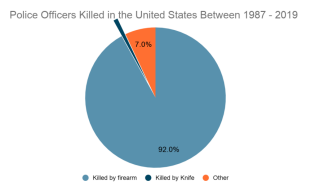
Does the 21-foot rule protect officers from knife attacks? Knife attacks on police officers are extremely rare. Between 1987 and 2019, only 0.99% of 1924 officers were killed by a knife or cutting instrument.166 In other words, over the past 32 years, only 19 police officers have been killed by a knife. And the majority of these deaths occurred in close quarters or as part of an ambush. None were killed by a suspect running or charging at them with a knife, which is the scenario upon which the Tueller drills are based.
Non-fatal injuries by Knife attack are also extremely rare. Knife attacks comprise only 1.96% of the 1,819,923 police officer assaults between 1987 and 2018.167 See Appendix D. for more data on police officers killed or assaulted by knives.
Less than 1% of officers killed in the line of duty are fatally wounded by knives, yet 17% of people fatally shot by the police were carrying a knife or edged weapon.168 These statistics tell us this: when a police officer encounters a person with a knife, it is very unlikely he’ll be killed or harmed. But when a community member, such as Travis, has a knife and encounters a police officer, the chance of being harmed may be much greater.
This suggests that officers overestimate the risk presented by civilians with knives. Myths like this, combined with their warrior mindset and focus on self over mission, may contribute to needless deaths like those of Travis Jordan. This is why it is critical that officers are given the factual information and that their training be based on that information. Below we discuss the role of other options officers may use when confronted with a person in crisis who has a knife: less lethal weapons.
Police Best Practices in Addressing People with Edged Weapons: The Role of Less Lethals
Scrapping dangerous and outdated training is one way to change how officers respond to persons with edged weapons or knives. Another is by giving them different tools. Abraham Maslow said in 1966, “I suppose it is tempting, if the only tool you have is a hammer, to treat everything as if it were a nail.”. Police officers have successfully de-escalated persons in crisis who have edged weapons, such as knives, by using time, distance, and less lethal weapons. The problem is either officers aren’t given less lethal options, or they are not trained to use them tactically. This section of our paper reviews three types of less lethal weapons that could’ve been used to protect the “sanctity of life”: bean bag guns, chemical agents, and tasers.
Bean Bag Guns
Bean bag guns are less lethal weapons that fire a small fabric “pillow” filled with #9 lead shot weighing about 40 grams. The following news article169, titled, “Houston police using bean bag rounds with mentally ill, sensitive suspects” from ABC news in Houston, TX gives an example of a situation similar to Travis’.
“March 8, 2017 – Following a Freedom of Information Act request, the Houston Police department released body camera footage of a tense standoff between several officers and a man who wanted to die. The standoff resulted in the man being shot with several rounds of bean bag shots. The incident happened on Jan. 3 in downtown Houston. Officers were dispatched to the scene of a man who was armed with a knife and claimed he “killed the whole north side.”
The man can be heard saying, “I want to die. Shoot me.” Officers are heard saying, “You have to let us help you.”
At least five officers surrounded the man. Several officers were armed with taser guns, and one officer is seen in the video going to the back of his police SUV to grab a shotgun. The officer is seen loading it up with bean bag rounds. The ammo is used to stun its target, even though, if shot at the wrong spot on a person, can be lethal.
After a nearly 30-minute standoff with the suspect, officers decided to close in. The officer with the bean bag shotgun fires a shot, then another. Other officers move in and deploy tasers at the suspect who is still holding a knife and waving his arms. The tasers were unable to penetrate the suspect since he’s wearing a leather jacket and jeans. More bean bag rounds are fired. One officer is seen in the body camera footage getting closer to the suspect. He fired his taser at the suspect’s leg. The suspect finally puts his knife down and officers move in to detain him.
“It was to me the best outcome we can possibly have,” said Houston Police Chief Art Acevedo.
He said bean bag shotguns have been around for years and are used when officers request them. Acevedo said he wants the guns and other help to be on hand and ready when officers respond to a mental health crisis.
“I want to make sure that our response protocol includes a minimum number of officers, a mental health crisis intervention officer, and less lethal,” said Acevedo.
The department has about 130 specially colored shotguns in circulation. Every officer is trained to use it. The rounds are made of a small Kevlar sock, filled with lead pellets. The shot is meant to stun its target.
“I don’t want to create a false perception that every time someone has a knife that officers are going to because every situation is unique,” said Acevedo. “We use them when appropriate to try to save lives.””
The Role of Less Lethals
Officers Keyes and Walsh were not able to use less lethal methods of de-escalating the situation when they were sent to Travis’ house because they were not given less lethal weapons. They had mace and a gun. Neither officer had a taser or a beanbag gun. Bean bag guns are one less lethal option police officers may use to de-escalate. Providing officers with options other than firearms is important, for our safety.
Chemical Agents
Minneapolis Police Officers Keyes and Walsh had chemical agents, also known as mace or pepper spray, on their duty belt. According to Freeze Plus P mace training course, the type of Mace the officers were equipped with had a streaming range of 1-12 feet.170 The Officers discussed having mace but did not use it. Below are statements pulled from the BCA report and BWC footage:
- – Keyes says to Walsh, “Get your mace.”171
- – Officer Walsh says in his interview, “I have a can of mace.”172
- – Officer Keyes said in his interview, “I have a duty belt on. A full duty belt um has a couple pairs of handcuffs on it, um my baton, uh chemical agents, my firearm, my additional magazines for my firearm.”173
Minneapolis Police Officers are required by policy to carry mace. Below is MPD Policy 3- 205 F and 3-202A:
- 1. 3-205 F: Every sworn MPD employee shall carry a 4 oz. canister of chemical agents on their person at all times while working in uniform. REQUIRED EQUIPMENT (03/08/02) (12/30/10) (12/17/18) Every sworn MPD employee working in a uniformed capacity shall carry the following authorized equipment and weapons: MPD issued chemical agent (3-203 C).
- 2. 3-202A: Use of Force USE OF FORCE – REPORTING AND POST INCIDENT: a. Chemical Agent Exposures require a CAPRS report but does not require supervisor notification. (5-306)
- 3. CHEMICAL AGENTS A.1 MPD approved chemical agents may be used as a non-lethal use of force, consistent with current MPD training and MPD policies governing the use of force (including all sections in P&P 5-300) only be used against subjects under the following circumstances:
- a. On subjects who are exhibiting Active Aggression, or
- b. For life saving purposes, or;
- c. On subjects who are exhibiting active resistance in order to gain control of a subject and if lesser attempts at control have been or would likely be
- ineffective, or;
- d. Chemical agents shall not be used against persons who are only displaying Passive Resistance as defined by policy. (5-313)
Tasers
Tasers are a common less-lethal weapon that police officers in the United States use. In 2016, only 60% of the Minneapolis police patrol officers had tasers.174 What is concerning is that Officer Keyes and Walsh self-assigned to this EDP call knowing they did not have a non – lethal option like a taser. Officer Walsh even stated in his interview that he was not “trained or certified to carry a taser” and Officer Keyes, did “not have a taser at all.”
The reason Officers Keyes and Walsh did not have tasers because the Minneapolis Police Department stopped giving them to new recruits. This change occurred in 2016. MPD spokesman Scott Seroka explained, “Generally, newer officers aren’t issued tasers as we have a limited number of them.”175
The department cited the cost of tasers as the source of the shortage. Tasers cost $1,500 per officer.176 However, that same year, the Minneapolis Special Weapons and Tactics (SWAT) unit received $50,000 worth of new uniforms paid out of the department’s general fund.177 The new uniforms changed from an olive green to a dark navy blue to look less “militarized.” The money spent on changing the appearance of SWAT uniforms could’ve purchased an additional 33 tasers, which is enough to fully equip the average police recruit class.
Officer Keyes thought about using a taser during the interaction. In his interview he states,
“As he was coming out of the house, I remember thinking, like, I don’t have a Taser, but I remembered that [squad] 824 said he was gonna be here in a couple blocks.
45
And that’s a park squad and I know, just from um, you know, going on calls with park cops that they are all carrying Tasers usually.”178
Clearly, Officer Keyes realized too late that they needed more tools then they were equipped with. Below are statements pulled from the BCA report:
● “NW states in his interview that he was not “”trained or certified to carry a taser”” and that his partner, Keyes, did not “”have a taser at all.””179
● RK states that he was trained to carry a taser but not issued one and that Walsh was not carrying one.180
BCA – Incompetent Investigation
It is crucial to public safety that the MN Bureau of Criminal Apprehension conduct a timely, detailed, unbiased investigation into any police involved shooting. The conduct of the police officers involved should be investigated as any witnesses would be in a civilian murder case. There should be no ties, political or friendly, between agents of the MN BCA and the police officers they investigate. The facts of the case- the weapon, the witness statements, etc.- should be gathered with the same tenacity, confidentiality, and using the same rules as any other violent crime. The findings of the investigation should be transparent, unlike other criminal cases, because the perpetrators of these crimes have pledged to protect and serve the community and we are living in a time when that pledge is in question.
The MN BCA must also remain neutral during investigations of police shootings and completely transparent in process and findings at the conclusion of an investigation. The agents of the MN BCA are themselves a law enforcement agency so complete transparency is the only way to prove neutrality. If this cannot be guaranteed and proven on a case-to-case basis, then it will be critical that the investigations be conducted by neutral parties who are not connected to law enforcement, possibly non-governmental organizations. The people of our communities deserve to be protected and served by law enforcement that are held accountable by an entity whose goals are positive development of our communities including successful police/civilian interactions.
The MN BCA has investigated 104 out of 147 critical incidents in MN since 2009.181
The truth is that the MN Bureau of Criminal Apprehension works alongside law enforcement during many types of investigations including missing person searches, fingerprinting, and forensics. This fact is not disputed and the relationship between the MN BCA and law enforcement is conceded by and touted by the MN BCA on their website:
“The Bureau of Criminal Apprehension (BCA) provides investigative and specialized law enforcement services to prevent and solve crimes in partnership with law enforcement, public safety and criminal justice agencies. Services include criminal justice training and development, forensic laboratory analysis, criminal histories and investigations.”
In the context of police involved shootings of community members such as Travis Jordan, this fact is alarming. There is no possible way the MN BCA can conduct a neutral investigation of a police involved shooting because members of the MN BCA have relationships with members of local law enforcement. These working relationships require camaraderie and trust among the two groups. We can fully support the involvement of the MN BCA working with local law enforcement on such topics as missing person searches, fingerprinting, and forensics. But the MN BCA should not be allowed to investigate local law enforcement in criminal matters involving police officer related shootings because it is a conflict of interest.
It has become common knowledge among civil rights activists in Minnesota that the MN BCA is unable to conduct a neutral and thorough investigation into police related shootings. On July 7, 2016, Charles Samuel, Executive Director of the MN Chapter of the American Civil Liberties Union made a statement to the local media about not allowing the MN BCA to investigate the killing of Philando Castile by Saint Anthony police officers:
- ● “We do not believe that the Bureau of Criminal Apprehension is that independent entity because the recent history of the BCA suggests that it is incapable of conducting a thorough and objective investigation into this tragic event,” Samuel said.182
- ● “The Minnesota BCA’s investigatory record in officer involved maimings and killings is mediocre at best and corrupt at worst,” said Robert Bennett, a civil rights attorney who’s represented several families of victims of police brutality cases in Minnesota. “They employ a double standard. If it was you or I committing the crime, they’d investigate the devil out of it. But if it’s police officers, they don’t.”
It has also become common knowledge among civil rights activists that the MN BCA is not transparent in their investigations of police shootings. Many factors make transparency of these investigations critical including trust of the community towards police officers who have pledged to protect them and matters of systematic racism. In 2016, both the ACLU and the NAACP sued the MN BCA for access to videos regarding the police killing of Jamar Clark.183
There is also a great concern that the MN BCA creates facts in order to drive the investigation in the direction of its liking. The MN BCA may be intending to reach a certain conclusion, for instance that the officers in question had no other choice but to shoot a civilian, and so must write the narrative to fit that conclusion. In the Travis Jordan case, the MN BCA acquired a search warrant of the Minneapolis Police department for the training records for Ryan Keyes and Neal Walsh. As a part of the information to the judge for the search warrant, the MN BCA used the twisted narrative of Travis looking to buy a gun as if it was fact. The judge who signed the warrant, Peter Cahill, was formerly employed in the Hennepin County Attorney’s Office and will preside over the trial of Derek Chauvin for the murder of George Floyd.184 As we have shown earlier in this report (See “The Role of Dispatch”), there was no reason to think Travis had a gun since he had only just thought about buying one several months before the incident. This dangerous piece of information, which may have contributed to the death of Travis, was used as justification by the MN BCA, an agency that is supposed to be investigating his death in a neutral manner. Please see the affidavit185 below:
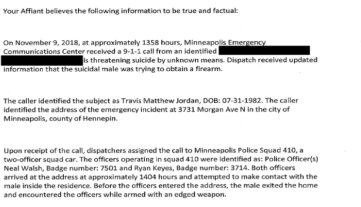
There is no way the MN BCA can work in a neutral, transparent way when it is investigating police shootings of community members. There is a direct conflict of interest given the relationship between the MN BCA and local law enforcement. The MN BCA also does not work in a transparent way when investigating these killings, which is critical in these times of civil unrest and distrust of law enforcement. The only way to make sure investigations into police shootings of community members are carried out in a neutral, transparent way is to assign an outside, non-governmental organization the task of conducting the investigations.
Hennepin County Attorney Report
For every police killing, there is a conventional narrative that’s usually in the County Attorney’s report on failing to bring charges against the officer(s). The County Attorney Report is a legal brief that consists of the facts and circumstances that are found in the investigating department’s report. They then take their version of the facts and apply them to the MN laws regarding police involved shootings or deaths. At the end of the report, it concludes whether Mike Freeman will press charges against the officer(s), but unfortunately, officers being charged for police involved shootings are rare in Minnesota.
Below we have disassembled Mike Freeman’s report and show the failure of accountability that we found when comparing our facts and circumstances to the BCA’s findings:
Freeman Report—A Failure of Accountability
In the aftermath of the Jordan killing, County Attorney Mike Freeman released a report explaining his decision not to prosecute the officers involved in killing Mr. Jordan. This report was riddled with false information.
False Information #1
“At 1:58p.m., on November 9, 2018, a known adult female called 911 to report that her friend, Travis Matthew Jordan, was threatening to commit suicide at his home at 3731 Morgan Avenue North, Minneapolis, Hennepin County. She said that she was not at that address, but at 1:05 p.m. Mr. Jordan texted her a music video of a person committing suicide. At 1:45p.m., she spoke to Mr. Jordan and he said he wanted to die. She also said Mr. Jordan had said something
in recent days about getting a gun.”
Taren, Travis’ girlfriend and the 911 caller, told dispatch very clearly that Travis had texted someone about purchasing a gun months ago, not “recent days” like Freeman claimed. Taren also told the dispatchers that he never went through with the purchase.
False Information #2
“The officers went to the home to investigate the call made by a known adult female. She called because Mr. Jordan made statements over the phone and sent a text that led her to believe he was suicidal. When the officers arrived, they tried to make contact with Mr. Jordan by knocking on the front door. When he did not answer, Officer Keyes walked around to the side of the house. Mr. Jordan came to the window and clearly communicated to Officer Keyes that he was not going to come out to speak with them. Officer Walsh contacted his sergeant to see what they should do next. While he was on the phone, Officer Keyes remained on the side of the house.”186
It was clear that Travis was in the throes of a mental health crisis. While he was in his home, at most he posed a danger to himself. There was no sound reason for Officer Keyes to demand that he come outside. At that point, a mental health professional could have been contacted to either address the situation or consult with Officers Walsh and Keyes on the best way to handle it. Certainly, escalating the situation by demanding that Travis leave his home was not the best way to handle it.
False Information #3
“Keyes could see Mr. Jordan coming toward the front of the house and alerted Officer Walsh that Jordan had a knife. Jordan came onto the porch and then to the front door of the house. Mr. Jordan was agitated and aggressive and waving the knife. He repeatedly said, “Let’s do this,” which, under the circumstances, gave the impression that he wanted the police to engage with the use of force to resolve the situation.”187
Travis was following the orders of the officers to come outside. He was not waving the knife. He was walking outside with his arms down to his sides. What Travis, who was in the throes of a mental health crisis, was saying is irrelevant. Police officer action is dependent on the actions of the person, not what they are saying. Bear in mind that Travis only started saying, “Let’s do this” after Officer Keyes made several demands through the window to Travis, escalating the situation.
False Information #4
“As he approached Officer Walsh, BWC video shows that Mr. Jordan neither retreated nor complied with the officers’ commands and instead presented the officers with an immediate threat of death or great bodily harm. Officers Keyes and Walsh fired to protect themselves and each other, acted out of fear of great bodily harm or death, and their use of deadly force was justified.”188
Travis only came out of the house because the Officer Walsh demanded he do so. When he emerged from the house, Travis had the knife in his hand pointed backwards, not in a threatening manner towards either Officer.
As already outlined, the defenses to edged weapons are distance and barriers. The walls of the house were an excellent barrier until Travis responded to the commands of the officers and exited the house. Once he exited, the officers could then use distance as a defense. Instead, Officer Walsh stopped backing up, allowing Travis to close the gap placing them all in danger. Officer Walsh had a clear open sidewalk he could have continued to walk down, maintaining, or even increasing his distance from Travis until help arrived from the other officers.
Further, both officers were aware Travis was experiencing a mental health crisis and was intoxicated. This should have led to them using de-escalation tactics learned in CIT training just months prior.
False Information #5
“Despite numerous and repeated requests and commands to stay where he was and drop the knife, Mr. Jordan refused and instead came aggressively toward the officers, closing the distance to only eleven feet between him and Officer Walsh.”189
People experiencing mental illness are not able to quickly process and follow commands. The officers issued differing sets of commands. First, Officer Keyes repeatedly told Travis to come outside. After Travis stood in the doorway to his home, Officer Walsh told him to not come outside. Not only did both officers give commands, which is not considered best practice, but they also gave contradictory commands to a person who was undergoing a mental health crisis and to a person they knew had been drinking. Further, Officer Walsh stopped moving, which allowed the gap to close between himself and Travis. Officer Walsh could’ve continued to create distance and find cover. He chose not to.
False Information #6
“[Travis] waved the knife as he quickly approached and showed no desire to retreat or cooperate.”
“The man continued to yell and moved the knife in an overhead manner from his side to his chest.”
“The man brought the knife up and leaned at the officers like he was trying to force them to react. Officer Keyes said, ‘I felt like he, at any second he could run at me and stab me with that giant knife. Um, but I didn’t shoot him. Um, I backed up and we continued to try to give him verbal commands.’”
“The man continued to yell, ‘Let’s do this’ and flailed his arms aggressively.”
Travis did not wave the knife, flail his arms aggressively, or move the knife in an overhead manner. In fact, a second-by-second review of the officers’ BWC shows that Travis’ arms stayed below his midline the entire time (see Appendix C). This next photo was taken from the body-worn camera footage of Officer Keyes at the very first shot.190 It shows that Travis was not waving the knife. His arms were down at his sides until that point and he only raised them once he was shot and he began to fall forward. The knife was never raised or pointed toward either officer.

Still photo from Officer Keyes’ body-worn camera just after the first shot. False Information #7
“At the time he was shot, Mr. Jordan was wielding a very large knife he had been refusing to drop despite numerous clear commands to do so. Told not to come out of the house or toward the officers while he was holding the knife, Mr. Jordan did the opposite, aggressively approaching the officers, particularly Officer Walsh.”191
Body-worn camera footage shows that Officer Keyes demanded that Travis come out of the house and talk to them. He yelled this through the window multiple times.
False Information #8
“Officer Keyes fired one shot at Mr. Jordan and all indications are that the bullet missed Mr. Jordan. Officer Walsh fired seven times and shot Mr. Jordan at least three times, fatally wounding him.”192
Officer Walsh, in fact, fired first at Travis. Officer Walsh then shot three additional times while Travis was falling. If Travis ever had posed a threat to the officers, it would surely have ended once he began falling to the ground. While Officer Walsh was shooting, Officer Keyes shot once but then stopped when Travis fell to the ground. After Travis was on the ground, Officer Walsh lowered his weapon and shot him four more times. This was after the knife was out of his hand.
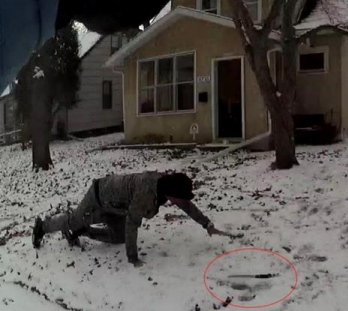

False Information #9
“At that point it was clear that the use of deadly force against Mr. Jordan was necessary to prevent harm or death to Officers Walsh and Keyes. Only when the officers fired did Mr. Jordan drop the knife.”193
Officers Keyes and Walsh escalated the situation, then used Travis’ response to that escalation to justify killing him. Further, even if shooting him the first time was justified, once he fell to the ground, there was no justification for Officer Walsh to shoot him four more times after he was on the ground and had dropped the knife.

Still photo from Officer Keyes’ BWC footage, as Officer Walsh fires his first shot. 
False Information #10
“Officers Walsh and Keyes’s use of deadly force under these circumstances was reasonable as demonstrated by applying the Graham factors to this case.”
“The severity of the crime at issue: The officers were called to check on a suicidal individual. When they encountered Mr. Jordan, they had cause to believe that the 911 caller’s information was accurate and they were in a situation where Mr. Jordan could harm himself and/or anyone else who may have been in the house. The officers could not leave the scene until Mr. Jordan was safe and the situation was defused.”194
What Mr. Freeman hints at but fails to explain is that under Graham, reasonableness is measured by the totality of the circumstances and that totality includes issues like the severity of the crime at issue, an objectively reasonable assessment of the threat, and a determination of the level of force needed to end the threat. Further, any consideration of whether to bring charges must include all elements of the OFFICER’S ACTIONS, not just Travis’ actions. Consider these elements relevant to the totality of the circumstances:
- Travis had committed no crime at all. He was in the throes of a mental health crisis and possibly impaired by alcohol.
- The officers were told that the purpose of the call was a wellness check.
- Officer Keyes had contact with Travis and knew he was safe and secure in the house.
- A neighbor told Officer Walsh that everyone else was at work.
- The officers escalated the situation by walking past the window and yelling into the window at Travis.
- The officers escalated the situation by ordering Travis out of the house.
- Officer Keyes shined a flashlight in Travis’ eyes, escalating the situation further.
- Both officers failed to remember or utilize their crisis intervention team (CIT) training or other de-escalation methods.
- Both officers failed to slow the situation down until others could arrive to assist.
- When Travis emerged from his house, in compliance with the officers’ orders, the knife was pointed only at himself.
- There was no attempt to use less lethal force such as Tasers or bean bag rounds.
- Travis’ arms remained at his sides, with the knife pointing only toward himself, until he had been shot once and was falling forward. Only then did he put his hands forward to catch his fall.
- Despite this, Officer Walsh shot Travis once then continued shooting him four more times after he was on the ground and the knife was out of his hand. Officer Keyes shot Travis once then stopped shooting once Travis was on the ground.
In sum, the officers were responding to a welfare check. They knew Travis was non violent and safe alone inside his house, where he was not a danger to anyone else. They could have called Travis’ girlfriend to help de-escalate, but they didn’t. Most importantly, Travis had not committed a crime under which the “severity of the crime” rule from Graham v. Connor could be applied. Suicide and suicidal ideation are not crimes. Assisting someone in their suicide, however, is a crime, one which the officers completed that day.
Mr. Freeman’s bias toward Travis becomes obvious when he refers to Travis repeatedly as a “suspect” though Travis had committed no crime. His biases are confirmed with the realization that Mr. Freeman only meaningfully examined Travis’ actions and not those of the officers. He never considered the concept of state created danger, thus failing in his review of the totality of the circumstances necessary to assess the legality of the use of force.
Conclusions and Recommendations
Any critique of the handling of Travis Jordan’s death must include all the responsible actors:
● Minneapolis Police Department
● City of Minneapolis
● Minnesota Bureau of Criminal Apprehension
● Hennepin County Attorney’s Office.
We will explain in more detail below.
Lack of Accountability within the Minneapolis Police Department
Travis Jordan’s death was a result of the failure of individual officers, Keyes, and Walsh, to de-escalate. In addition, Travis’s death signals the need for systemic changes in the culture of policing. Systemic change is defined as “fundamental change in policies, processes, relationships, and power structures, as well as deeply held values and norms.”195 The following section will discuss systemic problems that are barriers to police accountability and our recommendations for change within MPD.
We will look at:
● MPD’s Critical Incident Policy
● Minneapolis Police Discipline: Coaching
● The Minneapolis 4th precinct and its history of police shootings
Travis’ case is not an isolated incident of MPD’s failure to properly train their officers in de-escalation. Rather, it is part of a larger pattern, particularly in the 4th precinct. The following section will review other police shootings in the 4th precinct and the common themes that connect them all. It will also revisit MPD’s training, equipment, policy failures, and our recommendations for change.
4th Precinct
The Minneapolis 4th Police Precinct is in the heart of North Minneapolis and has experienced some of the most controversial police encounters over the years. North Minneapolis has the largest Black population in the city and also struggles with the highest rates of poverty compared to the rest of Minneapolis.196 Residents in the 4th precinct are also stopped in their vehicles at higher rates than other Minneapolis precincts.197 The precinct holds the highest number of arrests in the city, and to top it all off, the Minneapolis Police Department has had five Police involved Shootings since 2015, all in the 4th precinct.
Prior to Travis Jordan’s shooting, there has been a history of police-related killings in the 4th precinct. Each killing is different, yet they all share common themes. They all occurred within a very short amount of time, the officers did not attempt to de-escalate, and non-lethal weapons were not used.
Below are few Minneapolis Police involved killings that have occurred in the 4th precinct that illustrate these themes:
11/15/2015: Two police officers were requested by paramedics to an apartment complex. The two police officers shot and killed Jamar Clark 61 seconds after arriving on scene.
Neither officer carried a Taser nor used de-escalation tactics.
7/30/2018: Police officers responded to a 911 caller reporting an intoxicated male shooting his gun in the neighborhood. 40 seconds after arriving on scene they shot and killed Thurman Blevins. They were on their way to assist with another suspect with a gun.
One officer had a taser but didn’t use it. Neither officer tried to de-escalate.
11/09/18: Police officers were called for a welfare check, failed to de-escalate, and killed Travis Jordan.
Neither officer carried a Taser nor used de-escalation tactics.
Training
The Minneapolis Police Department has a responsibility to train officers adequately for situations they will likely encounter on the street. We are still waiting to receive data on the training provided by MPD in the academy and in-service sessions. We do, however, have evidence that police academies spend, on average, 15 times more training time on firearms and defensive tactics then on conflict management and mediation.198 Further, Officers Keyes and Walsh only received the minimum amount of training in crisis intervention.
Officers across the United States receive the most training in preparing to use force or respond to violent crimes. Yet, violent crimes represent a tiny fraction of the 911 calls officers are responding to. Nationwide, including in Minnesota, calls involving mental health crises are rising.199 But rather than prepare officers for mental health crisis calls, calls they’re most likely to encounter, many police agencies instead train using a militarized method.
An article by Vox magazine200 found that almost half of American police agencies use a high stress, physically, and psychologically excruciating approach that is used to train soldiers for battle. Tom Tyler, a legal scholar at Yale Law School and a founding director of Yale’s Justice Collaboratory elaborates, “Often what these situations require is someone to calm things down, cool things off, and de-escalate. But police tend to manage all the problems they face through the threat or use of coercive force. This amplifies the level of emotion and anger in a given situation and can create a spiral of conflict that ends tragically.”
Equipment
The reliance on force in training of police officers is reinforced by the tools we give them. We equip officers with handcuffs and a firearm, and don’t give them the tools for de escalation and conflict resolution. Increasingly, police departments are also handed military grade equipment – such as armored vehicles and assault rifles – to use on American civilians. These tools do not reflect what people call the police for. Most people call the police to check on a loved one in crisis, for interpersonal disputes, or for non-violent crime reports.
As discussed earlier, Officers Walsh and Keyes did not have a taser. Around the time of the shooting, the Minneapolis Police Department had stopped issuing tasers to new recruits due to the cost. The officers did however carry mace. The Freeze Plus P mace they carried could have reached a subject up to 12 feet away. Officer Walsh estimated in his interview that Travis was 8 to 10 feet away from him. Officer Keyes told Officer Walsh to get out his mace, and even though they could’ve used mace per MPD policy 5-313, they did not. Finally, the Minneapolis Police Department did not provide other less lethal options, like bean bag guns, to officers to help them de-escalate.
Policies
At the time of the shooting, MPD policies instructed officers to:
A. Use de-escalation tactics to avoid or minimize use of physical force,
B. Treat individuals in crisis with heightened sensitivity,
C. Prevent the loss of life in all tactical situations.
Officers Walsh and Keyes failed to follow these policies. However, MPD has a responsibility to control officer conduct through policies. If their current policies on de escalation and crisis intervention failed to prevent the loss of Travis’ life, MPD has a responsibility to revisit and update them. MPD must also be sure that their training and equipment they provide officers aligns with the intended goals of their policies. As we’ve demonstrated earlier, officers were given instruction and tools that emphasized force, not de escalation. Without considering how their policies are actually carried out, MPD policies on de escalation and use-of-force will continue to fail.
Another important consideration for MPD policies is how the department enforces and disciplines officers who do not follow them. Officer Keyes and Walsh have not been disciplined by the department for failing to follow policy. Further, there was no discipline for the MPD sergeants who failed to follow the critical incident policy by not taking the PSS.
Minneapolis Police officers are rarely disciplined even for serious violations. It is doubtful these officers will receive any policy discipline. This is in large measure because the mechanism for adjudicating complaints is toothless; disciplining only 1.47% of the complaints they receive201. Further, officers are shielded from the consequences of their conduct by the Minneapolis Police Federation, an unusual union in that it includes officers and the sergeants and lieutenants responsible for managing them. This arrangement makes it hard to have a proper discipline process in place. More information on the police union can be found in Appendix A.
Recommendations
Given the data the CUAPB has provided in this report about the killing of Travis Jordan by Minneapolis police officers Keyes and Walsh and countless other police shootings in Minneapolis, the CUAPB has several recommendations for the Minneapolis Police Department that will ensure that less of these shootings take place which will increase the amount of trust for the MPD from the Minneapolis Community.
Training:
– Increase officer training on de-escalation techniques and mental health crises. – Decrease the “militarized” policing model.
– Require all officers to undergo annual situational awareness, use of force, and de escalation training and practicums to make clear the expectation for policing is not about viewing residents as enemy combatants, but about responding to the needs of community members.
Equipment:
– Allocate additional funds for less lethal weapons such as bean bag guns and ensure all officers have tasers.
– Encourage the broader use of less lethal apprehension methods.
Policies:
– Audit MPD de-escalation and crisis intervention policies for potential policy failures
– Ensure MPD policy goals are actually achievable based on the training and equipment available to officers.
– Audit, revamp, and enforce MPD’s discipline policies and disciplinary bodies (Internal Affairs and the Office of Police Conduct Review)
City of Minneapolis
In addition to the Police Department, The City of Minneapolis had a responsibility to provide Minneapolis Police Officers with the necessary training, equipment, and resources to handle Travis Jordan’s mental health crisis call. The City of Minneapolis holds the power of the purse over the police department, as the department’s budget comes out of their general fund202. Their failure to adequately prepare their officers contributed to Travis’ death and many others killed by Minneapolis Police. The City is also responsible for deterring police misconduct and poor organizational culture through their Office of Police Conduct Review.
Mental Health Crisis Response
At the time of Travis Jordan’s death, the City of Minneapolis had funded a pilot program for a co-responder mental health crisis team. The program paired a police officer with a licensed social worker to respond to non-violent mental health crisis calls. In November 2018, the program was only operating in the 3rd precinct. Since then, the co-responder program has been expanded to all five precincts.203
CUAPB has also taken the position that the City of Minneapolis needs to fund a non police mobile mental health crisis team. The City responded to community demands by devoting $2.4 million of the 2021 budget to creating non-police 911 mental health response team.204
Travis’ case, however, raises the questions of how and who should respond to mental health crisis calls that involve weapons. The co-responder teams and the non-police mental health crisis teams will not respond to calls that involve violent persons or weapons. Solutions to how to respond to these calls effectively and safely are still needed. There needs to be an investment from our leaders in nonlethal responses to persons in crisis.
Discipline
The Office of Police Conduct Review (OPCR), within the City’s Civil Rights Department, investigates allegations of police misconduct and makes recommendations to the Chief for discipline.
Within the past three years, the City’s officer discipline rate has been an abysmal 1.47%, far below the national average of 7%-8%205 and the former police chief’s discipline rate of 7.14%. In addition, more than half of officers terminated by the City have gotten their jobs back through arbitration. The problem, however, is not the arbitration process; it is that the Chief and the City fail to issue consistent and progressive discipline, so their discipline does not stick through the arbitration.
The OPCR also uses a kind of discipline called coaching to resolve over 50% of their complaints206. Recently, the City has been criticized for skirting public data laws by classifying coaching as non-discipline, thus making them private data. As a result, they’ve hampered the public’s ability to identify problem officers by keeping hundreds of documents out of the public eye.
Recommendations:
Mental Health Crisis Response:
– While creating non-police 911 mental health crisis teams is a step in the right direction, more discussion needs to be discussed on proper solutions to mental health crisis calls like Travis’.
– The City must ensure access to effective and adequate mental health crisis response by continuing funding for their non-police mobile mental health crisis team.
Discipline:
– Audit the OPCR and Internal Affairs to identify the problems in the investigation and discipline process of officer complaints.
– The Chief of Police needs to engage in consistent and progressive discipline and set into place a “disciplinary reset” mechanism.
By holding our officers and city officials accountable, providing them with more education, and holding discussions surrounding proper solutions to mental health calls, we could prevent situations like Travis’. However, the police officers were not the only ones who needed to be better. The police department takes many different units, people, and entities to ensure all is working properly. It is essential they all do their jobs fairly and right.
Dispatch
As we have stated earlier in this report, the Minneapolis Police Dispatch had a crucial role in the death of Travis Jordan. MPD Dispatch failed to articulate information to officers that was crucial to the facts and circumstances surrounding the murder of Travis Jordan. As you read below, these are the recommendations we think would benefit MPD dispatch and the communities they serve:
MPD should follow the same principle that the Memphis Police Department put into place:
• The Memphis Police Department (Memphis, Tenn.) established a specific dispatch code for mental health-related calls (referred to as “mental disturbance” calls). They also established a separate code for mental disturbance calls that involved weapons. Those calls would otherwise be coded with a higher classification due to the presence of weapons and the disposition data from those calls would be missed.207
• The Thomas Jefferson Area CIT (Charlottesville/Albemarle County, Va.) uses a specific dispatch code for calls that involve a person with mental illness, as well as a disposition code that indicates one of four potential resolutions: o 931-3: Mental Health Crisis Call – Resolved at location o 931-7: Mental Health Crisis Call – Voluntary committal transport (to hospital) o 931-1: Mental Health Crisis Call – Emergency custody order (involuntary transport) o 931 + Arrest Code: Mental Health Crisis Call – Resolved with an arrest208
Recommendations
– Implement a specific dispatch code for mental health related calls and a separate code for mental disturbances involving weapons following the example of the Memphis Police Department.
Minnesota Bureau of Criminal Apprehension
The Minnesota Bureau of Criminal Apprehension (BCA) is the top law enforcement agency in the state. They oversee the work of all Minnesota law enforcement departments, providing laboratory and investigative services that allow these departments to solve crimes. Consequently, they work closely with every agency in the state. They have a conflict of interest when investigating police involved shootings of community members and, therefore, cannot conduct the investigations in a neutral way. BCA agents themselves have been involved in shootings of community members.
● BCA Beth Eilers and Dustin Vanderhagen shot and killed Adam Jo Klimik as he was being arrested and charged at the officers with a knife. The BCA had the St Paul Police Dept conduct an independent investigation and looked at evidence in this killing.209 Thus, they are inherently NOT neutral in their investigations of police critical incidents.
The inability of the MN BCA to remain neutral in police involved shootings is evidenced in the bias shown in their investigations into these incidents. The investigations should be carried out with the same attention to detail and intensity that one would expect from any other criminal investigation of a violent crime.
• MN BCA agent Chris Olson interviewed the other officer who was present during the shooting, Mathew Harriety, three days after the shooting over coffee and donuts at Officer Harriety’s attorney’s house.210
• Chris Olson admitted to prosecutor Amy Sweasy that waiting to conduct the interview is a courtesy commonly extended to police officers, but not to civilians.211
We are told the MN BCA is tasked with making sure we, members of the Minnesota community, are kept safe from potentially lethal members of law enforcement. But we must start asking if the MN BCA is capable of conducting objective, high quality investigations into police critical incidents? Justine Damond’s father, John Ruszczyk, called the BCA’s early work on the death of his daughter Justine’s case “either active resistance or gross incompetence.” He is not alone in raising this question.
“The Minnesota BCA’s investigatory record in officer involved maimings and killings is mediocre at best and corrupt at worst” said Robert Bennett, a civil rights attorney who’s represented several families of victims of police brutality cases in Minnesota. “They employ a double standard. If it was you or I committing the crime, they’d investigate the devil out of it. But if it’s the police officers, they don’t.”
Maybe it’s time to start investigating the MN BCA.
Recommendations
– The state of Minnesota must establish an independent agency whose sole responsibility is to investigate and potentially prosecute police officers who kill members of the community.
Hennepin County Attorney Mike Freeman
This analysis documents the myriad of disturbing factual inaccuracies that led Mr. Freeman’s decision not to charge, indict or hold Officers Walsh or Keyes responsible in the shooting and killing of Mr. Jordan. The comprehensive and impartial investigation required was hijacked by a seeming desire to ensure all responsible officers were exonerated. This abrogation of duty is appalling given the facts and the multiple violations of policy and procedure.
Minnesota Law permits a law enforcement officer to use deadly force when necessary “to protect the peace officer or another from apparent death or great bodily harm.”212 Freeman quotes from several court cases that hold apparent death or great bodily harm is judged by the standard of a reasonable police officer in that place and moment in time. He then applies this standard to a very limited set of alleged facts that simply are not supported.
Police shootings are judged on the “totality of the circumstances.”213 In this case, that begins by not limiting the analysis to the final seconds in the gun from his pocket and police opened fire. Up until a couple of years ago, the Federal Courts in the 9th Circuit had a Provocation Rule: if a police officer did something unconstitutional, and this resulted in a police shooting, the shooting was not justified as the actions of a reasonable police officer. The U.S. Supreme Court overturned the Provocation Rule214 but reaffirmed that the officer’s actions could still be found unreasonable under the totality of the circumstances.
In conclusion, Freeman’s analysis ignored inconvenient evidence of officers shooting an impaired man.
Officers Ryan Keyes and Neal Walsh used lethal force against a citizen who had a history of MPD interactions resolving peacefully (with voluntary treatment). De-escalation tactics, such as those found in PERF’s ICAT SbC training module215, would have been effective – especially when the situation had a mere 4% chance of ending in injury or death.
In so doing, Freeman preserved his relationship with the police, and undermined the justice he was sworn to uphold.
Recommendations:
– Justice will not be served until there is an independent and comprehensive review of the killing of Mr. Jordan, which clearly was not done by County Attorney Mike Freeman. This could be affected by one or more of the following: having the City hire a team of legal experts, asking for the State Attorney General to step in, or calling for a federal investigation to review whether Mr. Jordan’s’ civil rights were violated.
Final Words
The City of Minneapolis has yet to answer for the many lives taken at the hands of the Minneapolis Police Department. After former Minneapolis Police officer Mohamed Noor was found guilty of the murder of Justice Damond Rusczyk, Judge Kathryn Quaintance posed these important questions to the City:
“The primary concern of the jurors who heard the testimony in this case when I spoke with them after the verdict was:
Will there be changes? Change is needed.
Will some of these supervising officers be fired or disciplined?
Is what we saw normal for the Minneapolis Police Department and the Bureau of Criminal Apprehension?
How will this be prevented from happening again?
Why are officers more concerned about their personal safety than the safety of the public, especially in such a low-crime neighborhood?
Why was there so much discussion of ambushes?
Why should a civilian have to be afraid of approaching a squad car?
What about the motto on the car door — “To serve with compassion”?
Why were Noor and Harrity so reactive? What was their training?
The jurors were particularly concerned with Officer Harrity’s statement that his priority was making sure he did whatever he had to do to get home safe each night. Jurors remarked that they thought the priority of the police was supposed to be to protect and serve the public.
No one who heard the testimony in this case or who works in the criminal justice system can question the difficulty of a patrol officer’s job or the dedication of the majority of the police and first responders, but here something went very much awry. The victim’s family and some of the witnesses, including some officers, have expressed concerns. A large amount of taxpayer dollars will go to Australia, but Minneapolis residents await the promised “transformation,” and the questions of the jurors remain unanswered: What has changed? What will change so this does not happen again? How does the Department address officer safety without jeopardizing public safety? The jurors and the people of Minneapolis need and deserve answers.” Neither the City nor the police department have answered these questions. How many more people will die at the hands of the police until they begin to reflect on both the systematic and micro-level issues within MPD?
Appendix A. Police Federation
The Minneapolis Police Federation presents one of the largest obstacles to police accountability in the City. The Federation is the collective bargaining unit for Minneapolis Police Officers. The Federation represents officers on issues such as: benefits, scheduling, fitness & wellness, settlement of disputes, legal counsel, and discipline. The Federation has powerful political sway and has blocked numerous attempts of police reforms from the Mayor, City Council, and Minneapolis community. The Federation blocks attempts to discipline officer misconduct, and Federation leaders themselves are untouched by any attempts to rein them in when they step outside the bounds of their role. The result? A culture of impunity among the rank-and-file. Samuel Walker, professor emeritus of criminal justice at the University of Nebraska, described the culture, “Knowing that it’s hard to be punished for misconduct fosters an attitude where you think you don’t have to answer for your behavior.”
Our recommendation: Separate unions for rank-and-file officers and middle managers
Police union contracts present many barriers for supervisors who try to discipline officers for misconduct. These problematic provisions include: delays in interrogations of officers suspected of misconduct, providing access to evidence before interviews, set limits on consideration of disciplinary history, statutes of limitation on officer misconduct, limits on anonymous complaints, and limits on civilian oversight groups (Rushin, 2017). Another barrier is the inclusion of sergeants and lieutenants in the police union. This issue was identified by a local coalition, Minneapolis For a Better Police Contract, in their recommendations for changes to the City of Minneapolis’ labor agreement with the Police Officers Federation of Minneapolis. They wrote,
“Most unionized workplaces have separate unions for management and line staff. This is in large measure to avoid the inherent conflicts that occur when a staff member challenges discipline that was meted out by a front-line supervisor, who is also a union member. This also avoids the difficult conflict for supervisors themselves, who are expected to be loyal to the employer while also remaining loyal to the union. These conflicts are a barrier to accountability and meaningful discipline.”
Appendix B. Minneapolis Police Policies: Use of Force and In-Service Training
1. Sworn MPD employees shall carry a CED (if issued) while working in a uniform capacity. 2. REQUIRED EQUIPMENT (03/08/02) (12/30/10) (12/17/18)
Every sworn MPD employee working in a uniformed capacity shall carry the following authorized equipment and weapons. MPD authorized CED (if issued), MPD authorized impact weapon (optional for those issued a CED) (3-203 C)
Use of Force (5-300) (see policy for unrelated details)
5-314.01 USE: The use of CED’s shall only be permitted against subjects under the following circumstances: subjects who are exhibiting active aggression or lifesaving purposes, or on subjects who are exhibiting active resistance in order to gain control of a subject and if lesser attempts at control have been or would likely be ineffective. CED’s shall not be used against subjects who are demonstrating passive resistance as defined by policy.
Dept Organizations and Functions (1-500) CEDs
1-505.01 IN-SERVICE TRAINING: In-Service Training provides ongoing various training courses to sworn personnel. Training includes the annual mandatory in-service. The In-Service Training Supervisor is also responsible for the following programs and training: Use of Force Program, CEDs (Conducted Energy Devices), CIT (Crisis Intervention Team) and other programs as assigned.
Officers’ Actions that Unnecessarily Place Themselves, Suspects, or the Public in a Deadly Force Situation
Directly from the policy: “Officers shall use reasonableness, sound tactics and all available options during encounters to safely resolve the situation. Officers shall not initiate independent action that unnecessarily place themselves, suspects, or the public in harm’s way, thereby limiting their options so that deadly force becomes their only option to resolve the situation. If reasonableness and sound tactics are not used by officers during encounters, the likelihood of injury to the officer, suspect, and public increases significantly. Will the Officers’ actions that day be looked at according to policies? Will the MPD look at this death of Travis and try to resolve a good faith effort that in the future this will not occur again? Will there be any accountability on the part of the MPD to try to do better? From past situations it seems neither the MPD nor the BCA is interested in analyzing the officers’ actions.
 The Reinvestigation Workgroup