
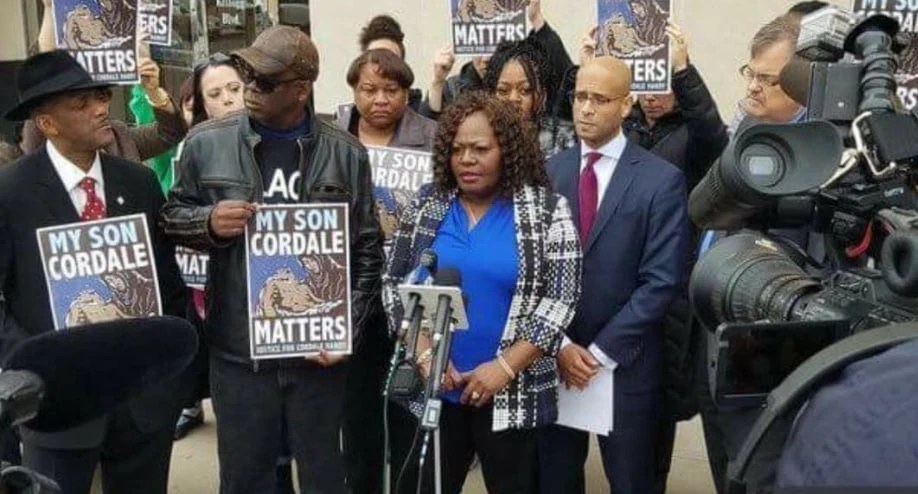
The Killing of Cordale Q. Handy On March 15, 2017 by the St. Paul Police Department
An Analysis by
Communities United Against Police Brutality
4200 Cedar Avenue Minneapolis, Minnesota
55407 612-874-7867
February 6, 2020
This analysis relies on Bureau of Criminal Apprehension (BCA) data as submitted to the Ramsey County Attorney’s Office, the Ramsey County Attorney’s Office report, St. Paul Police Department records, as well interviews with witnesses and observational data we collected.
- The Killing of Cordale Q. Handy On March 15, 2017 by the St. Paul Police Department
- An Analysis by Communities United Against Police Brutality
- Introduction
- Synopsis of the Incident
- Police Narrative
- Incident Timeline
- Video from East Side Enterprise Center
- Time of Death
- Failure to Render Care
- Witness Treatment
- Key Witness Statements
- Officer Training
- History of Deadly Force by the St. Paul Police Department
- Shortcomings of Minnesota Bureau of Criminal Apprehension Investigation
- Choi Report—A Failure Of Accountability
- Analysis, Conclusions and Recommendations
- Appendix
Introduction
On March 15, 2017, Cordale Quinn Handy was shot and killed by St. Paul police officers Nathaniel Younce and Mikko Norman. In their use of deadly force, eight shots were fired; seven of them hit Cordale.
The purpose of this analysis is to examine:
(1) the quality of the investigation by the BCA,
(2) the actions of the St. Paul police during this killing and its investigation afterwards, and
(3) the decision of the Ramsey County Attorney’s Office in not charging the involved officers.
In doing so, CUAPB is providing a thorough accounting to the community to show why this police killing should not have occurred, and the need for an independent review to hold responsible parties accountable. We provide conclusions and recommendations at the end that are intended to prevent other killings of community members by St. Paul police officers.
Synopsis of the Incident
On the evening of March 15, 2017, Cordale Handy was experiencing a mental health crisis. He believed a man named Dante was in his apartment, trying to hurt or kill him. He called 911 for help but then hung up. Moments later, 911 called him back. He was respectful, telling them, “I don’t feel safe. Someone is setting me up.”
After speaking with 911, Cordale called his mother. He told her he believed Dante was hiding in a sleeper sofa. Cordale’s significant other (MB) folded up the sleeper sofa and sat on it to show him there was nothing there. Still scared, Cordale fired 16 shots into the sofa and other parts of the apartment. He left his apartment building, located at 795 East 6th Street, yelling “Hey 911! Hey 911!”
Cordale walked north on Sinnen Street, stumbling and looking fearful. His white dog trotted alongside him. Cordale dangled the gun by the butt of the magazine from his right hand.
Cordale was halfway down the block when two police officers came out of the apartment building. MB ran after the officers, telling them the gun was unloaded. Cordale looked over his shoulder. The officers told him to stop, get on the ground, and drop the gun. According to a witness, Cordale stopped, turned to face the officers and sat down. He threw the gun three to four feet away from himself and held his hands above his head. The witness was emphatic—Cordale followed the officers’ commands. Seconds later, the two officers opened fire.
Cordale fell back and was curled up and protecting his injured left side. His head was facing north, away from the officers, and he was laying in the gutter, facing the curb gasping for air.
Ofcs. Norman and Younce rolled him over. Ofc. Norman kneeled on Cordale’s back while he and Younce handcuffed him. At that point, Cordale was face down with arms behind his back as he struggled to breathe. Police rendered no medical aid. The St. Paul Fire Department’s EMS unit pronounced Cordale dead 8 minutes later. The gun Cordale had thrown was found three to four feet away from his body.
The St. Paul Police Department did not have body-worn cameras at the time of the incident. Squad cameras did not capture Cordale’s shooting but did capture witness reactions to it and some aspects of the aftermath. There were video recordings from a community center adjacent to the shooting and from a consulate across the street.
Police Narrative
According to the St. Paul Police Department and the Bureau of Criminal Apprehension (BCA) on March 15, 2017, Officers Younce and Norman were dispatched to 795 East 6th Street in response to a domestic call. Upon arriving on scene, they entered the apartment complex and heard a female screaming. Officers Younce and Norman checked the building but didn’t find anything, so they headed outside to check the area. They encountered two women who told them a male was headed northbound with a gun and a dog.
The officers started to run down Sinnen St. toward 7th Street and saw a male with a dog. Officers started to yell out commands such as, “Police, stop! Drop the gun! Get on the ground.” Officers stated that the male stopped, flopped on the ground “like a baby,” and put down the gun. Officer Norman stated the male picked up the gun, put it down again, and repeated that twice. Officer Younce then stated that the male pointed the gun in the direction of his partner, Officer Norman. Officer Younce shot the male first and then Officer Norman began to shoot, following his partner’s lead.
Officers shot a total of 8 times, hitting the male 7 times. Officers approached the male and put him into handcuffs. They called for St. Paul Fire and EMS (FEMS), however did not provide any medical care themselves.
Incident Timeline
Below is a timeline of the incident. There are significant differences between the times showing on the BCA log and the St. Paul Police Department log, thus both times are listed. There are a number of sources of information from which this timeline was drawn. These include 911 transcripts and audio recordings, squad car radio transmissions, incident minutes (detailed report of the call logs), and other sources.
| BCA Log | SPPD Log | Squad | Officer | Source | Fact |
| 2:09:01* | MB Blakney’s cell phone | Cordale called 911 according to cell footage on MB Blakney’s phone. | |||
| 2:10:04 | Cell phone | Cordale hangs up the phone. | |||
| 2:10:20 | Cell phone | Cordale puts the phone back to his head. | |||
| 2:10:23 | Cell phone | Cordale’s phone rings. | |||
| 2:10:28 | Cell phone | Cordale says he accidentally called 911. | |||
| 2:10:41 | Cell phone | Cordale says, “hello?” | |||
| 2:10:47 | Cell phone | Cordale says, “I accidentally called y’all.” | |||
| 2:11:47 | Cell phone | Cordale is still on the phone call. | |||
| 2:13:33 | Cell phone | MB says, “Who is Dante?” | |||
| 2:14:05 | Cell phone | Cordale says, “Hey man, can you hear me? I don’t feel safe.” | |||
| 2:14:12 | Cell phone | Cordale says, “I don’t feel safe.” | |||
| 2:14:46 | Cell phone | Cordale says, “Someone is setting me up.” | |||
| 2:15:16 | Cell phone | Cordale says again, “someone is setting me up.” | |||
| 2:18:48 | Cell phone | Cordale says, there is a “n*gga” under the couch.” | |||
| 2:19:17 | Cell phone | Cordale says, “who the fuck is under the couch?” | |||
| 2:19:20 | 2:19:58 | 911 | “Female heard screaming for help. Buzz 39 for entry ongoing for 10 mins.” | ||
| 2:19:39 | Cell phone | Cordale says, “they gonna kill me.” | |||
| 2:19:45 | Cell phone | First shot is fired. | |||
| 2:19:57 | 2:20:12 | 911 | “Comp has no visual. I can still hear female screaming for help.” | ||
| 2:20:11 | 2:23:56 | 320 | Auto case # SP170315055853 assigned. | ||
| 2:20:39 | Cell phone | Last shot fired by Cordale. | |||
| 2:20:46 | Cell phone | Gun clicks. | |||
| 2:20:48 | Cell phone | Gun clicks. | |||
| 2:20:58 | Cell phone | Last gun click. | |||
| 2:21:14 | 320 | Unit 320 has gone on scene while 0.11 miles away from incident. | |||
| 2:22:30 | Cell phone | MB says, “Hey baby, come here” and sounds like she enters the hallway. | |||
| 2:23:28 | Cell phone | Cordale screams, “Hey 911.” | |||
| 2:23:31 | Cell phone | Cordale screams, “Hey 911!” | |||
| 2:23:36 | Cell phone | Cordale screams, “Hey 911!” | |||
| 2:23:39 | Cell phone | Cordale screams, “Help!” | |||
| 2:23:41 | Cell phone | MB screams, “They gonna kill both of us!” | |||
| 2:23:56 | 2:24:20 | 911 | “New caller, female named Martina [MB] saying male has gun but it’s unloaded and male is running down the road.” | ||
| 2:23:59 | Cell Phone | A thump is heard. | |||
| 2:24:00 | Cell phone | There is a second thump. | |||
| 2:24:19 | 2:24:32 | 911 | Female caller stating gun is unloaded. Female yelling at someone in background phone disconnects. | ||
| 2:24:32 | 2:24:34 | 320 | 320-Radio | One running northbound with a dog and possibly a gun | |
| 2:24:34 | 2:24:48 | 320-Radio | “Give me the air” | ||
| None given | None given | 320 | Mikko Norman | 320–Radio | “He’s lying on the ground.” |
| 2:24:47 | 2:24:47 | 320 | Nathaniel Younce | Incident Minutes | “Shots fired” |
| 2:24:47 | 2:24:47 | Radio | Yelling heard over radio | ||
| 2:24:47 | 2:24:48 | Radio | Duplicate call appended | ||
| 2:24 | 3:41 | 368 | Dao Vang | Arrived and saw Cordale fall face first. | |
| 2:28:19 | 3:41 | 389 | Jordan Wild | Helped secure the gun. | |
| 2:24:47 | 2:25:00 | Call appended to Incident number 201770315-0129085 | |||
| 2:25:00 | 2:25:23 | 911 | Now caller heard some shots, heard 5. | ||
| 2:25:23 | 2:25:52 | 320 | 320-Radio | Squad 320 is at 7th and Sinnen | |
| 2:25:52 | 2:26:32 | Call Notes | Multi agency FEMS [fire-ems] called. Incident #9003. | ||
| 2:26:15 | 222 | Peter Baldwin | Arrived on the scene | ||
| 2:26:15 | 222 | Jeffery Korus | Arrived on the scene | ||
| 2:26:18 | 1675 | JLM asked “Will someone help him?” | |||
| 2:26:32 | 2:26:36 | Call Notes | Problem changed from unknown problem Delta to shooting Delta by FEMS. | ||
| 2:26:36 | 2:26:39 | Radio | “Code 4 medics.” This indicated that the scene was safe for medics. | ||
| 2:26:49 | 2:26:49 | SPPD generated an automatic case number. | |||
| 2:26:51 | 215 | Daniel Lee | Arrives on the scene. | ||
| 2:27:24 | 2:27:39 | 320-Radio | Code 4 [the scene is safe], slow others [no need for sirens] | ||
| 2:27:38 | 301 | Chou Yang | Arrives on the scene. | ||
| 2:28:08 | 1675 | Witness asks “He gonna die?” | |||
| 2:28:19 | 325 | John Wylde | 325-Radio | At 2:25:46 AM Wylde was 0.6 miles away | |
| 2:27:38 | 2:28:22 | 310 | Ch 4-Radio | “Suspect in custody” [Cordale was handcuffed] | |
| 2:28:51 | 215 | Daniel Lee | Arrives on the scene. | ||
| 2:28:21 | 2:29:19 | 310 | Radio | “In custody pistol on scene.” | |
| 2:28:36 | 302 | Arrives on the scene. | |||
| 2:29:10 | 207 | Arrives on the scene. | |||
| 2:29:18 | 1665 | Dryer, Everett | Recorded on squad footage: Ofc. 1: “Got a tourniquet?” Ofc. 2: “No, I’m getting out of the scene.” | ||
| 2:32:03 | 116T | Melissa Joly Darin McDonald | Arrives on the scene. McDonald checked Cordale’s pulse, stated no pulse. | ||
| 2:32:06 | 123 | Vincent Adams A. Buckley | Arrives on the scene. | ||
| 2:32:15 | 116T | Squad video | Squad video shows medic stroll very slowly to Cordale. | ||
| 2:33:00 | Incident Minutes | Cordale declared deceased. | |||
| 2:33:16 | 319 | Thomas Roth | Arrives on the scene. | ||
| 2:33:37 | 116T | Squad video | Medic leaves the scene. | ||
| 2:34:31 | 212 | Eric Reetz | Arrives on the scene. | ||
| 2:41:46 | 322 | A Gelbmann | Arrives on the scene. | ||
| 2:43:27 | 301 | Chou J Yang | Went to the apartment from the scene. |
Video from East Side Enterprise Center
The East Side Enterprise Center fronts Margaret Street, with its back along Sinnen Street. A security camera faces the middle section of Sinnen Street, on the block between 6th and 7th street. The camera is on the eastern side, projecting over a driveway.
There are three houses on the west side of Sinnen Street, separated by an empty lot between each one. The top of the southernmost house is outside of the frame of video footage. The house in the middle is almost directly across from the camera. In the video, there are two cars parked southbound on the west side of the street in the middle 8
of the first and second house. The southernmost car is parked underneath a lit street lamp. The house on the northernmost end sits to the left of an alley, with a telephone pole in front of it. There are no cars parked on the eastern side of the street in the video frame, and there are two dumpsters on the northern side of the center’s driveway. The lawns on the west side of the street are full of snow and there are patches of snow on the center’s driveway.
| 0:09 | Cordale enters the frame from the south. He is backlit, and he casts a shadow on the driveway. He is looking back, walking northbound on the eastern sidewalk of Sinnen Street. He’s stumbling, dangling what appears to be a gun in his right hand. He is holding the gun from the magazine end, loosely. Cordale is barefoot. |
| 0:10 | Cordale looks back over his left shoulder a second time. |
| 0:11 | He continues to stumble northbound, his white dog running alongside him. He is still dangling the gun in his right hand, and is using his left hand to hold his sweatpants. His pants are drooping around his thighs and his underwear is partially exposed. |
| 0:13 | Cordale looks back again, loses his balance, and stumbles forward in the driveway. By this point, he is in the middle of the frame. The dog, who had run ahead, stops and looks back at him. The gun is still dangling from his hand by the extended magazine. |
| 0:17 | Cordale looks back, still holding his sweatpants with his left hand, and then walks forward past the dumpsters. |
| 0:27 | On the western sidewalk of Sinnen Street, under the streetlight, Ofc. Younce runs into the frame and stops before a car parked on the street. |
| 0:28 | One second later, Ofc. Norman also runs into view in the right corner of the screen. The officers stay in the corner for a moment, inching up the street. Both officers have their guns pointed straight out in front of them, in ready position, and are slightly crouched. |
| 0:30 | Younce crosses in front of the car and into the street, while Norman runs past the streetlight still on the sidewalk. |
| 0:31 | Younce’s gun is visible and in the ready position, pointing down the street. He is still on the western side of the street, scaling alongside the parked car. Norman continues inching up the sidewalk. |
| 0:32 | Norman turns on a flashlight when he is standing near the trunk of the first parked car and walks fast paced down the street. Younce stays alongside the car and runs forward toward the other car until 0:35 seconds, with his |
Ballistics
Cordale owned a Glock series 21 .45 caliber gun. It had an extended magazine with a capacity of 26 rounds. He shot 16 bullets in his apartment. At some point, the magazine fell apart, leaving the spring mechanism and base plate in the bathroom. He may have hit the base of the magazine on the bathroom door.
Police also seized a Luger LC9s 9 mm handgun from the apartment. This gun was legally owned by MB. There was no evidence that this gun had been fired.
The other two guns involved in this case belonged to Ofcs Younce and Norman. They were both Glock 17 9 mm. Each officer shot 4 times. Four of Norman’s shots and three of Younce’s shots hit Cordale. Casings from their respective weapons were found near where the officers were standing when they opened fire.
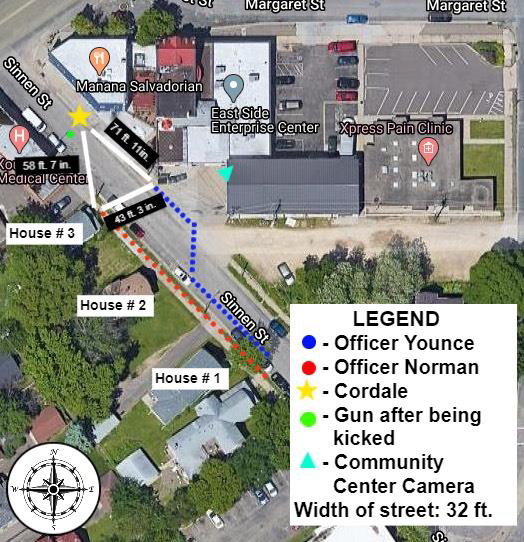
Ofc. Younce fired first from behind the dumpsters on the east side of the street. He fired twice before Ofc. Norman joined in. 11
Body Position and Gunshot Wounds
According to witness statements and the officer’s own admissions, Cordale was sitting on the ground when officers opened fire. Based on bullet trajectories and officer and witness statements, he then fell back and rolled to his left side.
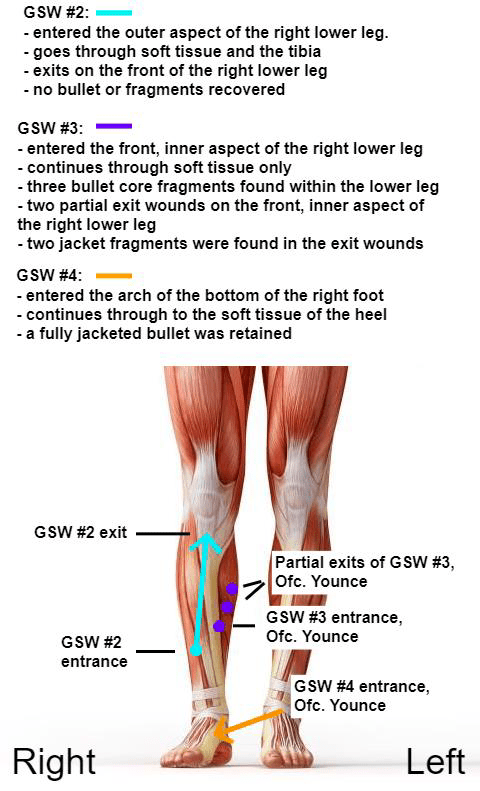
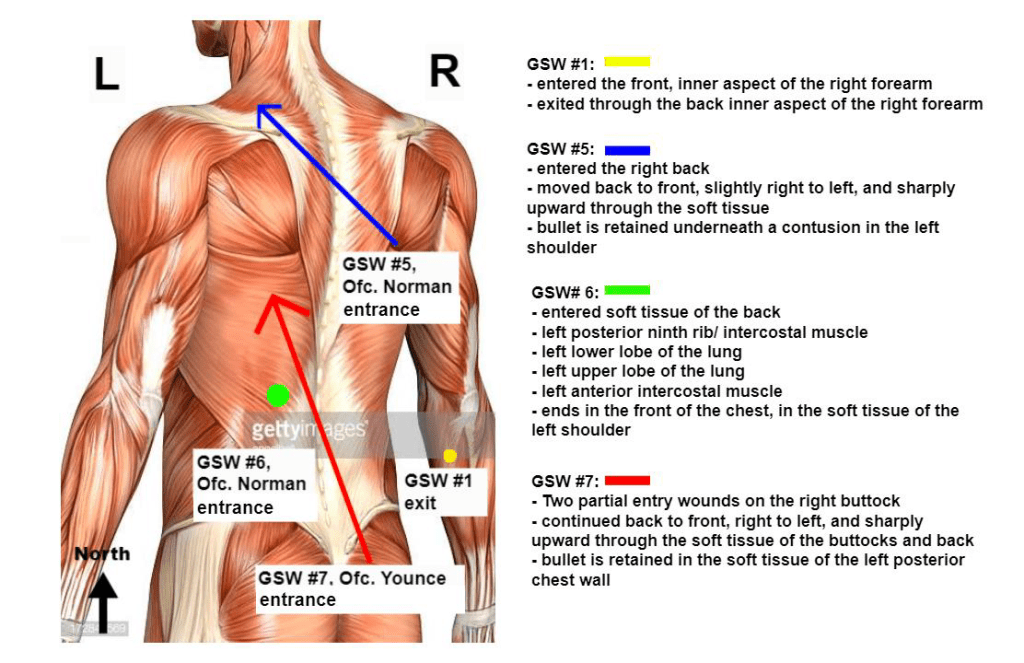
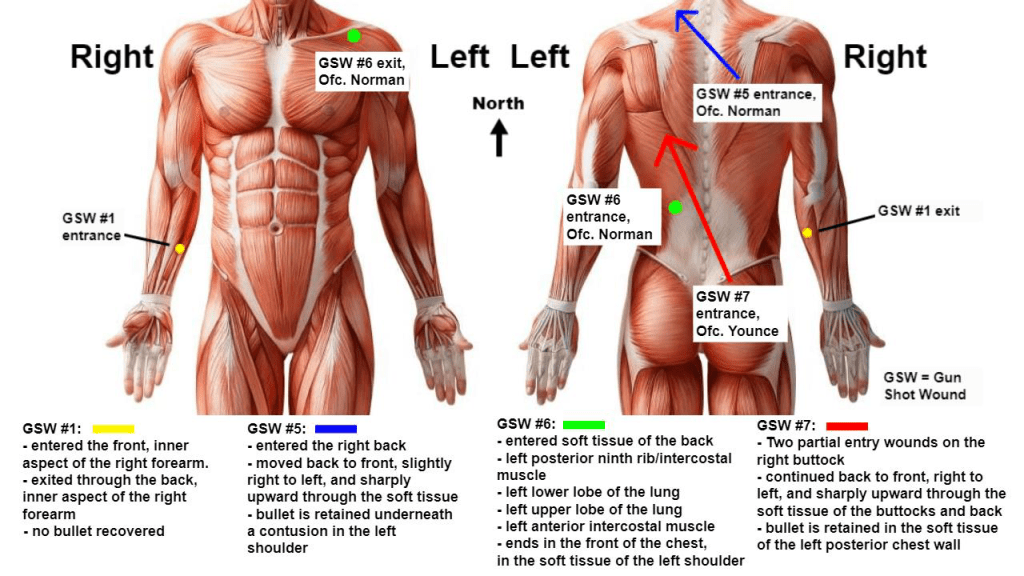
The Ramsey County Medical Examiner’s autopsy report lists the following gunshot wounds sustained by Cordale (numbers do not indicate the order the wounds were received):
- Right forearm: Entrance in the inner aspect, exit in the outer aspect.
- Right lower leg: Entrance in the outer aspect, exit in the front of the leg.
- Right lower leg: Entrance in the front inner aspect, partial exit in inner aspect of leg. Jacket and bullet core fragments recovered.
- Right foot: Entrance in arch of right foot. No exit. Jacketed bullet recovered.
- Back: Entrance on right side of back, 7” from the top of the shoulder and 3.5” to the right of the midline. No exit. The bullet traveled upward and to the left, ending 1.5” from the top of the shoulder and at the midline. Jacketed bullet recovered.
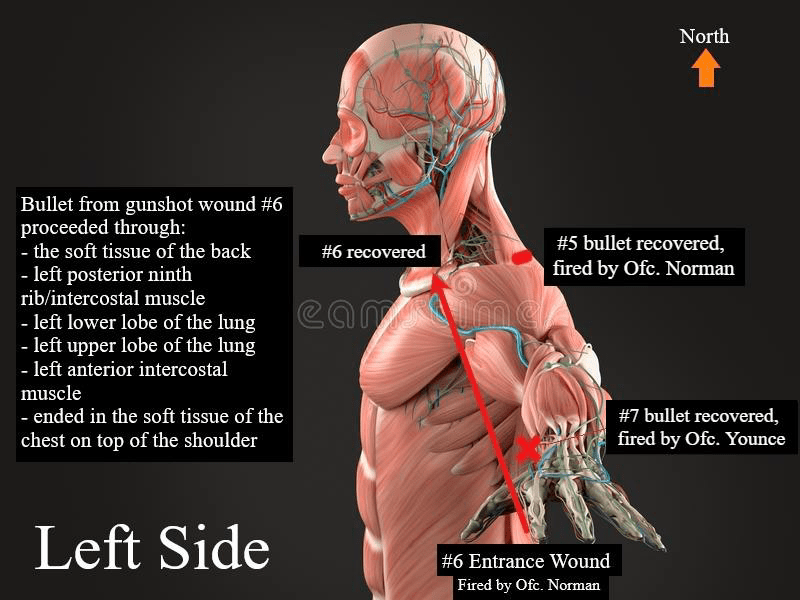
- Back: Entrance on left side of back, 12” below the top of the shoulder and 1.125” from the midline. The wound tracks sharply upward and forward, running through the length of the left lung, collapsing the lung. This was the shot that killed Cordale. A jacketed bullet was found in the front chest wall 2.5” from the top of the shoulder and 6.5” left of the midline.
- Right buttock: Entrance in the right buttock 22.25” from the top of the shoulder and 0.75” to the right of the midline. Exit is 21.5” from the top of the shoulder and 1.25” right of the midline with brief re-entrance into the lower back. A jacketed bullet was recovered from the skin of the back.
While the order of firing cannot be determined, based on bullet trajectories paired up with witness statements about his body positions, it appears that shots were fired while Cordale was in the following body positions:
- While sitting up: 1, 3
- While lying on left side: 2, 5, 6, 7
- Indeterminate: 4
*See Appendix C for diagrams of the bullet trajectories.
Time of Death
| 2:24:47 | Initial shot fired by Younce. Norman began firing and Younce continued firing. Eight shots fired in total, with seven hitting Cordale. |
| 2:25:52 | St. Paul Fire and EMS (FEMS) called. |
| Uncertain | Ofc. Wild stated he saw Cordale’s arm move. |
| 2:27:38 | Cordale handcuffed |
| 2:29:18 | Officer asks about a tourniquet (believed Cordale was still alive) |
Only one of the shots, #6, had the potential to be lethal. The others were superficial. Shot #6 occurred when Cordale was lying on the street. Approximately 8 to 9 minutes passed between when Cordale was shot and when he was declared dead. During that time, officers rolled Cordale from his side to face down and handcuffed him. He was still breathing at that time. Pictures of the pavement around Cordale’s mouth show an area where saliva and moisture from Cordale’s breath formed an approximately 8” patch of ice.
Failure to Render Care
Despite Cordale being alive after the shooting, no officer provided any medical care. St. Paul Police Department policy requires officers to take all steps necessary to preserve life, including rendering aid to people who have been injured by them until the St. Paul Fire Department arrives (Policy #401.00). Further, Minnesota state statute 609.662 requires “a person who discharges a firearm and knows or has reason to know that the discharge caused bodily harm to another person shall immediately investigate the extent of the person’s injuries and render immediate, reasonable assistance to the injured person.” Failure to do so can result in imprisonment and/or a fine up to $4,000.
Police officers have specific training on the requirement to render aid given their greater responsibility to the public. Minnesota police officers are required by the Peace Officers Standards and Training Board, the state licensing agency for law enforcement officers, to be certified as Emergency Medical Responders. After initial first responder training, renewal is required every two years. Thus, officers on the scene had both the obligation and skills to render aid to Cordale and possibly prevent his death.
Officers had ample opportunity to render aid. Ofc. Norman and Younce handcuffed Cordale but instead of providing assistance, Ofc. Norman knelt on Cordale’s back, almost certainly adding to his suffering. In photos of his uniform after the incident, his right knee and thigh were stained with blood. After Ofc. Wild and Norman kicked the gun even further away from Cordale (it was already 3-4 feet away from Cordale’s feet) they still provided no assistance to him. Ofc. Jordan Wild stated that he saw Cordale’s arm still moving. He yelled, “Don’t move!” However, instead of rendering aid to someone shot, suffering, and still moving, and thus still alive, Ofc. Wild turned his attention to securing the scene. Witness JM noted that Cordale was still alive and begged police officers on the scene to help him, to no avail. Witness MB also implored them to help Cordale but they ignored her pleas. 13
Police officials were clearly concerned about this failure to render care. At least one media outlet repeated their public statement that “Crews attempted life-saving measures, but responding medics declared him dead on the scene.”1 Video footage, the St. Paul Police timeline, and interviews with officers show this to be simply false.
According to a forensic pathologist who inspected the autopsy report at CUAPB’s request, “The injuries to the left chest are substantial, with two perforating injuries to his left lung. This would cause a near immediate pneumothorax [collapsed lung] and respiratory compromise. Bleeding from these wounds would occur briskly. I do not see how he would have survived more than a few minutes after this wound was inflicted.” Cordale suffocated from a deflated lung. He could inhale, but his collapsed lung would not inflate. It is speculative whether immediate intervention could have saved his life, but it is certain he died without it.
Witness Treatment
After Cordale was shot in front of witnesses MB and JLM, these traumatized witnesses were mistreated horribly by police. JLM was forced into Ofc. Wild’s vehicle, which sat in full view of Cordale’s body. She was obviously distraught and sobbing. She pleaded with police to cover his body but they refused. She also complained about being claustrophobic and begged for the officers to crack open a window, despite the cold temperature that night. Officers ignored her pleas. After holding her in Ofc. Wild’s car for over an hour, she was finally moved to another squad car out of view of Cordale’s body. She was barefoot and an in a robe the entire time.
MB was wearing only underwear and t-shirt and was barefoot when she ran outside to follow Cordale. She collapsed in the street after seeing Cordale gunned down. Her distress was obvious—she screamed loudly and pleaded with officers to provide care for him. She tried to get near Cordale and asked repeatedly to touch him as he lay dying. Instead, six officers dragged her to a squad car, further traumatizing and injuring her. She remained in the squad car for at least 3.5 hours. MB may have been held in the squad car for a lengthy period to coerce her into giving a statement.
During that time, Ofc. Titus asked JLM if he could go into her apartment to get clothes for MB. JLM agreed and instructed him on where to find sweat pants and a sweatshirt for MB. However, it appears that this was a ruse to get into JLM’s apartment as no officers ever brought MB any clothing. They may have been looking for MB’s cell phone.
Key Witness Statements
What follows are statements by witnesses to parts of the incident. These statements provide perspective on what occurred.
Interview with MB
MB, the 10-year significant other of Cordale, never gave a statement to St. Paul Police or the Minnesota Bureau of Criminal Apprehension. She did however provide an interview to a CUAPB Investigator.
MB and Cordale had gone out earlier in the evening. They came home and went to bed. Cordale was unable to sleep. He was upset about an upcoming court case. MB got up and put in a movie. Cordale called 911 because he believed a man was hiding under the futon in their living room. He hung up on 911 and called his mother. At this point MB began recording Cordale on her phone. In the footage, Cordale is on the phone with 911, in fear of someone in the room. Cordale shoots a gun 16 times at the futon. At that point, MB was on the phone with Cordale’s mother.
MB also spoke about the scene in the street before Cordale was shot. MB said that the police were not listening. Both officers were screaming orders, “Get on the ground!” “Put the gun down.” It was chaotic and confusing. Cordale said nothing. He was walking northbound on the street. When the police got within earshot of Cordale, he stopped, turned around and saw the police. Cordale immediately sat down on the ground and threw the gun away toward the west. MB described with her hands that she saw the gun land 3 to 4 feet away from where Cordale was sitting upright. MB said that she saw Cordale raise both hands in the air and that he was sitting like that when the police started shooting. MB also says that the dog turned and ran towards the police when Cordale turned around toward the officers.
Since Cordale is out of the field of view of the Community Center video, MB’s statement is useful in determining when Cordale turned toward the police, as the dog passes through the field of view of the camera just before the officers begin shooting.
When questioned whether Cordale laid down on the ground, MB said no, that his hands were up. She demonstrated that position with her hands high on both sides of her head. MB stated that the police started shooting at that point. MB said that Cordale never pointed the gun at the police.
MB is the only witness to the shooting who did not fire a gun at Cordale. Her account agrees with Officer Younce in stating that the gun was three or four feet away from Cordale when he tossed it down. She agrees with Officer Younce in stating that Cordale stopped, turned toward police, sat down, and tossed the gun aside.
MB’s account contradicts the police account in one important way. MB insists that Cordale did not point a gun at police officers, and that he was not holding a gun at the time he was shot. The two officers say that he was holding a gun. Normally, the word of sworn officers would be given greater credibility than the word of a civilian, but it is important to realize that the officers have a reason to lie and MB does not.
Officer Mikko Norman
Mikko Norman is one of the two officers who fired on Cordale Handy, firing five or six shots after his partner Officer Younce fired first.
He was interviewed by Senior Special Agent Christopher Olson and Special Agent Brent Peterson of the Bureau of Criminal Apprehension. Olson was later criticized by the Hennepin County Attorney’s office in the Justine Damond case for asking Sgt. Shannon Barnette leading questions that manufactured the police narrative that Officer Noor responded to a slap on the cruiser when he opened fire. Olson also admitted giving Officer Noor’s partner three days before interviewing him over coffee and donuts at the home of his attorney. Olson admitted that this is a courtesy extended to officers but not to civilians.
In his portion of the interview of Ofc. Norman, conducted three days after the shooting of Cordale Handy, Olson repeatedly tried to lead Officer Norman to make statements that support a finding of a justified shooting; Norman repeatedly missed the cue. For example:
CO: Okay. Alright. And, Brent asked you this a little bit but I just want, make sure we’re clear on this. He laid down and in your estimation was that in response to a verbal command? Was that in response uh do you know why he laid down?
MN: I don’t know why he laid down.
In this section Olson was dealing with a problem in Norman’s statement. Norman has described Cordale as lying in the street after being ordered to do so. If Cordale was responding to police commands, a judgment to shoot him would likely be faulty. But Olson immediately continued:
CO: Okay. you’ve been a cop for two years uh can you describe his behavior as you’re uh, uh providing verbal commands? Can you, can you articulate, describe his actions, his movements?
MN: He was, it’s almost like he was, he didn’t know where he was going. He was up on the sidewalk and then on the street. And then up on the sidewalk again. And then he laid down. It, I mean it, it was, it was very fast so it, he didn’t move very far from when we started yellin’ at him to when he laid down. But he didn’t, he seemed out of it. Like he was, like she said he was high on drugs.
CO: So you in your uh your career as a law enforcement officer you’ve dealt with people experiencing a delirium, excited delirium or not would you uh recognize…
MN: Uh yes, I have.
CO: …symptoms of that?
MN: Yes I have. Yeah. 16
CO: I don’t want to lead you here but I just I want to uh his behavior to you. It looked as though he may not be understanding you is that, an accurate?
MN: Hm, I can’t say that.
Here, Olson was trying to lead Norman to diagnose Cordale as in the throes of “excited delirium,” a pseudo-diagnosis that has been used primarily to justify use of force by police. Excited delirium has been criticized by numerous scholars for lacking a clear definition and “precise etiology and pathophysiological pathways.” (Byard, 2018; Gonin et al., 2017; Lipsedge, 2015) The condition has attracted further controversy with suggestions that it is simply a diagnosis used to cover up the use of excessive force by police officers (Sullivan, 2007). Further, this diagnosis is not listed in the American Psychological Association’s Diagnostic and Statistical Manual of Mental Disorders (DSM-IVTR) nor the World Health Organization’s International Classification of Diseases (ICD-10).
Throughout his portion of Ofc. Norman’s interview, Olson was not acting as a neutral investigator of the facts. He was attempting to lead Officer Norman in such a way as to justify the shooting. Prior to his portion of the interview, Special Agent Brent Peterson did a better job of adhering himself to a factual inquiry, but even his portion reveals several flaws in the police narrative.
MN: …Uh and then I saw the male was holding a black handgun in his right hand. Um, so we started to run a little bit more um I remember yelling police stop, drop the gun get on the ground. Just you know, general police commands. Um my partner then ran to the east side of Sinnen. I stayed on the west. Um at this point the male laid down um in the street.
EG: (coughs)
MN: On the east side of Sinnen. Um he laid down on his back with his feet towards us. Um so his head was to the north his feet to the south. Um and then he set the gun down next to his side uh within arms length. Um and was just, as we were yelling at him uh I remember airing “hey he’s laying on his back um near 7th Street,” over the radio. Um the male then picked the gun up and pointed it at me for a brief second. And then put it, put it down right away. And again we were yelling you know get away from the gun, just general police commands. Um I could hear a female yelling behind me. Um and then he picked the gun up again and this time he uh um when he picked the gun up he pointed it right at me. Um lifted his head up and his upper torso and it looked like he was aiming down the gun at me and I thought he was gonna shoot me. And then I heard my partner shoot one shot. And the I, and then I shot and probably shot five or six times.
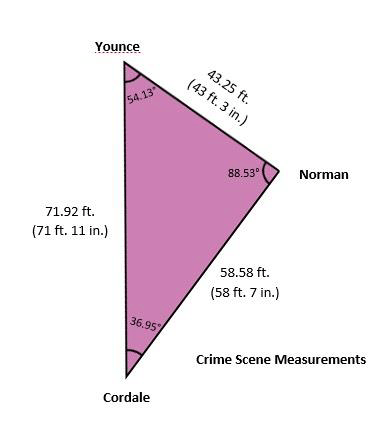
Mikko Norman’s story establishes the baseline of the police narrative. Cordale pointed a gun at a police officer and the police shot him. There are several inconvenient facts for Officer Norman. By looking at autopsy photos, CUAPB investigators were able to determine the location of Cordale Handy’s body. By comparing a video from the East Side Enterprise Center to the street, investigators were able to determine the location of the officers when firing. The distance between the locations was 70 feet, nearly twenty five yards. The officers, who had recently completed firearms qualification, knew the difficulty of making a pistol shot at that distance, in a well-lighted range. A shot from the gutter, on one’s back, while intoxicated, in the dark, is so difficult as to beggar the idea of reasonable fear of death.
Making Officer Norman’s statement more doubtful are several details from the East Side Enterprise Center video and the radio logs. Officer Norman is seen progressing down the street with his gun in one hand and his flashlight in the other hand. He radios (or “airs”) that Cordale is lying in the street. According to photos of Norman in the investigatory file, he wears his radio microphone in the center of his chest. In order to radio that Cordale is lying down, Norman must either take the gun or the flashlight off of Cordale. In the Community Center video he raises the flashlight to the center of his chest, pointed at the ground directly at his feet. This manuever had to interfere with his night vision and his ability to see what Cordale is actually doing.
Six seconds after Norman airs the fact that Cordale is complying with the order to lie down, Norman airs that shots are fired. Three of those six seconds are occupied with firing “five or six” shots at Cordale according to the Community Center video. How accurate can Officer Norman’s perception be of whether Cordale has put the gun down, picked up the gun and pointed it at him, put the gun down, picked the gun up and pointed it directly at him?
His absence of visibility renders his shooting of Cordale as not justified. He says, “… And then I heard my partner shoot one shot. And then I, and then I shot and probably shot five or six times.” In his statement, the immediate reason for his opening fire is the shot by his partner. His partner’s judgment in firing a shot is not sufficient to justify Norman’s opening fire on Cordale, and his fear for his life is a dubious assertion based on the range, Cordale’s position on his back, his belief that Cordale was intoxicated, and the focus of his flashlight away from the target, affecting his night vision.
Interview of Nathaniel Younce
Officer Younce was the first to fire on Cordale. He was interviewed by two BCA special agents. In this interview Officer Younce tells how he was really set off by the call from the beginning, how he moved in to get a better shot and how he was concentrating on his gun’s sight picture. He also recited some of the firearms training he received that caused him to act as he did. It includes a section of Special Agent Henning leading Younce through questions to justify his shooting of Cordale. The tone of his description is confused and sometimes self-contradictory.
Younce’s initial description of the call shows that he was on high alert and perhaps experiencing tunnel vision even before meeting Cordale.
NY:…We’re continuing east through the building. Go through a fire door. And I can hear really loud yelling an it se[t] me off cuz I’ve been to a lotta domestics and there’s something about this that was, really amplified.
DH: Um-hm
NY: And, yeah it just didn’t feel, didn’t feel right at all.
Younce continued to describe following two females, one black and one white down the stairwell to the street, and trying to interview one of them.
NY: Sure yeah, definitely. So Mik’s on my left hand side. Uh I’m on the right hand side. I’m directly engaged with this uh, uh white female. A medium, medium heavy build I believe. Uh she looks at me um her eyes get really wide, her face expression something I, feel like I’ve never seen before. Eh it almost looked like she was, she was super-super scared, super nervous by us which I thought was really weird. And she said No-no-no um don’t hur[t] him, don’t hurt him and I asked don’t hurt who what’s going on where is he. Uh I asked her these questions really quick…
DH: Um-hm.
NY: …trying to get some kind of bearing on what…
DH: Yeah.
NY: … what kinda situation I’m dealing with cuz I’m trying to focus on her I don’t know what else is going around me. Um, um she says, I ask her why I, I ask here where is he, something about does he have a weapon just cuz it’s that heightened. There’s some reason that she doesn’t want us there. And I think she feels like something bad is gonna happen so, so I ask her either I ask her if she has a weapon, somehow a weapon a comment of a weapon happens. Um and they, they’re pointing that he’s down this way or gesturing that he’s down that way. Uh…
Younce is so focused on the woman he is speaking with that he doesn’t have awareness of what is going on around him. He obscessed on the weapon and the direction of the suspect. Further;
NY: She said he has a weapon but it’s unloaded. Which means I can’t think of any other commonly carried weapon that needs to be loaded so I assume no that’s, the only thing that that meant to me is that he probably has a firearm. On the fact that it’s unloaded means absolutely nothing to me.
Younce has heard that the weapon is unloaded, but he has totally discounted that information. While true that he cannot know for sure that a weapon is unloaded, he should at least consider the possibility that neither he, his partner, nor the neighborhood is in deadly peril. Younce and Norman progress down the street.
NY: So I’m still not sure that he has a gun for sure. I yell to him um something to the effect of uh, um it was um I think I announced myself as police and then I say um stop and get on the ground. Uh my firearm is at my side at this point. Or at my low ready as I’m coming up the street. He turns towards us.
While low ready would have Younce’s gun pointed at the ground in front of him, the community center video shows Younce advancing with his gun raised to eye level and pointed at Cordale the entire time.
NY: Cuz we’re me and Mik are uh walking quickly towards him. Um, so I see him he turns faces us and as he turns he’s act his motions aren’t right. It’s not like a sober person would be. His arms are, waving around um his body swaying back and forth. He doesn’t seem stable on his feet. And it, he seems really off I, I don’t know exactly if he was drunk or high on pills or maybe that’s just the way he was but it, it wasn’t normal to me. So at that point he uh at that point we’re walking closer to him. When he turns and faces us he puts his arms up in the air in some weird way. He lets go of the dogs leash and I see very obvious that he has a firearm in his right hand. Um the silhouette the, the background of the light um on 7th Street made it very obvious and the gun actually had a it looked like an extended magazine as well. Because the when he had it in his hand the handle came way way down past…
Younce doesn’t mention that Cordale has just turned and raised his hands above his head in the universal gesture of surrender. He is focused on the “fact” that Cordale is drunk or high on pills. In the autopsy performed by Ramsey County, lab testing determined that Cordale had only metabolites of marijuana from prior use in his system. All other lab testing for drugs was negative. Younce mentions that Cordale released the dog’s leash. The video shows that Cordale never had the dog on the leash. Younce is very focused on the gun dangling from Cordale’s right hand.
Younce doesn’t mention that Cordale has just turned and raised his hands above his head in the universal gesture of surrender. He is focused on the “fact” that Cordale is drunk or high on pills. In the autopsy performed by Ramsey County, lab testing determined that Cordale had only metabolites of marijuana from prior use in his system. All other lab testing for drugs was negative. Younce mentions that Cordale released the dog’s leash. The video shows that Cordale never had the dog on the leash. Younce is very focused on the gun dangling from Cordale’s right hand.
At this point Cordale obeyed the police commands to stop and get on the ground. Younce and Norman are at a distance at which Younce does not feel like he could “shoot this guy.” Obviously the “drunk” man on the ground would be equally unable to shoot Younce, but both officers simultaneously run up on Cordale. They do not seek cover. One does not establish a good shooting position while the other talks to Cordale. They run up so they can shoot.
NH:…So we’re, I’m probably about half block now um and then I see him and then Mik’s on my right hand side. He’s fanned out now to the left hand of the street. Uh, the guy raises his, the guy he, he’s on the ground and I, I should have shot him as soon as he did this he comes up, he puts his arm up like this. And I want to get this guy, every opportunity and then he puts his arm back down. And then he brings it back up and it’s coming closer and closer and where it would take less than half a foot to, to make it a, to shoot and kill him. Uh he could have easily turned the gun and shot and killed me. He could have turned the gun shot and killed, um the two females behind him. He coulda, shhh shot in the air and hit the apartment building and killed somebody. Either way he’s pointing this firearm towards my partner and it’s continuing to move towards my partner. Um I’m running at this point. Um I’m trying to get the best sight picture I can.
The most telling thing Younce says here is that he should have shot him as soon as he raises his arm. This speaks not just to his perception of the situation, but to the training he received from the St. Paul Police Department and before he was hired by the police department. This theme will recur when Younce is questioned about his training. Returning to Younce’s perceptions, he has recounted how Cordale complied with his commands, but he has yet to recount telling Cordale to drop the gun. He has said that Cordale is unsteady and waving his arms weirdly, but says that now Cordale is pointing the gun at his partner. He does not find the first time Cordale does this to be threatening enough to his partner to shoot, but the second time he finds that Cordale is an imminent threat to his partner, women behind the officers, residents of nearby apartments, and maybe himself. Younce is running and Younce is concentrating on his sight picture, lining up his shot.
NY: I take three shots. One-two-three um I hear Mik fire about the exact same time uh he rolls, he rolls to his side and then as he’s and then he rolls back. I can’t tell if he still has the gun cuz the gun comes back and I can’t tell if he drops it right away cuz his hand went from here to here. He’s doing one of these just rolling, swaying back and forth. I can’t tell if he’s hit or not. Or if he dropped the gun because he’s, impaired or if because he was actually hit by us. Um, then I fan out just a little bit it, this is all, all, all this is right here is in within…
DH: Um-hm.
NY: …feels like seconds, moments. Time, speeds up and slows down and um so I fan out to the right. I see a, or there’s a pole I’m trying to kinda get to a cover so there’s a pole. I see him um motion this way and then motion back. He like this, roll and then he like rolls back to where he, looked like he was trying to go back to the firearm again. So I get behind the pole and then as I get to the pole like this, I can’t tell if the pole’s right next to me or if it’s back farther and then I fire 21
one more shot within seconds of each other so it felt like boom-boom-boom um ath the pole, boom and then uh…
DH: Was he facing away from you at this point?
NY: No he was still in the exact sss um I don’t remember. He, he was rolling back towards the gun. All I know is he made another motion towards the gun.
Running in, Younce takes three shots. Now, after firing his weapon, he takes cover behind a pole to assess the situation. But he admits he can’t tell whether Cordale still has the gun, or if Cordale dropped the gun, then he states that he believes that Cordale is moving towards the gun as he is rolling. Thus, he must have been aware that Cordale had tossed the gun aside. However, he fails to mention that Cordale rolled to his left side, away from the gun. After a pause, he fires again. If nothing else, this shot cannot be justified. In Younce’s own words he doesn’t know if the target is armed or if he is merely moving in the direction of a weapon when Younce uses deadly force, though that was when the last shot was fired. And the aftermath is telling.
NY: And uh that was when the last shot was fired. And then after that um when I, when I brought my sights up now after that I, I went back to um to uh um see my sights again and then I lowered it and then I saw that now he was laying on his, or he was just turning over to his left side, oh and then it looked like he um he like wasn’t going back any farther here he wasn’t making any more motions now. He, he um curled up and uh and then stopped right there and then the gun is sitting or actually the gun it’s sitting now um like three or four feet, enough to reach still but um I wanted to stay there behind my cover kind of um (inaudible).
When Younce stops shooting, and lowers his gun to see, what he sees is that the gun is three to four feet away from Cordale, below Cordale’s feet.
After moving onlookers away from the scene, Younce believes he helped handcuff Cordale because his handcuffs were missing. He calls for medics, but does not render aid himself.
After a description of the aftermath, Special Agent Henning begins the BCA practice of leading the witness to clarify the elements that justify shooting Cordale:
DH: And you said at this point then he raises the gun towards your partner?
NY: Um-hm.
DH: And at this time you felt what?
NY: I, had to fire or else my partner could die. Some, I could die. Um…
DH: But he was specifically pointing it towards your partner… 22
NY: Yes.
DH: …at this point?
NY: yeah.
DH: Okay.
NY: Yeah. Right…
DH: (inaudible)
NY: Right at him or, like I said right at him or like a half a foot off where I just felt like I shoulda fired even sooner.
Henning is attempting to elicit that Younce was afraid for his life or the life of his partner and that Cordale posed an imminent danger to Younce or his partner. Henning is somewhat successful in establishing these prerequisites for the use of deadly force, though Younce undercuts his attempts by saying that Cordale could have killed his partner OR Younce. It is not really possible that both officers on opposite sides of the street were in immediate danger. Younce undercuts the statement that the weapon was pointed at his partner by saying, it was either at him or like a half a foot away.
Henning goes on to ask about Younce’s training both before and after being hired by St. Paul. He reviews reality based training where Younce had to make decisions on when to fire his weapon. This appears to be training he received before being hired by St. Paul. He also had qualified his ability to fire his weapon a week or two prior to the incident, something St. Paul does quarterly. We learned from his partner’s interview that St. Paul supposedly provides use of force training annually, though neither interview establishes when the officers took that training or what it entailed. CUAPB investigators believe that St. Paul PD emphasizes how to shoot over when to shoot. This emphasis was evident in the conduct of the officers in the shooting death of Cordale Handy.
Report of Officer Marshall Titus
From SPPD’s Critical Incident report and Communications Network report.
In the Saint Paul Police Department’s Critical Incident Report, Officer Marshall Titus (squad B844) writes (page 87);
ON 03/15/17 squad B844 (Titus) was working off duty employment at M&H Gas Station located at 721 Arcade St. I was in full uniform and drove a fully marked squad car to the business. Around 0223 hours I heard officers call on the radio saying they were chasing a male with a gun on foot from 795 6th St East. I recognized that location as being three blocks away from where I was working and decided to respond to assist. As I was driving towards the call, I heard squad 23
320 (Younce/Norman) call for emergency radio traffic (10-3) and state that shots were fired. I arrived at the intersection of 7th St East & Sinnen moments later.
Officer Titus neglects to mention that Officers Norman and Younce were drinking coffee at the M&H gas station, where Titus was working at the time they got the call, according to Officer Norman’s interview. He was well prepared to assist, and less than a 30 second drive away according to a CUAPB investigator who made the trip without the aid of lights and sirens.
Titus’ report’ continues;
I parked my squad car facing SB Sinnen from the intersection. When I got out I saw a male laying on the ground next to the East sidewalk just south of the intersection. On the ground next to the male was what appeared to be a black handgun. I saw two officers pointing their firearms towards the suspect and approaching him to take him in to custody. As other officers were handcuffing the suspect, I observed two females approaching the scene on foot; [MB] (03/01/88) and [JLM] (04/30/76).”
Titus claims that he arrived on the scene moments after squad 320 called for emergency radio traffic (10-3), as he well should have. However attempts to confirm his arrival time based on radio traffic are frustrated: in the CN Detail for 17-055853 (Case Locked Down) (page 3), it was reported that Officer Titus received and sent the call at 03:04:16 and arrived at 03:04:19, nearly 45 minutes after the shooting.
Electronic devices truly dislike Officer Titus. His arrival on scene and critical elements of the scene could have been confirmed by the squad video camera footage, since he arrived under lights and sirens, unlike Younce and Norman, an action which would activate the squad video camera. Unfortunately, the squad video camera footage from Officer Titus’s squad was corrupted. Officer Andersen was tasked with collecting the footage and writes (SPPD Critical Incident Report, page 30), “Officer Titus’ squad had video but there were files on the disk that were corrupted. When I inserted the disk into the card reader, I received an error message, ‘Could not detect the meta-information in the video file:f:\data\20170315\083439.av. Stopped auto import.’ There were four files 083439.&&1 (1 KB), 083439.&&2 (1 KB), 083439.AV$ (3792928 KB) and 083439B.XXX (0KB) on the disk. I had to remove those files from the disk before the other files would upload. Once the non-corrupted files were uploaded, I copied them back onto the disk.”
St. Paul Police Department failed in its use of technology to monitor the actions of its officers.
Statement of Officer Dao Vang.
From the St. Paul Police Department Supplemental Offense/Incident Report, complaint # 17055853.
Officer Dao Vang reports that he moved to aid the officers responding to the Cordale Handy incident. He says he arrived in time to see a black man with a gun fall face first to the ground.
Officer Vang’s report undermines the reports of Officers Younce and Norman who stated Cordale was already on the ground. It may reinforce the report of MB who stated that Cordale was in a seated position when he was shot.
Interview with JLM
From an interview by BCA SSA Luke Hanegraaf and SA Brent Peterson.
JLM was a friend and neighbor of Cordale and his girlfriend MB. In her statement taken the night of the shooting, she hears a cry for help from her friend and comes out to see a glassy-eyed Cordale in the hallway. She and MB follow Cordale out the back door of the apartment building. JLM is the white woman at the back door mentioned by both officers in their statements. She states that she follows the officers following Cordale, but does not describe the shooting. She does describe the aftermath.
BP: How many times did you hear gun shots?
JM: I don’t know (female crying)
BP: Okay.
JM: Why didn’t they help him? (inaudible, female crying) why didn’t they try to help him?
BP: Well what happened?
JM: He was breathing? (female crying), they handcuffed him (inaudible, female crying). Why didn’t they help him? Why didn’t they help him?
BP: I can’t answer that I don’t know. Did paramedics and fire department show up?
JM: Like five minutes later.
BP: Okay.
JM: And they threw me in the squad c-they wouldn’t let us near him. Someone could have been with him when he died. And they wouldn’t let us near ‘em.
BP: Did the off-after he was handcuffed did the officers move him at all?
JM: They didn’t touch him, they didn’t help him they just let him die.
Officer Training
In the Saint Paul Police Department’s summary report of use-of-force incidents in 2016 and 2017, they state that officer use-of-force training “places a heavy emphaisis on using time and distance to de-escalate situations and using multiple officer tactics so fewer, potentially injury causing, techniques are required.” Officers Younce and Norman knew that Cordale was behaving erratically based on witness statements before the incident. Despite this, Cordale followed their commands to “stop” and “get on the ground.” The two officers, running down the street after him, should have followed their training on creating more time and more distance knowing that Cordale was in mental health crisis.
History of Deadly Force by the St. Paul Police Department
On March 22, 2017, community groups wrote to the St. Paul mayor and police chief that “among jurisdictions with relatively low murder rates, St. Paul (3.69 homicides per 1,000,000) has one of the highest rates of police killings. SPPD’s police homicide rate, 9.18 police killings per 1,000,000 population, is more than double the national average (3.95 per 100,000,000), and higher than places like New York, Minneapolis, Milwaukee, Boston, Pittsburgh.”2
The St. Paul Police Department is the deadliest in the state of Minnesota [CUAPB data] and is the 19th deadliest in the country.3
Shortcomings of Minnesota Bureau of Criminal Apprehension Investigation
The Minnesota Bureau of Criminal Apprehension (BCA) is the top law enforcement agency in the state. They oversee the work of all Minnesota law enforcement departments, providing laboratory and investigative services that allow these departments to solve crimes. Consequently, they work closely with every agency in the state. BCA agents themselves have been involved in shootings of community members. Thus, they are inherently NOT neutral in their investigations of police critical incidents. This is evidenced in the bias shown in their investigations into these incidents.
In the Handy case, there are multiple examples of bias designed to exonerate police officers.
- Interviews: It is obvious from the interviews conducted by BCA investigators that they never considered the possibility that this shooting was not justified. Questions were framed to elicit answers that would specifically justify the shooting. Interviewers used leading questions and stopped people who started to give information that contradicted their theory of the incident or called into question their assumptions.
- Investigators never addressed the fact that each shot fired must be individually justified. Interviews and the rest of the investigation breezed past this important legal point.
- Cell phones belonging to Cordale and MB were taken from the scene. The BCA released footage from MB’s phone that captured the scene in the apartment but it is believed that MB’s cell phone also captured at least part of the shooting and would clarify Cordale’s physical position and actions prior to the shooting but that video was never released.
- The BCA report never addresses the officers’ failure to render aid.
- The BCA “report” isn’t actually a report. What the BCA produced was a series of 108 documents that include chain of custody documents, lab reports, interviews and other papers, photos and videos collected from cameras located near the scene. There is no overarching document that explains relevant findings or that provides analysis or conclusions.
Choi Report—A Failure Of Accountability
In the aftermath of the Handy killing, Ramsey County Attorney John Choi released a report explaining his decision not to prosecute the officers involved in killing Cordale. However, this report is riddled with errors, false statements, and unsupported conclusions.
- Handy was dangling the gun upside down very loosely by the end of the magazine while stumbling barefoot down Sinnen St. This is clearly seen in the East Enterprise Community Center video, yet Choi fails to note this.
- Choi’s report lied about drugs in Cordale’s system.
- Choi’s report says that “at the 27 second mark of the community center security camera video, both officers can first be seen proceeding northbound on Sinnen along the westerly side of the street,”
- Choi’s report included the statement “Since he could not yet identify Cordale as being in possession of a firearm, Officer Younce kept his gun at his side.” This is simply untrue. Officer Younce had his gun pointed despite not being able to identify Cordale as being in possession of a firearm.
- Both officers said they were issuing commands—only one should have been. This is a significant training issue.
- Choi claimed that Cordale was “running up from really far away” when Cordale was, in fact, lying on the ground.
- “From their respective positions approximately 50 yards away, both officers observed Cordale appear to unintentionally ‘flop’ down onto his buttocks and lay on his back on the curb.” Another interpretation of Handy’s actions is that he was following their commands. Younce said he ordered Handy to drop to ground. Norman said “Police. Stop. Drop the gun. Get on the ground.” Handy stopped. He went to the ground. If Choi is trying to cast doubt about Handy’s actions, it is also fair to cast doubt on the officers’ narrative that Handy was raising and pointing the gun.
- Much of what Choi says in his report is based directly on the self-serving statements of the officers who killed Cordale. He did not include witness testimony that differs from the officers’ narrative.
- Choi quotes Officer Younce to have said that he ran to a position near a garbage dumpster to get the “best sight picture I can.” However, this quote refers to Officer Younce’s actions later. Officer Younce originally began running forward because “I felt like if I need to uh shoot this guy or if he decided that there was gonna be um an issue uh I needed to get closer cuz I, and I wanted to make sure I saw everything perfectly.” The quote reported by County Attorney Choi makes the claim that Officer Younce moved forward to get a better picture, while the actual quote depicts that Officer Younce moved forward to prepare to shoot. In other words, Officer Younce was preparing to shoot before any shooting would have been justified.
- Choi never mentions that the St. Paul police failed to render aid to Cordale as he was dying. Each officer on the scene had this obligation but Choi failed to even raise this as an issue.
- In his framing of the incident, County Attorney Choi makes much of Cordale running away from police. However, he fails to explain that Cordale was in the throes of a mental health crisis. He also fails to mention that Cordale called the police himself because he was afraid a man named Dante was in his apartment. In Choi’s report, he states that Cordale “also appeared to look back twice as if he was aware he was being pursued.” According to the cell phone footage, we know Cordale feared he was being followed by Dante. We also know he called the police earlier for help because of his fear.
Analysis, Conclusions and Recommendations
A group of Saint Paul Police Officers were drinking coffee at M&H gas station on Arcade Street and Minnehaha Avenue in the early morning of March 15th. Cordale Handy anxiously paced in his apartment three blocks away, suffering from a mental health crisis. He called 911 for help. He was scared of a man named Dante, who he thought was in his room. Cordale hung up the phone and moments later, 911 called him back. He hushed his girlfriend, MB, to speak with them. Cordale respected them and lowered his voice to say, “I don’t feel safe. Someone is setting me up.”
After speaking with 911, he called his mom. He believed Dante was hiding in a pull out couch, and MB folded it up to show Cordale there was nothing there. Still scared, Cordale fired 16 shots in the apartment. He left the apartment building, yelling “Hey 911! Hey 911!” Cordale walked north on Sinnen Street, stumbling. 28
His white dog trotted alongside him. Cordale dangled the gun by the butt of the magazine in his right hand.
Cordale was halfway down the block when two police officers came out of the apartment building. MB ran after the officers, telling them the gun was unloaded. Cordale looked over his shoulder. The officers told him to stop, get on the ground, and drop the gun. According to a witness, Cordale stopped. He turned to face the officers and sat down. He threw the gun three to four feet away from himself and held his hands above his head. The witness was emphatic–Cordale followed the officers’ commands. Seconds later, the two officers opened fire. The gun Cordale had thrown was found three to four feet away from his body, according to Ofc. Younce. Cordale was curled up and protecting his injured left side when officers rolled him over and handcuffed him. Cordale was on his stomach with arms behind his back as he struggled to breathe. Without receiving any medical aid, Cordale was pronounced dead 8 minutes later.
From the onset this case was tainted by the framing of it as a domestic incident rather than an incident involving a mentally disturbed person. This framing created tunnel vision, especially for Younce. As a result, both officers failed to recognize that Cordale had surrendered, that he was following commands, and that the incident was over before they began shooting. Further, the officers began shooting wildly despite the legal requirement that each shot be justified. Finally, both the shooters and the other St. Paul officers who arrived on the scene failed to render required aid to Cordale and abused the two witnesses of this tragic shooting.
Appendix
A. Civilian Witness Statements
B. Officer Arrivals and Departures
C. Bullet Trajectory Diagrams
D. Scene Diagrams
E. Measurements of Scene
References
Officers ID’d in officer-involved shooting in St. Paul. https://www.kare11.com/news/local/officers-idd-in-officer-involved-shooting-in-st-paul/422698527 ↩︎
March 22, 2017 Open Letter to St. Paul city Council signed by Black Lives Matter—St. Paul, Blue Lies Matter, Communities United Against Police Brutality, Justice for Marcus Golden, St. Paul for Justice, Twin Cities Coalition for Justice for Jamar ↩︎
https://mappingpoliceviolence.org/cities ↩︎
 The Reinvestigation Workgroup
Leave a comment